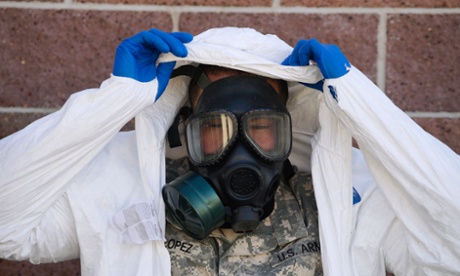
US military personnel returning from anti-Ebola efforts in west Africa will be subject to a stricter quarantine than recommended by the Centers for Disease Control and Prevention (CDC), the Pentagon announced on Wednesday.
The defense secretary, Chuck Hagel, has approved a plan from US military commanders for a “controlled monitoring regimen” lasting 21 days for troops deployed to Liberia and Senegal to help contain the outbreak. Over 3,900 service members are expected to join that effort, currently totalling 700, in the coming weeks. None of them come in direct contact with Ebola patients.
About a dozen US soldiers led by Major General Darryl Williams, who represented the initial complement of US troops sent to west Africa, are currently quarantined at a base in Vicenza, Italy. Hagel’s decision expands the prospective quarantine to troops across all military branches who take part in the anti-Ebola mission.
The new military quarantine rules place US service members under tighter monitoring conditions than the CDC consider prudent. This week, the CDC issued guidelines instructing only “high-risk” individuals, such as those who are exposed to Ebola-infected body fluids, to quarantine at home.
US personnel serving in what the military calls Operation United Assistance would not be classified as “high-risk” under the CDC’s new Ebola guidelines.
Hagel instructed the heads of the military services to prepare specific implementation plans for a quarantine within 15 days. The Pentagon said Hagel would review the quarantine after 45 days and decide then if continuing the quarantines are appropriate.
Rear Admiral John Kirby, the Pentagon press secretary, characterized what he called Hagel’s “initial steps” as “prudent given the large number of military personnel transiting from their home base and west Africa and the unique logistical demands and impact this deployment has on the force”.
Rep Buck McKeon, the California Republican who chairs the House armed services committee, cautiously praised the quarantine as “the right call” for the time being.
“I hope DoD can find a way to balance the concerns about health and safety while minimizing the burden on overtaxed troops on what could be a long deployment, but their safety and well being must be paramount,” McKeon said Wednesday.