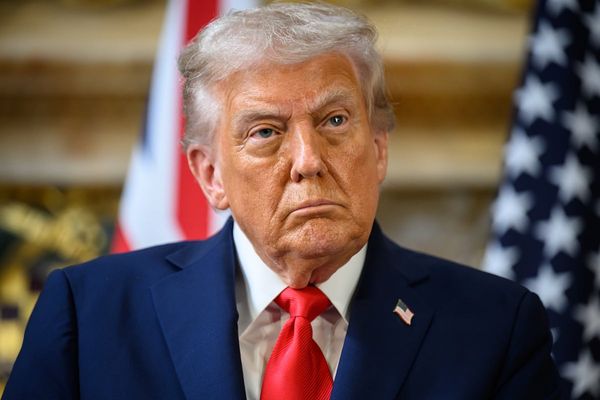
WASHINGTON _ President Donald Trump said Wednesday that he is shifting 1,000 U.S. troops from bases in Western Europe to Poland, but he stopped short of approving Warsaw's request for a permanent U.S. military installation near Russia's border.
Trump described the added troops, who will join about 4,000 U.S. soldiers who rotate in and out of Poland, as a "limited force," and said Warsaw would pay to house them and build military facilities for American use.
Though modest in scope, the troop deployment, combined with a missile defense site that the Pentagon is building in Poland, is likely to spur new complaints from Moscow that the United States and NATO are taking a more aggressive posture in Central Europe near its borders.
Poland joined NATO in 1999 after decades under Moscow's control during the Cold War.
"The alliance between the United States and Poland is reaching extraordinary new heights in 2019," Trump said with Polish President Andrzej Duda at the White House in an appearance that included a thundering flyover of two U.S.-made F-35 fighters.
Poland has promised to buy as many as 35 of the advanced warplanes.
U.S. forces being considered for Poland could include a squadron of U.S. Reaper drones and troops who specialize in logistics, one Pentagon official said.
U.S. and Polish officials also are discussing construction of training facilities, barracks for U.S. forces to use during rotations, an airfield and large-scale training ranges.
Trump sidestepped questions about whether the U.S. presence in Poland would be permanent, a sensitive issue with Moscow and within NATO, saying he didn't want to "talk about permanence or nonpermanence."
Although it is backed by the Pentagon, the deployment of U.S. forces on Russia's periphery is in some ways anathema to Trump, who repeated Wednesday that he would like to see improvements in relations with Moscow.
When NATO expanded to take in countries that had been Soviet satellites during the Cold War, the alliance promised not to permanently station combat forces in Central Europe unless security condition change, a pledge that Moscow says NATO has violated. Many NATO members see the promise as important to preserve, at least on paper.
Since Russia annexed Crimea in 2014 and backed separatist groups in Ukraine, the Pentagon and NATO have built up forces in Central Europe, hoping to reassure nervous NATO members that the alliance would come to their defense, as promised in the NATO charter, if directly threatened by Russia.
Current plans still call for rushing reinforcements and equipment from Germany, Italy and the United States to Central Europe if war breaks out _ which the modest troop presence in Poland will not change.
But for Poland, a U.S. presence is seen as a long-term guarantee of security.
Ben Hodges, a retired U.S. Army lieutenant general who commanded U.S. troops in Europe until last year, said Trump's decision to commit more forces to Poland was helpful for building up U.S. credibility and for deterring Moscow.





.jpg?w=600)