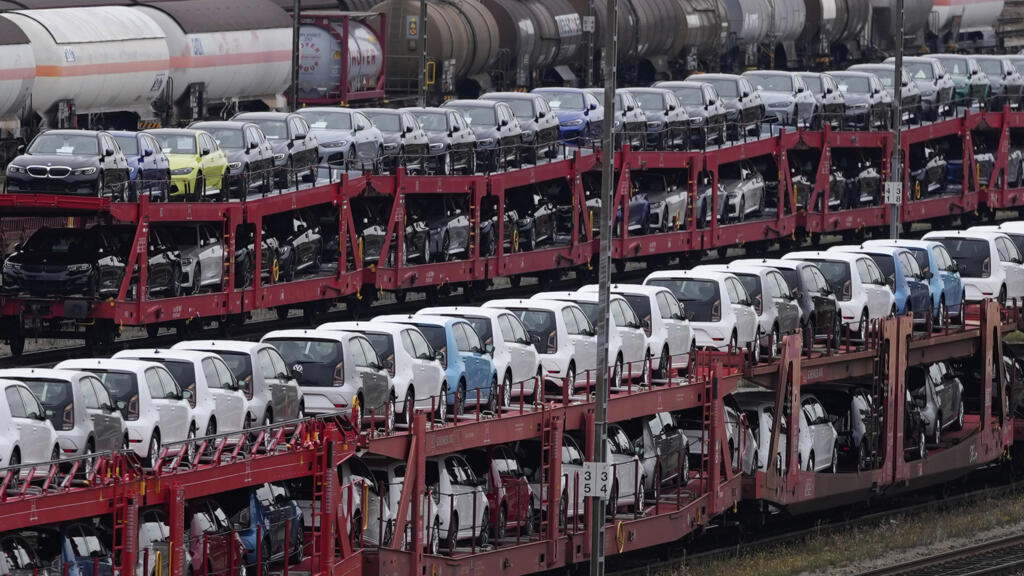
German car exports to the United States dropped by nearly 15 percent in the first three quarters of 2025, making the automotive sector the hardest-hit branch of German industry in US President Donald Trump's trade war, according to a study on the impact of tariffs on the Germany economy. The findings raise concerns for the European Union’s economy as a whole, which is dependent on exports.
German exports of motor vehicles and parts, machinery, and chemical products - key sectors for Germany and the EU more broadly - have been heavily impacted by tariffs imposed by the United states.
Under an agreement reached in August, the US introduced a 15 percent baseline import tariff on cars from Europe.
While this is lower than Trump's initial proposal of a 25 percent tariff, which would have been applied on top of an existing 2.5 percent levy, the reduced rate has still had a significant impact on exports, according to an expert report commissioned by the German foreign office.
Drop in German exports
The report estimates an overall drop in German exports to the US over the past year by 7.8 percent, following several years of growth.
“Since US import tariffs are unlikely to return to previous levels anytime soon, the development… may represent an approximation of the ‘new normal’ for German exports to the US,” the report warns.
Car exports have been particularly hard hit due to the “relatively high tariff burden on motor vehicles and parts” before the EU-US agreement, which only partially reduced some of tariff burdens.
Despite the adjustment, the impact on exports remains high.All sectors have seen declines, with machinery particularly affected by a 50 percent US tariff on steel and aluminium products.
Exports from the chemical industry to the US fell by 9.5 percent, though the report notes that tariffs alone do not fully explain the drop.
"Other factors are likely to have played a role in the case of chemical products, such as lower production in Germany due to higher energy prices," it said.
EU exports
As Germany accounts for a significant portion of EU exports to the US, the study warns that the bloc must mitigate future tariffs, and reduce its reliance on the US market by diversifying trade partnerships.
"It is crucial to prevent additional tariffs… for example on pharmaceutical products, as well as an expansion of goods subject to existing steel and aluminum tariffs,” the study writes.
At the same time, "trade relations with third countries must also be expanded through the swift conclusion of free trade agreements,” the study added.
It specifically urges the long-delayed signature of the Mercosur trade agreement with Latin American countries, which is facing continued pushback from farmers in France.
The report highlights India and Indonesia as potential markets to explore.
(with newswires)