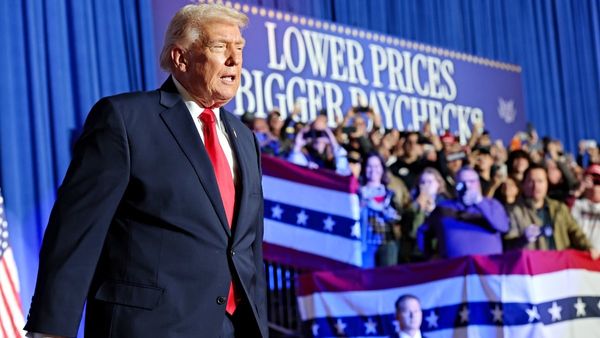
Major U.S. stock indexes rallied on Wednesday, rebounding from steep overnight futures losses in the wake of Republican Donald Trump's surprising presidential election victory.
The Dow Jones industrial was up about 175 points, or nearly 1 percent, in mid-session trading. That came after an 800-point plunge as Trump's victory became apparent early Wednesday, as investors somewhat duplicated the initial market turmoil and quick recovery that followed the stunning vote in Britain in June to leave the European Union.
The Nasdaq was up about 0.5 percent and the Standard & Poor's 500 rose about 0.7 percent after similar steep futures declines.
"Markets tend to assume the worst and react immediately," Brad McMillan, chief investment officer for Commonwealth Financial Network, said in a note to clients before the opening bell Wednesday. "Expect an immediate market pullback on fear, and then a pause."
As with Britain's surprise "Brexit" vote, part of the market's turmoil reflected money managers having guessed incorrectly on the outcome of the election.
"Markets tend to have knee-jerk reactions to these kind of situations" and in this case investors also "had all but priced-in a Clinton victory," Nigel Green, chief executive of the financial advisory firm DeVere Group in London, said in a statement.
Major stock indexes had fallen around the globe as world markets digested Trump's victory.
Japan's Nikkei index fell more than 5 percent overnight but major European indexes turned positive later Wednesday recovering from sharper declines earlier in the day.
Greg McBride, chief financial analyst at Bankrate.com, said Trump's inclusive victory speech helped calm markets _ for now.
"It's a knee-jerk reaction in both cases, first to the shocking election outcome second to the very tempered speech that president-elect Trump had given in acceptance," McBride said.
"In neither case are the multitude of questions outstanding answered," he said, adding that Trump was "deliberately vague" on specific policy positions during the campaign.
"So in the face of unanswered questions, I would expect very choppy waters in financial markets over the coming weeks and months," McBride said.
There was confusion in the credit markets, too.
Prices of many U.S. Treasury securities _ typically one of the safe havens that investors seek in volatile times _ fell in early trading Wednesday, driving their yields higher. The yield on the 10-year Treasury note, for instance, jumped to 2 percent from 1.85 percent on Tuesday.
"I don't think the bond markets have a good handle on the implications of the events of last night, so they're pricing in the potential for greater risk," said Guy LeBas, head of fixed-income strategy at the investment firm Janney Montgomery Scott.
"If you look at the proto-policies that Trump has referenced, including possibly renegotiating the U.S. debt and running a massive deficit, while those outcomes are by no means certain that enhances the risk of Treasury securities," LeBas said.
McBride said short-term bond prices fell because investors believe Federal Reserve policymakers are less likely to nudge up interest rates next month in the wake of Trump's victory. Long-term bond yields were up because Trump used his speech in part to tout plans for more infrastructure spending, "which portends bigger deficits and debt," McBride said.
Stocks in certain sectors rallied on speculation that Trump's proposals eventually would boost the companies' growth.
Aerospace and defense stocks, for instance, rose in response to Trump's promise to build up the U.S. military. Raytheon Co. surged 6.6 percent in morning trading, Northrop Grumman Corp. jumped 5.2 percent and Boeing Co. gained 1.2 percent.
Drug stocks also shot higher with Trump vowing to repeal Obamacare and replace it with another national health care plan. Pfizer Inc. and Amgen Inc. both rose 6 percent and Merck & Co. was up 5.5 percent.
The Mexican peso was down about 8.5 percent against the dollar after plunging to a record low amid concerns about a Trump presidency.
Trump has promised to build a wall along the U.S.-Mexico border to halt undocumented immigration. He also promised during the campaign to rewrite or scrap the two-decade-old North American Free Trade Agreement between the U.S., Mexico and Canada.
Investors also were concerned about the effect of Trump's victory on global trade. Trump has been highly critical of U.S. trade deals and adamantly opposes the proposed 12-nation Trans-Pacific Partnership pact with Asian nations.
Those positions have raised fears among investors of a global trade war and a U.S. recession after Trump takes office.
"Trump has proposed economic and trade policies which, if enacted, would represent a sharp departure from the status quo," HSBC Global Research said. "These include sharp cuts in income and business taxes, renegotiation of trade agreements and potential tariffs on goods imported from China and Mexico, and the large-scale deportation of illegal immigrants."
Fitch Ratings said Trump's victory "does not have immediate near-term implications" for the federal government's AAA bond rating. But "Trump's economic and fiscal policies would be negative for U.S. sovereign creditworthiness if they were implemented in full," Fitch said.