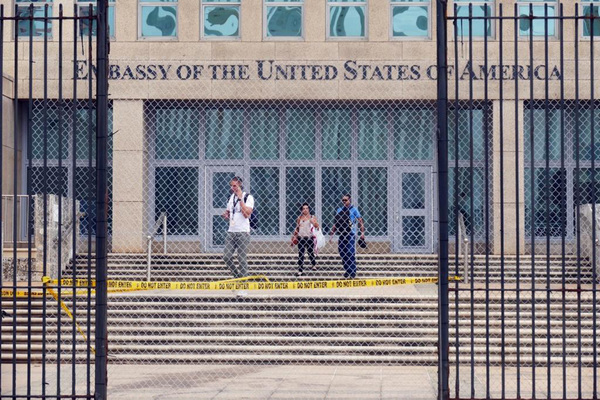
MIAMI _ The United States has decided maintain a reduced staff at its embassy in Havana, the Department of State announced Friday.
"The embassy will continue to operate with the minimum personnel necessary to perform core diplomatic and consular functions, similar to the level of emergency staffing maintained during ordered departure," the State Department said in a statement. "The embassy will operate as an unaccompanied post, defined as a post at which no family members are permitted to reside."
Secretary of State Rex Tillerson decided to reduce the diplomatic presence in Havana at the end of September due to the inexplicable symptoms suffered by at least 24 intelligence officers, diplomats and their relatives, who reported falling ill after hearing strange sounds and feeling vibrations. The State Department considers the incidents, which took place between November 2016 and August 2017, as "health attacks" against U.S. personnel.
The decision on whether or not to return to previous staffing levels had to be made before Sunday, following State Department regulations establishing that the temporary evacuation of personnel can only last six months before making it permanent. In this case, the current decision to declare the embassy in Havana as an "unaccompanied post" should be evaluated annually. That category also means that diplomats cannot be accompanied by their relatives.
The permanent reduction of personnel is bad news for Cubans who want to travel to the United States.
Since Sept. 29, the processing of almost all visas has been suspended in Havana and the issuing of immigration visas has been transferred to Colombia. Cubans must travel to a third country to request tourist and other non-immigrant visas, which has severely limited family and cultural exchange between both countries.
The number of U.S. travelers visiting the island also has dropped after an alert issued by the State Department advised Americans to "reconsider" travel to Cuba. Following the publication of an article in a medical journal, which describes the symptoms suffered by 21 of the victims who were exposed to an unknown "directional" source, the agency also issued a health alert last month associated with these incidents.
Among the symptoms described by the victims are hearing loss, difficulty with memory, headaches and other ailments associated with a concussion. The State Department has also received complaints from at least 19 Americans, who have complained of similar symptoms after traveling to the island, although the agency has not confirmed any of these cases.
A survey of 462 Americans who traveled to Cuba between 2017 and 2018 _ conducted by the organization Cuba Educational Travel _ found that 83 percent believe that the island is "very safe." A congressional delegation that visited Cuba last week also insisted that the island was safe for the Americans and asked the State Department to eliminate the travel alert.
The State Department still has no answers about what could have affected its staff in Havana but has insisted that the Cuban government is responsible for not having protected the diplomats. Initially, the investigation pointed to the use of a "sonic" weapon, but experts now believe that the sound could not have caused those symptoms.
The Cuban government, for its part, has vehemently denied that it had participated in any attack directed at U.S. personnel and raised doubts about whether these attacks even occurred.
"We still do not have definitive answers on the source or cause of the attacks, and an investigation into the attacks is ongoing," the State Department said in the statement. "The health, safety, and well-being of U.S. government personnel and family members are of the greatest concern for Secretary Tillerson and were a key factor in the decision to reduce the number of personnel assigned to Havana."
Currently, the embassy operates with a minimum staff. The Democratic representative for Tampa, Kathy Castor, told el Nuevo Herald that the embassy no longer has an official who deals with human rights issues, one of the areas that constitutes a priority in U.S. policy toward the island.