WASHINGTON _ The Obama administration directly accused Russia Friday of launching a series of recent cyberattacks, including one on the Democratic National Committee, calling them designed to disrupt U.S. elections in November.
"These thefts and disclosures are intended to interfere with the U.S. election process," said a joint statement from the Office of the Director of National Intelligence and the Department of Homeland Security. "We believe, based on the scope and sensitivity of these efforts, that only Russia's senior-most officials could have authorized these activities."
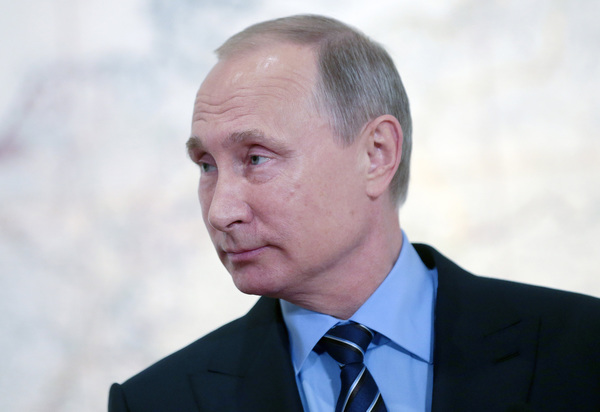
The statement said the U.S. government was confident in blaming Russa, but was vague on how it would retaliate against the government of President Vladimir Putin, with whom tensions have risen sharply, even in the past few days.
Kremlin spokesman Dmitry Peskov called the U.S. allegation "some kind of nonsense," the Interfax news agency reported. "(Our) website experiences tens of thousands of attacks by hackers every day," Peskov was quoted as saying.
The cyberattacks and hacks went beyond the breach of the DNC in June, which led to the leaking of some 20,000 internal emails a month later, immediately before the party's national convention. Committee Chair Debbie Wasserman Schultz, a Florida congresswoman, resigned her party post after the emails revealed that her staff had taken actions that favored Hillary Clinton during her primary campaign against Sen. Bernie Sanders of Vermont.
WikiLeaks released a new batch of emails Friday, including material involving Clinton campaign Chairman John Podesta.
The joint statement from Homeland Security and the national intelligence office also said hackers had been probing elections systems in a number of states and that those attacks "in most cases originated from servers operated by a Russian company."
The Obama administration said it was "not now in a position to attribute this activity to the Russian government." But it sought to reassure the citizenry that it would be very difficult to "alter actual ballot counts or election results" from the Nov. 8 vote through cyberattacks or intrusions _ something experts also asserted this week.
The accusation against Russia came two days before the next presidential debate and is likely to place scrutiny on Republican nominee Donald Trump and his call in late July for Russia's help to hack servers in the United States to find Democratic nominee Hillary Clinton's missing emails. Trump later said he was being sarcastic.
Politicians of both parties have been puzzled at why the White House delayed attributing the cyberattacks, and Friday's announcement brought both relief that blame had finally been placed and alarm that a longtime adversary had so blatantly attacked a pillar of the nation's democracy.
"Attempted hacking of our election system is intolerable, and it's critical to convince the Russian government to cease these activities. If it does not, we must develop a strong response," said Sen. Dianne Feinstein, D-Calif., who is the vice chairman of the Senate Intelligence Committee.
Her counterpart in the House, Rep. Adam Schiff, R-Calif., who is the ranking member on the House Intelligence Committee, called on the U.S. government to work to deter further meddling with European allies, which have faced similar malicious cyberattacks.
"All of us should be gravely concerned when a foreign power like Russia seeks to undermine our democratic institutions, and we must do everything in our power to guard against it," Schiff said in a statement.
President Barack Obama's top cyberterrorism aide, Lisa Monaco, told a conference on cybersecurity Thursday in Washington that Russia would feel a sharp response once the U.S. government laid blame.
"We will act responsibly, proportionally and in a time and place of our choosing," Monaco said.
Trump for months has expressed admiration for Putin, complimenting him several times as a decisive leader, but has in recent days sought to distance himself from those remarks.
"I don't love, I don't hate. We'll see how it works," Trump said of Putin this week. "Maybe we'll have a good relationship. Maybe we'll have a horrible relationship. Maybe we'll have a relationship right in the middle."
Those remarks at a campaign event Wednesday in Nevada came a day after Trump's running mate, Indiana Gov. Mike Pence, characterized Putin as a "small, bullying leader."
A month earlier, Trump said at a town hall event that Putin has "been a leader, far more than our president has been a leader" and that he welcomed Putin's compliments.
Pressed on Putin's invasion of Ukraine and its 2014 annexation of Crimea, Trump did not back off at the September event. "Do you want me to start naming some of the things that President Obama does at the same time?" Trump said. He also marveled at Putin's 82 percent approval rating among Russians.
Trump said at the same event that it was not known "for a fact" that Russia was behind the cyberattacks on the U.S. political system, and he questioned why the United States shouldn't work more closely with Russia to "knock the hell out of ISIS."
He called in a day later to RT America, a Russian television broadcaster, and said he was unfamiliar with Putin's claim that the DNC hacking was a "public service."
"I don't have any opinion on it," Trump said. "I don't know anything about it. I don't know who hacked; I'm not sure who. I mean, you tell me who hacked. Who did the hacking? I have absolutely no opinion on that."
Trump alarmed foreign policy officials when he suggested this summer that he would consider lifting economic sanctions the U.S. had imposed on Russia after it seized Crimea, and he raised questions about whether the U.S. would defend fellow NATO members in Eastern Europe against Russian intervention.
He has also suggested he would consider looking at recognizing Russia's annexation of Crimea, which the United States has denounced. Only Cuba, Nicaragua, Venezuela, Syria, Afghanistan and North Korea have supported Russia's intervention.
Russia watchers have suggested Trump's warm words may be assisting Putin.
Putin appears to be "riding this apparent endorsement by Trump in order to be restored somewhat to mainstream credibility in Western politics," Matthew Rojansky, a Russia expert and director of the Kennan Institute at the Woodrow Wilson Center, a Washington research and policy center, said last month.
He said it could be argued that Trump is serving Putin's interests, or it could be that Trump is "setting himself up to be able to do the hard stuff that every other American president wants to do, which is try to secure cooperation with Russia."
Trump's former campaign manager, Paul Manafort, has deep ties to pro-Russian politicians in Ukraine. Manafort was forced out of the campaign in August after reports surfaced that he had received millions of dollars in cash and conducted secret lobbying efforts in the United States on behalf of those politicians.
Dee Stewart, a Raleigh, N.C., Republican strategist, said the confirmation that Russia was behind the hacking was unlikely to have any effect on the election.
"Voters are looking at kitchen-table issues, which candidate is best at providing opportunities for women to have decent child care, a health care system that serves seniors," he said.
"I don't think for a minute that anyone has taken his comments about Putin's leadership skills to mean that he is somehow pro-Russian," he said. "The Democratic Party might have been pushing that, but I don't believe that has taken root among American voters."
"Of all the things that Donald Trump has said that could cause him political problems, this is probably going to be well down the list," Republican consultant Whit Ayres said of Trump's admiration for Putin. "It's not likely to crack the top 10."
"With a normal candidate and a normal year, someone having encouraged Russia to hack his opponent's email, even in jest, would be a huge issue," he said. "But these are not normal circumstances."
Private cybersecurity firms that analyzed the data breaches of the DNC and the state voting systems in Arizona and Illinois had already indicated that the attacks originated in Russia, in some cases from the same nodes used to attack political parties in Turkey and Germany and the Ukrainian Parliament.
Earlier Friday, Secretary of State John Kerry said Russia and Syria should be investigated for possible war crimes in Syria, where their forces have attacked hospitals, killing dozens of civilians.
"These are acts that beg for an appropriate investigation of war crimes and those who commit these would and should be held accountable for these actions," Kerry said.
In its statement, the Obama administration laid out why it thinks people should not be concerned that Russia might achieve the aim of disrupting or casting doubt on the U.S. elections, saying the nation's voting systems are decentralized and protected at the state and local levels.
"States ensure that voting machines are not connected to the internet, and there are numerous checks and balances as well as extensive oversight at multiple levels built into our election process," the statement said.
Monaco, the White House aide, had noted at Thursday's cybersecurity conference that the FBI has detected "a lot of probing and efforts to get at information but have not seen indications of manipulation."