WASHINGTON _ Responding to a Russian government demand to drastically slash American diplomatic staff in Russia, the Trump administration on Thursday ordered Moscow to close three of its consular offices in the United States.
Russia will be required to close its consulate general in San Francisco, the chancery annex in Washington and the consular annex in New York, the State Department announced. The deadline is Saturday.
A senior administration official would not say how many Russian staffers were affected but noted they will not be required to leave the country. The official also did not say if the Russian missions employ any Americans.
The move was the latest tit-for-tat action in worsening relations between Washington and Moscow, despite President Donald Trump's expressions of friendliness toward President Vladimir Putin.
Angered over a package of congressionally mandated economic sanctions, Russia had ordered the U.S. to cut its staff in Russia by around two-thirds, to 455. The administration official would not give an exact figure of how many staffers left Russia, or say how many of those cut were Americans, who will be transferred, or Russians, who will most likely be fired.
Trump did not comment immediately on the punitive actions. He previously said he should "thank" Putin for helping to trim the federal payroll. He later insisted he was being sarcastic.
As a result of the week's actions, both nations will have a similar diplomatic footprint _ each with an embassy and three consulates _ what the Russians had called "parity." The Russian government will have a few additional "annexes" that it will be allowed to continue to operate.
The two annexes that were ordered closed housed trade missions. The consulate general in San Francisco, a grand, butterscotch-colored building in the city's elegant Pacific Heights neighborhood, was the "oldest and most established" of Russian diplomatic missions in the U.S., part of the reason it was chosen, the official said. The official briefed reporters on condition of anonymity in keeping with administration practice.
Russia also operates consulates in Seattle, Houston and New York.
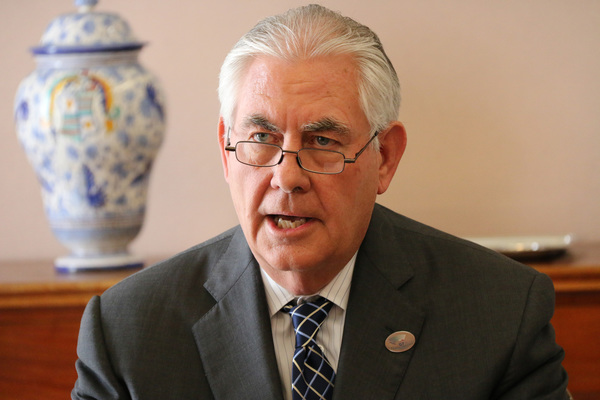
Secretary of State Rex Tillerson telephoned his Russian counterpart Sergey Lavrov earlier Thursday to notify him that the U.S. staff had met Russia's Friday deadline for downsizing and to inform him of the new U.S.-mandated closures.
Despite the tensions, the two agreed to meet again in September at the margins of the United Nations General Assembly in New York.
The drastic cut in its staff in Moscow, as well as in St. Petersburg, Vladivostok and Yekaterinburg, forced the United States to suspend most visa issuing and related consular affairs.
The State Department labeled the order "unwarranted and detrimental to the overall relationship between our countries."
"The United States hopes that, having moved toward the Russian Federation's desire for parity, we can avoid further retaliatory actions by both sides and move forward to achieve the stated goal of both of our presidents: improved relations between our two countries and increased cooperation on areas of mutual concern," the State Department said.
That may not be likely any time soon. Putin will probably feel the need to retaliate again.
Relations between Putin and then-President Barack Obama were already at a low point when U.S. intelligence services determined that the Russian government had interfered in the 2016 U.S. election campaign. In the last weeks of his presidency, Obama expelled 35 Russians whom he accused of spying, and seized two Russian vacation compounds in Maryland and New York.
Putin did not retaliate, apparently deciding to wait and see if relations between Moscow and Washington improved under Trump, who has almost never had an unkind public word for the authoritarian Russian.
But investigations into possible collusion between Russians and Trump's campaign have deepened and widened. In July, Congress voted for a new package of economic sanctions to punish Moscow for election meddling and its 2014 attack on Ukraine. The bill also made it difficult for Trump to lift the sanctions. He opposed the law but was forced to sign because it had been approved with a veto-proof majority.
Instead of rapprochement with Russia, Putin struck back, ordering the diplomatic staff reductions.
Tillerson has acknowledged that ties between the two countries may be more deteriorated than at any time since the end of the Cold War.
He has also said he hopes to be able to work with Russia on shared interests, such as fighting terrorism.
In a case of inconvenient timing, Russia's new ambassador to the United States arrived in Washington on Thursday to take up his post.
"The world is calmer and safer when @Russia and #USA act together on the international arena," Anatoly Antonov said on his Twitter account. "It is important that the US colleagues should understand that the confrontation with Russia is futile. There will be no winners in this conflict."
Later, he cited Lenin:
"Now we need to sort this out calmly, very calmly and act in a professional manner," he told reporters upon arriving, according to the state-run Russian news agency Tass. "To cite Lenin, we don't need any hysterical outbursts."
Lenin had famously once said: "We don't need hysterical outbursts. We need the measured tread of the iron battalions of the proletariat."
Antonov is a former military officer dispatched to replace Sergey Kislyak, a well-known and affable ambassador who found himself increasingly drawn into the Russia investigations.
In Russia, the reaction from the Kremlin reiterated a familiar line: The escalation in tensions between the two countries has been initiated once again by the Americans.
The American order to close the Russian consulate in San Francisco was "demagoguery against the backdrop of a new hostile campaign" against Russia, tweeted Alexei Pushkov, a senator and the chairman of the upper house of parliament's information policy committee.
Several senators and other officials spoke of retaliation.
"Most likely, they need to save face and fulfill their promises, given the fact that they had to comply with our requirements to reduce the number of employees before Sept. 1," Sen. Vladimir Dzhabarov said.
Earlier in the day, Kremlin spokesman Dmitry Peskov told reporters on a conference call that Moscow could not ignore "unfriendly steps" from the U.S.
"We regret the unconstructive stance taken by our counterparts in the United States and, of course, we cannot afford to leave unfriendly, and sometimes hostile steps towards us without retaliation," Peskov said.