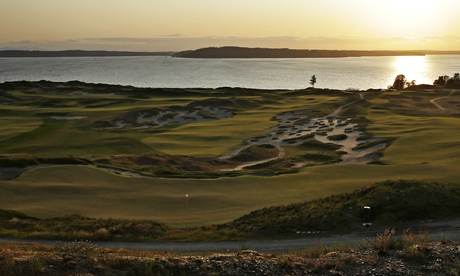
You don’t need to look far to detect rumbles of discontent relating to Chambers Bay. The venue, established in 2007, will host the US Open from Thursday, creating history as the first course in the Pacific Northwest to stage the year’s second major.
US Opens have rarely been a soft option. Since Michael Campbell triumphed with an aggregate of level in 2005, par has been breached four times by a champion. Over the same period, only Padraig Harrington, at Royal Birkdale in 2008, won the Open Championship when over par.
Mike Davis, the USGA’s executive director, is largely responsible for this. US Open course setups fall under his watch and he has a tendency to toughen or trick things up, to the audible frustration of competitors. Like a curious sporting fetish, Davis seems to revel in this.
Others, though, will inevitably fall under the Seattle spotlight. Robert Trent Jones Jr was already a renowned course architect before beating off 57 competitors to design Chambers Bay. He has done this before, all over the world, yet regards Chambers Bay as the jewel in his crown.
In the coming days, some players will take the admirable approach of getting on with the challenge in front of them. Every US Open entrant is facing the same task, after all. However, a fear of the unknown and inability to manage quickly the specifics of major courses inevitably triggers anger. Unfortunately, it can dominate a tournament.
“I take the comments seriously, I am happy to accept constructive criticism,” Jones says. “Everyone has an opinion. They voice it, that’s the nature of sport. I was a player once at a competitive level: you have to be in attack mode as a player. Now, I am more of a football goalkeeper.
“For the most part, professional golfers make poor architects. They cannot think how an amateur player plays the game. They think the way they play, which is different. You wouldn’t have a baseball pitcher teaching a batter how to bat. Very few would understand how to produce 18 holes that maintain interest, are challenging and are still fun to play by everyone.”
These points are entirely valid. The legendary Alister MacKenzie, who pieced together Augusta National, was a trained surgeon. “It is just a different mentality,” Jones says.
When Jones refers to “a links, an authentic links, on steroids”, he nods towards the potential for 7,900 yards of playing space on a 250-acre site. Because the course was built with the specific intention of hosting a US Open, there is adequate room for every tent, vehicle or human the tournament requires. Merion, the host in 2013, for example, does not have that luxury.
The backdrop and setting are significant, for this was a former gravel mine that had, and retains, the sand-base course designers adore. It is a public course and will remain so after the championship. Maintenance costs are around half of a typical newly constructed inland venue.
“I have played all my life, I played in US junior teams with Tommy Armour as my coach,” Jones says when asked if he fears the spotlight that will imminently arrive. “I always thought if you weren’t nervous on the 1st tee, you weren’t going to play well. The same applies here.
“This is the USGA’s party. I have given them multiple options for tees, for how they set up the course. I’m the composer, Mike Davis is the conductor, the players are the musicians. What you always want is perfect harmony.”
What Jones has undoubtedly produced is an aesthetically stunning course. There are quirks: the par-five 1st and par-four 18th can and will most likely be swapped around during the tournament. A single tree adorns the venue, leaving it wide open to the elements. At three separate points, players will find themselves 200ft above sea level. Like any links venue, how the ball is played on the ground will be key. With wind as the invisible hazard, airborne golf alone cannot prevail. Playing directly to flags will be at a premium, with slopes and angles in place to feed shots towards – or away from – holes.
“Mike hasn’t spoken to me about the set-up, but after the 2010 US Amateur Championship at Chambers Bay we had a full review of shots played,” Jones says. “The course will yield to great shot-making. It will not yield to poor thinking. This isn’t a normal tour event, it will test every aspect of play.”
Ah, the “normal” tour. It is a valid criticism of the PGA Tour that too many events are similar, played on essentially dull courses that can be chewed to bits by top players. When faced with a challenge such as Chambers Bay or, as was witnessed a few weeks ago, the Irish Open at Royal County Down, the inability to improvise is exposed.
“The PGA Tour is a guild,” Jones says. “People are in it to protect each other. They have gentle courses, flat bunkers, not many contours on greens.”
You can almost feel his disappointment. Over the next week, Jones wants pride to overtake any need for firefighting. As should neutral onlookers.
Sky Sports is showing the US Open live as part of a summer of sport including the Ashes, Formula One, international rugby and US Open tennis