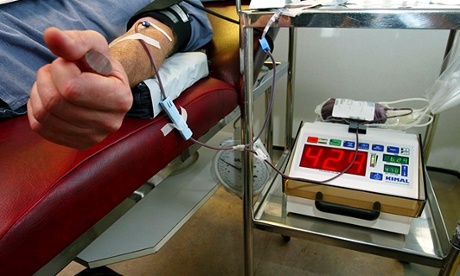
The US Food and Drug Administration on Tuesday announced that it is recommending a less stringent ban on gay blood donors, allowing some gay men to donate blood for the first time in three decades.
The agency, which regulates blood banks, is now suggesting that men who have sex with men must abstain from doing so for a year before they are eligible to donate blood.
The 31-year-old ban was enacted in the early days of the Aids epidemic when significantly less was known about the cause and condition of the disease. In acknowledgement of the considerable advances made in HIV and Aids research, the Department of Health and Human services and other government agencies have been reviewing the ban for several years.
Last month, a health and human services panel voted 16-2 in favor of getting rid of the ban. This announcement means that the recommendation will be placed in draft guidelines, put up for public comment and then finalized.
The one-year deferral is in line with policies in other countries including the UK, Canada and Australia.
I. Glenn Cohen, a Harvard University law professor who specializes in bioethics and health told the New York Times that the policy change is important, but “still not rational enough.”
“This is a major victory for gay civil rights,” Cohen said. “We’re leaving behind the old view that every gay man is a potential infection source.”
This change could raise the national blood supply by between 2% and 4%, according to a report by the Williams Institute, a think tank based at the UCLA School of Law.
The American Medical Association last year voted to oppose the policy, which has been called “medically and scientifically unwarranted,” by groups including the Red Cross, the American Association of Blood Banks and America’s Blood Centers.