You can follow our new live blog here, as Asian markets open on Wednesday:
Rebound that took the Dow up more than 440 points disappeared http://t.co/C7FLd9Jlqa pic.twitter.com/CX0tHSydqp
— Bloomberg Business (@business) August 25, 2015
The outcome of Tuesday’s abortive US market rebound looked a lot like Monday’s panicky back-and-forth, but with less drama:
This time, the major indexes opened down, spent the day solidly up with a few hiccups here and there, and then abruptly plummeted starting at 3 pm Eastern without stopping until the bell.
Here’s our US business editor Dominic Rushe talking to Ken Goldstein, economist at the Conference Board, on the decline:
“Somebody woke up last Thursday and headed for the exit and a stampede was on. Now they are back again,” said Goldstein. “It doesn’t say much about our financial geniuses.”
Goldstein said consumers could be affected by the stock market wobble, which could trigger a lack of confidence ahead of the all-important holiday season despite relatively good economic data on housing, jobs and manufacturing. “The more we scare the bejeezus out of the consumer, the more risk we face,” he said.
The morning rise comes after three days of falls on stock markets around the world that erased close to $3tn globally.
It was universally hoped that Monday’s falloff was simply an adjustment to declining fortunes in China, but with two days down, American markets and Chinese misfortune would seem to be linked more closely than many had hoped.
This blog is wrapping up for the day, but our colleagues in Australia will be back for the open of the Chinese markets. Read our complete report on the abrupt reversal of fortune in the US financial world here.
Updated
The Nasdaq, the Dow and the S&P 500 are all down the at closing bell
- The Dow - 15,665, down 205.51 points, 1.29%
- S&P 500 - 1,867.74, down 25.43 points, 1.34%
- Nasdaq - 4,506, down 19.76 points, 0.44%
Updated
US markets have lost almost everything gained today
The Dow and the S&P 500 have not had a good hour. After a day’s worth of upward-trending trading, the market is looking a great deal like it will close right back down where it started in a few minutes - and it ended yesterday very low.
Leading the charge downward in the Dow is major pharmaceuticals company Merck, off by more than 4.3%, with Verizon (down about 1.6%), another pharma company, Pfizer (down 1.8%), and Microsoft (down nearly 2%). Credit card giant American Express is down 1.65% today thus far and off by more than 21.09% year-to-date.
The NASDAQ is still barely above sea level, up by 0.07%.
Updated
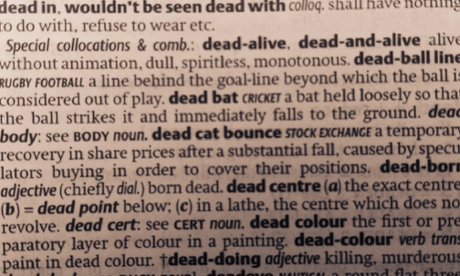
Here is a term folks are likely to be learning for the first time today: “dead cat bounce.” The poor cat mentioned here is being enlivened by speculation after a long fall, but he is not likely to chase any more mice. Another: “stop-loss order,” an order to sell stock “intended to save further loss than has already been incrurred.”
Netflix and Hecla Mining are two different dead cats picked by market prognosticators today, but it’s interesting to note a preponderance of clean energy companies on those lists, as well: there are no fewer than three solar-powered felines toe-tagged by the skeptics at The Street.
- Folks objected to the explanation of stop-loss in the comments so I’ve tried to make it a little clearer and opted for the dictionary definition instead.
Updated
RELAX EVERYONE: Stock market has already recovered almost everything lost this morning http://t.co/Svd6McAtoh
— Herman Cain (@THEHermanCain) August 25, 2015
Everything’s fine.
A Goldman Sachs note dated late yesterday tells everybody to take a deep breath and not worry about a global recession, although the firm isn’t wild about the dollar in 2015. “Within DM [developed markets, as opposed to EM - emerging markets], we have recommended being long Japan and Europe versus the US in local currency terms for most of the year.”
“Despite the recent escalation of market concerns, our economics team caution against taking too big a global growth signal away from the weakness in China and its impact on commodity market weakness,” wrote a team of researchers led by Peter Oppenheimer.
Oppenheimer’s team said they viewed growth in the US and Europe as fundamentally sound, but warned that China might indeed be suffering from longer-term instability. “[T]he risks in China itself, and those directly tied to China, have no doubt risen,” said the Goldman analysts. “In this regard, unlike the US and Europe, China has yet to adjust to make the necessary structural changes to re-balance its economy.”
An hour and a half to the market close and here’s what the fundamentals look like: off the highs for the day, with the rally running out of steam.
- S&P 500 up 1.21%, or about 23 points total
- Nasdaq up 2% (about 91 points)
- The Dow Jones Industrial Average up 1.34% (about 212 points)
Major overperformers today:
- Best Buy, which had been riding the downward curve the same as the rest of the market and today jumped more than 14% on news that the Apple Watch would be sold there soon (and probably also on Cook’s prediction below that electronics were still a solid bet in Asia, which in turn should bolster the rest of the market.
- Consol, a coal and gas mining company based in the Appalachians.
- Netflix, which was off yesterday, prompting some premature grave-dancing over the “overvalued” shares (they’re back to their standard over-value).
Big losers on the market:
- Pepco a holding company for numerous local utilities around the mid-Atlantic US...
- ...and Exelon, with which it was not allowed to merge.
- Navient, which holds student loan debt and bought a large amount of it from Sallie Mae recently.
Updated
A lesson from 538: please don’t sell those shares you’ve been holding on to at the first sign of trouble, or your loss will be somebody else’s gain (actually maybe just ignore the whole thing). Case in point: Apple, which, like many other heavy-hitter stocks, traced a crazy-looking mountain range of buys and sells yesterday, closing down against the previous day at $103.15. Today it’s already up 3.95%, and Apple CEO Tim Cook’s mini-editorial on stock price and continuing opportunity in China looks pretty solid.
Apple's @tim_cook just e-mailed @jimcramer @CNBC pic.twitter.com/zzEqmDKFUK
— Carl Quintanilla (@carlquintanilla) August 24, 2015
Maarten Hooft of Quest Venture Partners, a Google veteran who specializes in early-stage startup financing, said that he tended to favor the long game:
When people are panicking it’s an interesting time to buy. I very much follow what Warren Buffet advocates, which is ‘buy and hold.’ The average length of time people own their stocks is what, maybe six months? I own mine for years. For me, I’m like, ‘Look, Facebook is still gonna be around. Apple is still gonna be around.’
Updated
Zimbabwean president Robert Mugabe chose Tuesday to make his first public address in eight years saying his nation’s fortunes were tied to China, crisis or no crisis, Reuters is reporting.
The government of Zimbabwe is “signing key projects with China, covering energy, railways and telecommunication, water, mining, agriculture, and tourism,” Mugabe told a crowd of both supporters and detractors.
Chinese financiers have expressed unhappiness with their investments in Africa, the report said, and with many in China far less liquid now than they were a few weeks ago, investments in the developing world could easily land lower on their list of priorities.
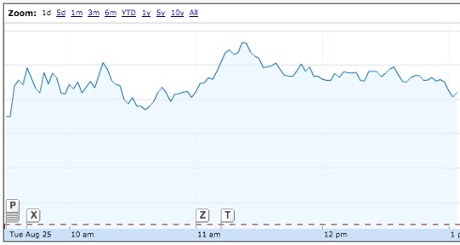
The “rallying” US market only looks impressive if you forget that the selloff has been going on for quite some time. To wit, here’s a one-day graph:
And here’s a graph of a little more than a month’s worth of activity:
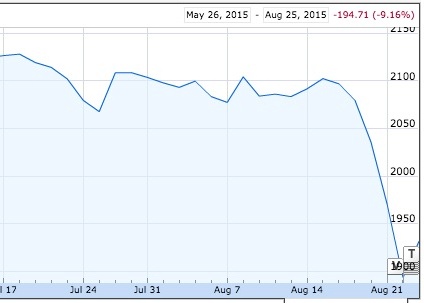
A true “rally” from that falloff would be a nearly vertical line.
This great time-lapse of the Dow shows yesterday (on the left) against today (on the right): Monday’s market jerked back and forth all morning before settling down, while today it held fairly steady up about 300 points until a recent spike. The market was briefly up far enough to put the points gains in the top 10 (see below) ... but not any more.
Yesterday’s Dow looks nothing like today’s Dow. Behold, a tale of two markets… (h/t @CarlQuintanilla) https://t.co/Zcvc01tYBI
— CNBC (@CNBC) August 25, 2015
This is Sam Thielman taking the reins. It’s midday in New York and investors are casting about for something sturdy to buy - consensus picks include, oddly, Best Buy, the American brick-and-mortar electronics retailer, which is up 14.41% in trading today as of this writing.
Paul Vigna over at the Wall Street Journal reminds us that the heftiest gain ever logged by the Dow Jones Industrial Average was just over eight points in 1933 - because there were only fifty-something points in the index then.
From Dow Jones itself, a quick list of the biggest one-day gains (points, not percentage) in its history, the top of which is October after the beginning of the US housing market crisis:
10/13/2008 - 936.42 points, 11.08%
10/28/2008 - 889.35, 10.88%
11/13/2008 - 552.60, 6.67%
3/16/2000 - 499.19, 4.93%
3/23/2009- 497.48, 6.84%
11/21/2008 - 494.14, 6.54%
11/30/2011- 490.05, 4.24%
7/24/2002 - 488.95, 6.35%
9/30/2008 - 485.21, 4.68%
7/29/2002 - 447.48, 5.41%
Updated
FTSE 100 recovers £46bn after surging 3% today

After Monday’s slump, Britain’s FTSE 100 index has just posted its biggest rally in four years.
The blue-chip index jumped 182 points by the close of trading, a gain of 3%, to 6081.
That means that£46.7bn has just been wiped back onto the value of the index, which shed almost £74bn during Monday’s rout.
It ends a 10-day losing streak which had sent the Footsie 17% down from its record high in April.
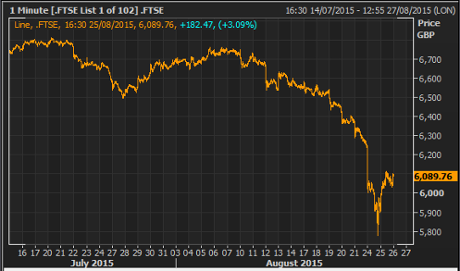
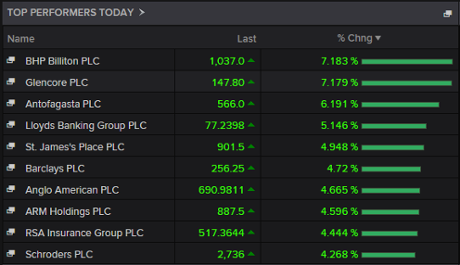
Copper producer Antofagasta led the risers, finishing up 8.7%, as China’s rate cut helped to push commodity prices higher.
It’s a relatively small rise in historic terms, though, as this chart shows:
Markets go down, markets go up. How today's 3.09% rise in the FTSE 100 compares to the top 10 largest daily increases pic.twitter.com/WB2wKtOFl1
— RBS Economics (@RBS_Economics) August 25, 2015
Tony Cross, market analyst at Trustnet, says the City lost some of its fears over China today:
The FTSE-100 has staged a significant turn around over the last 24 hours with investors moving back in after yesterday’s punishing sell-off. The worst may not be over for China but at least for now, markets elsewhere seem happy to divorce themselves from activities in Beijing.
Updated
Big 'ol rally in Europe today- German DAX up 5%, FTSE up 3%, CAC up 4%....autos main gainer up 6% on close, tech and banking sector up 5.5%
— Louisa Bojesen (@louisabojesen) August 25, 2015
European stock markets surge back
Phew. Trading is over for the day in Europe, and the markets have stormed back from yesterday’s rout.
The FTSeurofirst 300 index has provisionally closed 4.4%, means it has clawed back almost all of Monday’s rout.
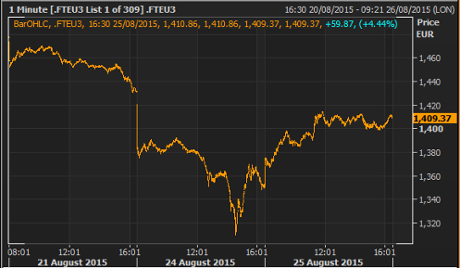
Some detail:
- The German DAX was up around 5.3% at the close
- The French CAC put on 4.4%
- Italy’s FTSE MIB gained almost 6%.
- Spain’s IBEX jumped 4%
- Portugal’s PSI20 jumped 4.7%
Just getting the UK data now....
Updated
The Wall Street rally is picking up pace, with the Dow Jones industrial average pushing over 400 points or 2.5%.
The S&P 500 index is also up 2.5%, which means it is no longer in correction territory (10% off the recent high).
Rally in the Dow Jones Industrial Average reaches 400 points http://t.co/Iehlvb9Kim
— MarketWatch (@MarketWatch) August 25, 2015
Fear index falls sharply
On Monday, the VIX “fear index” was too fearful to index -- to quote the ever-quotable Matt Levine.
That’s because volatility was so extreme that the VIX (a measure of volatility!) couldn’t be measured. But once things calmed down slightly, it hit worrying levels not seen since the dark days of 2009, closing at a four-year high.
Today, though, the VIX is a less cowardly beast. It’s down by 22% today, showing that US investors are less worried about the financial markets.
The Athens stock market went on a tear today, finishing up almost 10%.
Athens finishes surging session at +9.4%. FTSE Banks +26.9%. #ASE #Greece | Not clear why investors bought banking stock. No news re recap.
— Yannis Koutsomitis (@YanniKouts) August 25, 2015

Stock markets are dropping back from their earlier highs, but are still comfortably higher.
The Dow is now up 272 points, or 1.7%. That would be pretty impressive, if it hadn’t slumped by 588 points yesterday.
And in the City the FTSE 100 is now up 130 points, or 2.2%, having shed 288 points yesterday.
Michael Hewson of CMC Markets says it’s a fretful sign:
As we head into the close we’re already seeing today’s rally start to lose some of its early steam, pulling back from the intraday highs, which is a bit of a worry given the strength of the recent declines.
With that in mind we’re probably going to need a few more days like today before we can be confident that we’ve seen the lows.
Investors may be recognising that a Chinese interest rate cut doesn’t magically solve its economic problems, or mean that other central banks such as the Fed won’t tighten monetary policy sooner or later.

Encouraging news on the US economy - consumer confidence has hit a seven month high.
The Conference Board’s monthly survey of sentiment jumped to 101.5 this month, up from 91 in July.
The present situation index, a measure of current conditions, hit its highest level since the last recesssion, at 115.1 from 104 in July.
However, the survey was taken before China sparked global market panic, so people may be reassessing the situation now.
Updated

Back in Europe, stock markets remain sharply higher today. In London, the FTSE 100 is up 2.6%, or 150 points.
China’s decision to cut interest rates mid-morning had certainly calmed the nerves at the London offices of IG Index, the spread-betting and stockbroking group,
From IG, David Hellier reports.
The Chinese authorities acted after the markets closed in China, somewhat unconventionally as is becoming their wont. At IG there was a constant stream of television crews coming to film the drama of the trading floor but it seemed as if they had arrived late for the show.
“It’s the calm after the storm,” one analyst said, with many wondering whether Black Monday will truly be a one-off correction to the financial markets rather than the beginning of something more sustained.
The mood was composed as traders watched Wall Street open.
“You got the sense yesterday that there’s so much money waiting on the sidelines and that the US is struggling to move higher, “ says Chris Beauchamp. IG’s senior market analyst, adding:
“Yesterday was absolutely manic.”
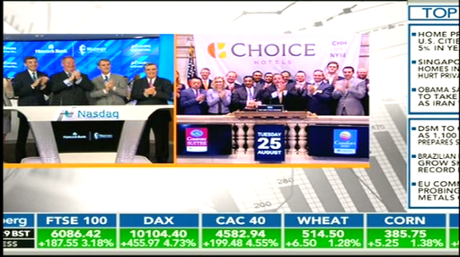
Choice Hotels rang the opening bell for the New York Stock Exchange today - a scary day to do it after yesterday’s blood bath.
But it seems to be working out for them so far. The Dow was up more than 300 points in the first few minutes of trading.
China’s problems have clearly continued into Tuesday but the US has, generally, had nothing but reasonably good economic news in recent weeks. That continued today with a report from S&P/Case-Shiller showing a slightly higher year-over-year gain in US house prices with a 4.5% annual increase in June 2015 versus a 4.4% increase in May 2015.
Updated
Our US business editor Dominic Rushe reports:
The global stock market panic appeared to be easing Tuesday as US markets opened up following a dramatic sell-off by investors around the world dubbed“Black Monday”.
The Dow Jones Industrial average rose more than 300 points in the first two minutes after the opening bell. On Monday the Dow crashed 1,000 points when it opened ending the day down 3.6%. The S&P 500 was up 1.11% and the Nasdaq 3.49%...
More here:
Dow Jones Industrial Average jumps nearly 400 points
Wall Street is putting the Black Monday selloff behind, and joining the rally which kicked off in Europe earlier today.
The Dow just jumped by 392 points, or 2.4%, in volatile early trading, as New York traders welcome the news that China’s central bank has cut interest rates.
That means it has clawed back more than half of yesterday’s rout, which wiped 588 points off the industrial average last night.
The broader S&P 500 index is also recovering quite strongly, up 1.6% in early trading
It’s quite a turnaround. Exactly twenty four hours ago, we were watching the Dow plunge by over 1,000 points.
All those red 2 std dev alerts I got yesterday are repeating today in a calming shade of green
— World First (@World_First) August 25, 2015
BREAKING: Dow up 330+ points moments after the open » http://t.co/UfqEhkJ8vm pic.twitter.com/fVdQMNs2SH
— CNBC Now (@CNBCnow) August 25, 2015
US tech stocks help drive Dow higher
Shares are pushing higher on Wall Street, pushing the Dow Jones up 320 points now. That’s a 2% bounce.
Tech stocks are leading the rally, with Apple up 5.5%.
Facebook has gained 4.78%
Updated
The Dow Jones is up 185 points, or 1.1%, as trading gets underway. But it may take a few minutes to open fully.....
The Wall Street opening bell is being rung right now. Here comes the rally!

Wall Street authorities are preparing for a volatile opening, in a few minutes time.
For the second day running they have invoked ‘Rule 48’, which allows trading to begin without a stock price being announced at the market open. That is designed to allow smoother trading.
Unlike yesterday, though, authorities are bracing for a surge on the stock market, after China’s central bank announced new stimulus measures.
NYSE is invoking Rule 48 once again in order to help mitigate volatility at the market open.
— Nicola Duke (@NicTrades) August 25, 2015

Europe’s stock markets are on track to post their biggest jump since 2011, just a day after suffering their biggest loss in four years.
Aanyone who took Monday and Tuesday off may wonder what the fuss was about....
Summary: Dow to surge after China's central bank acts
What a busy 12 hours we’ve had. And with America waking up, let’s have a recap.
The stimulus move, which has driven shares higher worldwide, came after another day of heavy losses in Asia.
In an unscheduled move, the People’s Bank of China cut lending rates, and deposit rates, by 0.25 percentage points. It also cut the Reserve Ratio Requirement, a move which should increase liquidity in the economy.
PBoC warned that the China’s economy still faces downwards pressure, as it pledged to use the tools at its disposal to maintain liquidity levels.
Economists say the move is meant to help China hit its growth targets, and also stem the panic that has gripped markets for days.
Investors in Europe hailed the move, sending the main indices surging over 4% at one stage.
Here’s the state of play now:
- FTSE 100: up 172 points, or 3%, at 6072
- German DAX: up 396 points or 4.1%, at 10044
- French CAC: up 191 points or 4.3%, at 4574
Wall Street is expected to rally strongly when trading begins in an hour’s time. Last night, the Dow Jones suffered its biggest one-day fall in four years, adding to recent losses this month:
Futures may be higher, but we're still on track for the worst Aug since 1998 (Long-Term CapMgmt) via @peterschack pic.twitter.com/hSoUgvpFcg
— Carl Quintanilla (@carlquintanilla) August 25, 2015
The PBoC’s action came too late to prop up share prices in China today, where the Shanghai composite index plunged by another 7.6% to its lowest point since last December.
Analysts believe that Beijing has given up supporting the stock market directly, leaving shares free to find their own level.
Japan’s Nikkei fell another 4% to an 18-month low, in a day of wild swings in Asia.
The selloff left “even the most hardened trader gasping for air”, says Frederic Neumann, HSBC’s co-head of Asian economics research team.
And there were grim faces across Beijing’s trading floors again, where investors spoke to The Guardian about the ‘horrible’ crash.

Updated
Larry Summers, the former US Treasury secretary has warned that the US economy is too fragile to handle higher borrowing costs:
Told @SquawkCNBC:Before the Fed can safely raise rates, we need to address secular stagnation -- that means more public & private investment
— Lawrence H. Summers (@LHSummers) August 25, 2015

Today’s rate cuts are positive, but not nearly enough, says David Goldman of Reorient, an Asia-focused financial services group.
Goldman believes the People’s Bank of China is failing to communicate to the markets, telling Bloomberg TV that:
The PBoC must do more and must explain what it’s doing more.
Goldman also believes that real interest rates are still too high for Chinese firms, despite today’s rate cut.
The People’s Bank of China is also trying to fix a mess of its own making, argues Andrew Polk, senior economist at The Conference Board.
He told Reuters that the PBoC just threw “everything but the kitchen sink” at the crisis:
Clearly the timing is all about the double-whammy of the stock market and downward pressure on the currency, both of which I’d argue they brought on themselves. They stood back and watched while the stock market ran up, then had a ham-fisted response when it fell, that created the need for a correction but made it more difficult to react.
China’s central bank has two objectives - prevent the economy stalling, and stop the market crash getting worse.
Tao Dong, chief regional economist at Credit Suisse, says:
“Clearly, this is targeted at the falling stock market.
“China needs extra liquidity to prevent systemic risks. But ultimately, fixing the economy is more important than fixing the stock market and advancing reforms is critical.”
(via Bloomberg)
Reuters’ Peter Thal Larsen agrees that the slumping stock market forced the PBoC’s hand:
China interest rate and RRR cut justified by slowdown and likely capital outflows. But timing suggests PBOC reacting to stock market slump.
— Peter Thal Larsen (@peter_tl) August 25, 2015
Updated
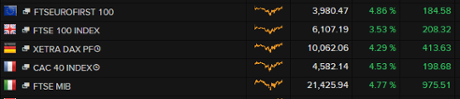
European shares surge
China’s decision to cut interest rates, and the reserve requirements on its banks, is driving shares higher across Europe.
The main indices are roaring back and recovering most of Monday’s losses, in a dizzying rally:
Wall Street is expected to rally too, after the Dow shed 588 points yesterday.
Dow Jones opening call +475 points to 16325.
— Brenda Kelly (@Brenda_Kelly) August 25, 2015
Updated
This is the fifth interest Chinese interest rate cut in the last 12 months, underlining how the People’s Bank of China has been easing policy in the face of a slowing economy:
China's interest rate move is its fifth cut this year, after a long period of stability http://t.co/ke1kXAAoEE pic.twitter.com/zLlYpMJtaL
— Bloomberg Business (@business) August 25, 2015
The People’s Bank of China also warns that the Chinese economy faces downward pressure, a recognition that the country is in a sticky patch.
But with inflation still low, it is possible to use policy tools to lower borrowing costs.
And that’s why it just cut rates by 0.25 percentage points.
China’s central banks says it took action today to provide “long-term liquidity” and to help support the Chinese economy.
The PBOC blames “fluctuations in the foreign exchange market” for causing a shortfall in liquidity, and vows to “closely monitor” changes in liquidity and use various tools to keep it under control.
#China has cut it's benchmark interest rate by 25bps. Stocks rallying globally. TM
— IGSquawk (@IGSquawk) August 25, 2015
China cuts interest rates
Breaking News: China’s central bank has cut interest rates in response to the market turbulence.
The People’s Bank of China has slashed benchmark interest rates by a quarter of one percent. That’s not a huge move, but a very significant one given events of recent days.
The PBOC has cuts the one-year lending rate to 4.6%, and the one-year deposit rate to 1.75%.
It has also lowered the Reserve Requirement Ratio, which governs how much money banks can lend to the economy.
#China cuts reserve ratio by 0.5 percentage point
— Ipek Ozkardeskaya (@IpekOzkardeskay) August 25, 2015
Market had expected the PBOC to act over the weekend, so today’s news is long-awaited....
European stock markets are pushing higher as the news breaks, pushing the main indices up over 3%.
More to follow....
Updated
Today’s UK newspapers are packed with coverage of the market slump, and a few puns too. Here’s a round-up:
China stock market crisis: what UK national newspapers think http://t.co/ftj4OAYsdY
— The Guardian (@guardian) August 25, 2015
What goes down, must come up again*
Meanwhile, S&P futures up 3.2% and Dow Futures up nearly 500.
— Joseph Weisenthal (@TheStalwart) August 25, 2015
* - this may not apply to Chinese stocks.....
Footsie continues to rally
Back in London, the FTSE 100 index of leading blue-chip shares is now up almost 2.9%, or 164 points, at 6065, as Turnaround Tuesday gathers pace.
That means it has clawed back more than half of Monday’s slump, which wiped off £79bn from top shares.
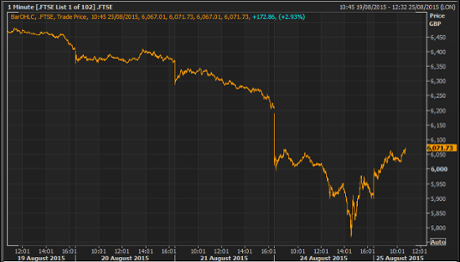
Confidence is bubbling, as investors see that Wall Street is expected to rally this afternoon.
Mining shares, which were kicked around the trading floors on Monday, are now sitting proudly at the top of the risers.
Traders may be calculating that this week’s volatility means central banks will be more reluctant to tighten monetary policy, meaning the era of cheap money could last even longer.
Matthew Ryan, Strategy Analyst at Ebury adds:
“The drama and unpredictable scenes of “Black Monday” may still be grabbing headlines and causing fear among investors, however, the impact could be good news for UK businesses.
Yesterday’s events will put additional pressure on the People’s Bank of China to further devalue its currency, with a cheaper Yuan benefiting UK industries importing from China.”
But, one morning’s rally doesn’t mean we’re out of the woods. As mentioned earlier, markets can swing wildly.....
Xinhua: Another nightmarish day for Chinese markets
China’s official news agency, Xinhua, has admitted that the country’s stock markets suffered “another nightmarish day” on Tuesday.
Xinhua says:
“The losing streak in China came despite the government’s decision on Sunday to allow pension funds to invest in the stock market.”
He Fan, the chief economist at Caixin Insight Group, tells Xinhua: “The continuous fall in the index in recent months indicates the economy is still bottoming out.”
Professor: China has stopped propping up the market
Christopher Balding, a professor of finance and economics at Peking University’s HSBC Business School, believes Beijing has given up supporting its stock market despite the huge losses of recent days (as Bloomberg also flags up).
Prof Balding told my colleague Tom Phillips that stock brokers have now recognised that China has pulled away the safety net, triggering today’s big selloff.
“It appears as if the government has taken a very conscious decision that they are not going to plough any more money into the stock market.
“I remember talking in the early days [of the recent crash] to some brokers and they said they would see an enormous bulge of orders and they would all be 10% above the market. Now, I was talking to a couple and they just said there was just absolutely no buying interest.”
“It seems that the government has made a very conscious decision not to throw good money after bad and there is just no interest in the marketplace, in other investors continuing to prop up the stock market.”
If that policy doesn’t change, Chinese markets could well keep falling until valuations become more attractive. And if the economy is weakening, this could take some time....
Updated
Billionaires have been hit hard by the market mayhem, writes Bloomberg’s Devon Pendleton:
Asia’s richest person lost $3.6bn on Monday, the most among all billionaires worldwide, as China’s stock markets had the biggest plunge since 2007 and a wave of selling spread across the globe.
Wang Jianlin saw $2bn wiped from his stake in Dalian Wanda Commercial Properties Co., according to the Bloomberg Billionaires Index, after the Hong Kong-listed property developer tumbled 17 percent to its lowest level since it went public in December. Wang also lost nearly $1bn from his Shenzhen-traded Wanda Cinema Line Co., which fell by the exchange-exposed limit of 10 percent on Monday. His fortune stood at $31.2bn after the decline.
Before anyone organises a whip round for the 1%, we should remember that the wealthy gained a lot from stimulus measures such as quantitative easing, as they already owned the assets whose value was driven up by QE.
From froth to freefall: Asia's richest got crushed yesterday, region's richest lost $3.6B http://t.co/cnQx1kuSxH @JillMao @TomMetcalf123
— Devon Pendleton (@DevonPendleton) August 25, 2015

Policymakers in Beijing have suspended the policy of intervening in the stock market while they debate their next step, Bloomberg reports.
This explains why Shanghai’s market keeps slumping each day; investors begin the session hoping for an intervention, but then start panicking once the cavalry fail to turn up.
Bloomberg says:
Some officials argue that falling stocks will have a limited impact on the world’s second-largest economy and that the costs of supporting the market are too high, said one of the people, who asked not to be identified because the deliberations are private. Officials who back intervention say tumbling shares pose a risk to the banking system, the people said.
The Shanghai Composite Index sank 15 percent over the past two days, extending a $4.5 trillion rout since mid-June that has shaken confidence among equity investors around the world. Chinese policy makers are trying to balance a pledge to loosen their grip on markets against the need to maintain financial stability amid the weakest economic expansion since 1990.
China has stopped supporting the stock market http://t.co/Ns9WV4kQUV
— Joseph Weisenthal (@TheStalwart) August 25, 2015
Updated

Mining giants are taking steps to protect themselves from the slump in commodity prices, and fears over China’s economy.
BHP Billiton announced this morning it will cut its capital expenditure sharply, from $11bn this financial year to $7bn by 2016/17. It acted after seeing underlying profits shrink by 52%, as iron ore, coal, copper and petroleum prices slid.
CEO Andrew Mackenzie warned that prices will remain volatile due to economic reforms on China, which prompted BHP to vut forecast for peak Chinese steel demand in a decade’s time.
The AAP newswire has more details.
The City likes the news, driving BHP’s shares up over 5% today. But it’s a long-term blow to the communities in places like Australia, where BHP has large operations.
Updated
If you’re trying to work out how China’s stock market turned sour so quickly, check out this timeline:
Today’s European rally is good news for investors (unless they ‘shorted’ the market), but it doesn’t change the fundamental problems in the global economy.
Nour Al-Hammoury, ADS’s chief market strategist, explains:
We have global deflation, concerns over the strength of the Chinese economy and an overheated equity market.
He believes the market is facing “a trust issue”, and looking to central banks to throw another lifeline:
A single intervention by any of the Central Banks is now likely to be of little use – there will need to be a coordinated response.

Wall Street is expected to bounce back when trading begins in five hours time, after suffering its biggest falls in four years.
Ahead of the open, ADS Securities are calling the Dow Jones industrial average up 374 at 16205 and the S&P up 39 at 1932.
Last night, we watched the Dow Jones index shed 588 points in a remarkably volatile session. Today could be lively too.
It’s no wonder that investors in Beijing are rattled. They’re experiencing a wickedly volatile market, with shares tumbling sharply since hitting a record high in June.
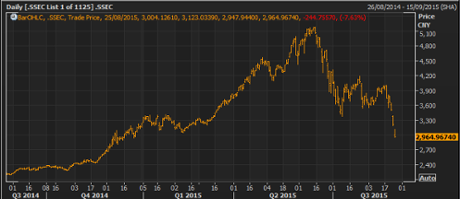
That bubble has now been firmly popped, and the Shanghai market has now suffered four big tumbles since - including the slumps yesterday and today.
Shanghai Index: 4 of the biggest 10 daily falls in last 15 yrs have occurred in the last 2 months #greatfallofchina pic.twitter.com/nbUxiFOjcr
— Guy Harding (@GuyHardingSky) August 25, 2015

City investors are ‘picking up the pieces’ after yesterday’s tumble, says Connor Campbell of SpreadEX, as European indices jump more than 2%.
But this could unwind quickly if Beijing cannot get the situation in China under control, he adds:
The Chinese central bank remains a bungling bit-player in this nightmare, instead of the reassuring white knight the markets need it to be, something that could cause losses to return if the same price-eroding fears over the bank’s ineffectualness begin to creep in once again.
Greece’s stock market is joining the rally, up more than 5% after a nasty tumble yesterday:
#Greece stock market rebounds 5.3% today after a nosedive by 10.5% on Mon. #economy #markets #stocks
— Manos Giakoumis (@ManosGiakoumis) August 25, 2015
Political uncertainty in Greece has been weighing on European markets ,after prime minister Alexis Tsipras resigned last week to trigger snap elections.
The left-wing group who broke away from Tsipras’s Syriza party are now trying to form a government. But if that fails (as seems likely), Greece will head to the ballot boxes again, perhaps on September 20th.
European stock markets are pushing higher, as Black Monday turns into Turnaround Tuesday.

The FTSeurofirst 300 index, made up Europe’s largest companies, is now worth €200bn more than on Monday evening.
That sounds quite impressive, until you remember that €500bn was wiped off the index yesterday.
And despite today’s bounceback, investors should still be cautious. History shows that markets rarely move in a straight line for long; autumn 2008 saw many of the FTSE 100’s biggest falls and rises.
Eu200b so far added back to European #stocks this morning...still Eu300b to go to make up for yesterday's rout...
— Caroline Hyde (@CarolineHydeTV) August 25, 2015
Updated
Beijing trader: It's horrible
My colleague Fergus Ryan is in a trading room in Beijing, where small investors are shell-shocked as they watched share prices tumble again today.
Fergus writes that many traders were intensely focussed on what no doubt were their plummeting fortunes.
One middle aged lady said only:
“Don’t bother me, I’m trying to focus”.
An elderly man was more candid, saying:
“I lived through wars, but nothing as horrible as this.”.
The 82 year-old former worker wouldn’t give his name, as “I depend on the Communist party to put food on my table”.
The old man held his hands up in a handcuff gesture suggesting he wasn’t free to talk, but he did have some candid things to say about their leadership.
“The Communist party is awful, all my money is gone”....
We’ll have more from Fergus later.
Updated
Shanghai Comp has closed lower by 7.6% today after falling by 8.5% yday. pic.twitter.com/hCUlQxuUIo
— Holger Zschaepitz (@Schuldensuehner) August 25, 2015
Chinese stock market crashes 7.6%

China’s stock market has crashed to its lowest level since December 2014, in a fresh wave of panic selling.
The Shanghai Composite index just closed, down 7.6% at 2,964 points, after another day of market turmoil and wild swings (as we’ve been blogging for the last eight hours).
It’s the first time in 10 months that the index has been below 3,000 points, extending the slump that sent world markets reeling on Monday.
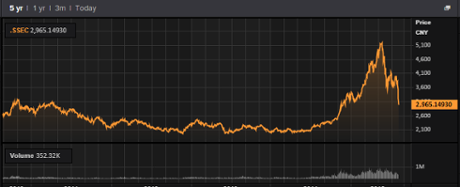
Fears over China’s slowing economy are being compounded by the realisation that Beijing authorities aren’t stepping in to prop up the market.
Zhou Lin, an analyst at Huatai Securities, says:
“The mood of panic is dominating the market ... And I don’t see any signs of meaningful government intervention.”
No wonder that Frederic Neumann of HSBC said traders were ‘gasping for air’ after the recent drama.
Updated
The bottom line: there was no reason for China's stocks to go up, so now there's no reason for them to stop going down.
— Matt O'Brien (@ObsoleteDogma) August 25, 2015
Banks and mining giants are dominating the top risers on the FTSE 100 in early trading:
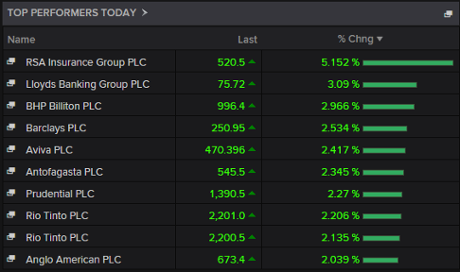
Insurance firm RSA is up after receiving a revised takeover offer from its rival Zurich, showing that it’s still business as usual in the City.
Updated
European shares rally after Monday's rout

Here we go again....
The FTSE 100 index has jumped by 102 points at the start of trading in the City, a gain of 1.7%, taking it back over the 600 mark.
Other European markets are also rallying, with France and Germany up 1.7% and Italy gaining 2%.
That recovers some, but not all, of yesterday’s rout which wiped around 4% off the main indixes.
And there are still fears that Europe’s fragile recovery will be knocked hard by China.
Augustin Eden of Accendo Markets explains:
Steep slides in equity markets and fears of a China-led slowdown in emerging economies are upending hopes in much of Europe that strong global growth and a weak euro would boost the region’s limp recovery.
European stock markets open in a few minutes.
The FTSE 100 is expected to rally, after shedding 288 points yesterday in its biggest one-day slump since 2009.
FTSE100 being forecast to open +75 at 5974.
— David Jones (@JonesTheMarkets) August 25, 2015
China’s benchmark stock market is being dragged deeper and deeper down, wiping 7.5% off the Shanghai composite index as more traders throw in the towel.
Almost every share price has been hit today:

“The recent turmoil has left even the most hardened trader gasping for air. And there’s probably more to come.”
So warns Frederic Neumann, HSBC’s co-head of Asian economics research, in a note to clients.
He says investors are spooked by two factors -- China’s faltering economy, and the possibility that the US central bank, the Fed, raises interest rates this year.
That puts further cracks into the two main growth pillars for the world economy of recent years: Chinese demand (including commodities) and easy money,”
(via Reuters)
Updated
Today’s rout across the China markets shows that traders realise Beijing won’t, or simply can’t, prop up share prices.
“It’s panic selling and an issue of confidence,” Wei Wei, an analyst at Huaxi Securities Co. in Shanghai, told Bloomberg.
“The government won’t step in to rescue the market again as it’s a global sell-off and it’s spreading everywhere now. It’s not going to work this time.”
It’s all looking rather ugly on the Chinese markets right now, as the stock market suffers more heavy losses.
The Shanghai Composite index just fell through the 3,000 point mark for the first time since December 2014, as another wave of selling rips through the country’s brokerages.
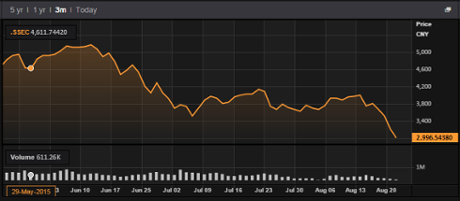
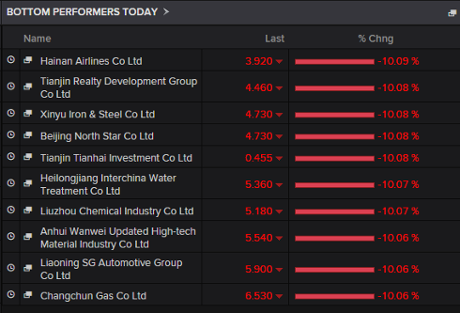
Not that it’s easy to sell shares right now. Trading in scores of companies have been suspended, after they fell by 10% -- the maximum allowed in one day.
BREAKING: Bye-bye! Shanghai benchmark index sinking nearly 7%, breaking psychologically important 3,000 points level pic.twitter.com/1YvVR4JhWF
— George Chen (@george_chen) August 25, 2015
Updated
The Australian market has closed up. The main S&P ASX200 benchmark finished 2.42% higher at 5,122.4 driven by the financial sector.
As Angus Nicholson at IG put it, the bargains were just too good to resist.
The buying opportunities in the ASX today were clearly far too tempting. Banks led the rise today, with the sector up over 4%.
Ouch. Japan’s main stock index, the Nikkei, has just closed at its lowest level in six months, shedding almost 4%.
Just two hours ago, the Nikkei was up 1%, before worries swept the Asian markets again.
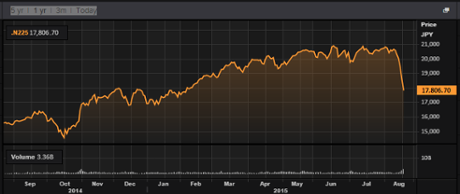
Turnover on the Tokyo market has been very brisk, hitting the highest level since November 2014, Reuters says.
Updated
Martin Farrer in Sydney handing over to Grame Wearden in London. Thanks for joining me.
Sell-off resumes as China worries drag on markets
The rout is gathering pace again.
The Shanghai Comp is down more than 6% while the Nikkei in Tokyo and the Hang Seng are also down in a wave of selling since the Chinese markets reopened after lunch.
One or two markets are proving immune to such negativity, namely Australia, South Korea and Taiwan
Updated
China's Shanghai Composite now down 6%
After a volatile session, the main Asian markets are suffering a late selloff.
The Shanghai Composite index is now down by over 6%, with an hour’s trading to go.
That puts the index close to the 3,000 point mark, meaning it’s now down by 6.5% this year.
Here we go again, Shanghai Comp. down over 6.2%.... Just 6 points above 3,000 now #ChinaMeltdown #ChinaMarkets pic.twitter.com/jdYQWzLpsZ
— David Ingles (@DavidInglesTV) August 25, 2015
And Japan’s market is having a wobble too, as trading draws to a close in Tokyo. Here’s the picture across the Asian indices right now:
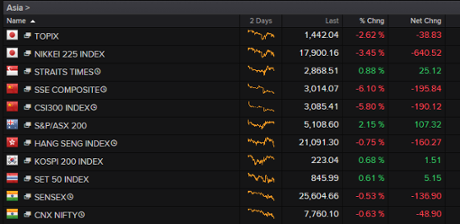
Angus Nicholson at IG Markets in Sydney thinks we might be seeing some more realistic valuations in the Chinese markets, which is why they’re lagging so much.
He thinks the authorities – what he calls the National Team – have decided to step back from interventions in the wake of a recent meeting of senior leaders at Beidaihe He writes:
Asian stocks obtained some respite after yesterday’s brutal sell off. Chinese stocks continued their declines, initially opening down over 6%, paring this back to 2.8%, then pushing back to a 4% decline.
What is increasingly clear is that the “National Team”, the China Securities Finance Corporation (CSFC), have stopped their daily interventions. The post-Beidaihe consensus appears to be that this was costing the government too much money. Thus, the rallies we are seeing in Chinese markets may have more to do with better valuations than government intervention.
Tricky business this. I’m watching Bloomberg TV here in the office and the Shanghai Comp is moving downwards at a rapid rate of knots to – it’s down 5.47% now.
Other Asian bourses are being dragged down too – Tokyo, Hong Kong both in the red.
The Australian market has performed the strongest today.
CMC Markets chief strategist in Australia Michael McCarthy said:
It is too early to say we are out of the woods. We might see a significant rally and a further significant sell-off. But, at the very least, we have seen a circuit breaker in that sour sentiment, and that should see markets in this region stabilise.
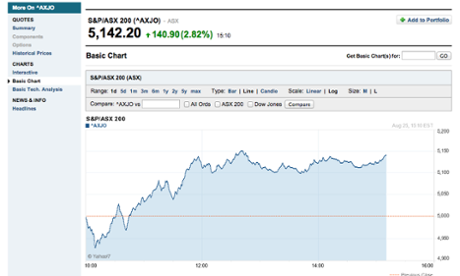
Markets down, up, and down again ...
If you’re just waking up in Europe – or wherever else for that matter – it has been a volatile day of trading on Asia Pacific markets.
Stock markets fell quite sharply at the opening this morning but – with the exception of the Chinese bourses despite a $24bn injection from the central bank – recovered strongly.
However, as the Chinese markets come back from lunch (which is clearly not for wimps there) there are signs of the recovery beginning to weaken, especially in Japan where the Nikkei is back in the red.
Anyway, the current state of play is this:
-
Nikkei down 0.43%
- ASX200 in Australia up 2.42%
- Kospi in Seoul up 1.2%
- Hang Seng is up 0.5% (but heading south)
- Shanghai Comp is down 3.87% (an improvement on -6% earlier)
-
BUT Wall Street futures are pointing up strongly
For slightly more on this, the Guardian’s Larry Elliott has written about how the selling on Monday showed what markets can look like when the stimulants – in the form of quantitative easing – wear off.
Larry writes:
Financial markets have gone cold turkey. For the past seven years, they have been given regular doses of strong and dangerous narcotics. The threat that the drugs will no longer be available has resulted in severe withdrawal symptoms ...
On the day that QE was launched in the UK, 9 March 2009, the FTSE 100 stood at 3,542 points. Its recent peak on 27 April this year was 7,103 points, a gain of 100.5%. There is a similar correlation between the three rounds of QE in the US and the performance of the S&P 500, which was up more than 200% during the same period.
Here’s the full article.
Michael Hewson of CMC Markets in London is another who thinks this is a correction that is overdue rather than the harbinger of global meltdown. He thinks today may see a let up in the selling of recent days.
While the moves in recent days have been quite alarming in their volatility when one looks back at the performance of stock markets over the last six years, perhaps the recent declines are long overdue.
For the last six years investors have been spoilt by central bankers who have been extraordinarily successful in pushing stock markets to record highs with the use of large scale loose monetary policy, while the Chinese economy has been growing at a fairly decent clip.
This steady growth was almost an unspoken truth until the middle part of this year as attempts by the Chinese central bank to stimulate a recovery in its own economic slowdown ran into the combined efforts of the Bank of Japan and the European Central Bank, whose policies have weakened their own currencies against the Chinese yuan, and in the process eroded China’s competitiveness.
In seeking to nudge its currency lower Chinese authorities appear to have triggered widespread concerns that all is not as well as previously thought with the world’s second biggest economy, and in the process triggered a widespread reassessment of valuations in some of the most sensitive sectors to the business and commodity cycle.
Back to commodities and they’ve made a decent recovery today with the oil benchmarks up slightly.
US crude was up to $38.67 after closing at $38.24 a barrel in New York on Monday night, its first below-$40 close since February 2009.

Brent crude for October was at $43.13 a barrel after closing at $42.69 a barrel in London, its lowest level since March 2009.
The Bloomberg commodity index, which tracks 22 raw materials, was up 0.58% to 86.3507, after losing 2.2% on Monday to close at its lowest point since August 1999.
And bullish investor sentiment from the Mayne man.
Trading in China and Hong Kong has stopped for lunch so things are quite calm. Seems like a good time to look at more reaction to what’’s been going on.
The consensus is definitely towards the view that other markets are decoupling from any China contagion.
This from Capital Economics is in that ballpark:
The current panic is essentially ‘made in China’. The recent data from other major economies have generally been good and there is little to justify fears of a major global downturn.
China’s recent economic data suggest that growth remains sluggish, but are not weak enough to justify fears of a hard landing.
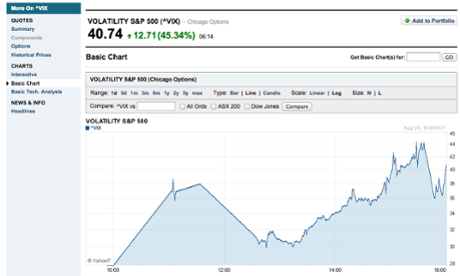
Having said that, the S&P VIX volatility index, otherwise known as the Fear Index, is heading north again – a bad sign.
As my colleague Graeme Wearden explained yesterday, “the VIX tracks the prices of options on the S&P 500, which are often used to hedge against potential losses. So a jump in the VIX shows that investors are getting scared...”
US futures are helping the market bounce back.
The US market is headed for a 2% rise at the opening on Tuesday which has breathed life back into Asia today.
Market recovery - in pictures


Photograph: Thomas Peter/Reuters

Asian markets bounce off three-year lows
Bargain hunting looks like it has helped lift Asian shares.
The MSCI’s broadest index of Asia-Pacific shares outside Japan is up 1.7% after an initial dip to three-year lows, and Japan’s Nikkei index also erased most of its early losses after an initial drop of 4.3%. It’s currently up 1.1%.
Yukino Yamada, senior strategist at Daiwa Securities in Tokyo, said:
There appears to be buyback as many markets look oversold after panicky selling in the last few days. Even the shares that had little business ties with China were sold.
Hang Seng up 1.28%.
ASX200 up 2.19%.
Kospi up 1.62%.
However, China’s markets are still being sold. The Shanghai Comp is down 4.33%.
Updated
Morgan Stanley says shares in Australia’s banks have further to fall despite the rally today.
The banks have seen record profits on the back of the booming housing market in Sydney and Melbourne, but some observers believe they are overpriced even after the recent falls.
Morgan reckons that the big four are still “on average, 12% above its bear case scenario”.
Thanks to Mike Janda of the ABC for this.
And here is Stephen’s piece. So much going on today that I missed it launching a few minutes ago ...
One of our roving economics commentators, Stephen Koukoulas, has been looking at the market turbulence.
His analysis will be online shortly but here is a taster:
The savage market ructions of recent weeks and days are disconcerting. While not unprecedented, the quite staggering fall in share markets and commodity prices are threatening to undermine the global economy.
For Australia, the news is particularly alarming. Australia’s stock market has not performed well in recent years, lagging well behind the other markets. If the market ructions translate to an extended period of weak global growth, Australia’s already dismal export performance will be hampered and the commodity price weakness will further undermine national incomes.
Here’s our first news take on the story today from our correspondent in Tokyo, Justin McCurry.
Tony Abbott, the Australian prime minister, has become the latest politician to have his say. Not surprisingly, he is adopting the “nothing to see here” approach.
He has urged Australians not to “hyperventilate” over the slump on global share markets after receiving a briefing from the Reserve Bank governor, Glenn Stevens, and senior officials on Tuesday morning.
I think it’s important that people don’t hyperventilate about these type of things. While the Chinese economy is slowing, the rest of the world economy does appear to be picking up.
America is growing, not spectacularly but steadily. Europe certainly seems to have turned the corner ... and here in Australia, our fundamentals are strong.
Updated
Markets bounce back
It’s been a much better day so far with the major markets – except China – back in positive territory.
Here are the main points:
- Despite big swings on the Asian markets the main indices are up.
- The Nikkei is up 1.1%; the ASX200 is up 2.99%; Hang Seng up 1.69%; Kospi in Seoul up 1.7%.
- The yen has begun to fall back against the US dollar. This will be welcomed in Tokyo where the finance minister, Taro Aso, has called for action from China.
- But the Shanghai Composite is down 3.74%
- China pumps $25bn into the markets but there’s still not the massive intervention some expected or even further cuts in bank reserve ratios.
- The Australian dollar is up 1.25 buying US72.22 cents
- Even some commodities like copper, which have had a fearful kicking in recent weeks, are up.
- And Goldman Sachs says the global economy is not heading for recession.
Updated
Goldman Sachs has moved in to steady the ship. The global economy is not at risk of a recession, it says.
Thanks to Reuters, here is what Goldman’s experts said in a note to clients:
The drop in commodity prices during the past year and recent economic and foreign exchange weakness in China and other emerging markets will not tip the global economy into recession.
But the Wall Street bank reduced its short-term outlook for the equity market to “neutral”. It also maintained its view that commodities will underperform.
We see a meaningful risk that markets are overinterpreting the collapse of oil and commodity prices as a negative growth signal. The fall in prices of oil and other commodities are primarily a reflection of excess supply rather than weak demand.
Updated
On the sea of red v sea of green debate, the answer is, of course, that red is an auspicious colour in Chinese culture, indicating wealth.
Thanks to Tom Phillips, our man in Beijing.


Updated
Things are still improving on the main indices. Even the Nikkei has returned to positive territory, up slightly by 0.12%.
And yet, sentiment remains quite negative in Shanghai, where the Composite Index is still off 4.6%.
Zhou Lin, an analyst at Huatai Securities, doesn’t see any sign of government intervention:
Global investors are cannibalising each other. Calling it a market disaster is not an overstatement. The mood of panic is dominating the market ... And I don’t see any signs of meaningful government intervention.
Updated
Bear or bull? A good up-summing of the market dilemma by the Australian stock exchange’s chief, Elmer Funke Kupper.

He has told Australian Associated Press:
There are two schools of thought. One is this is a correction that was probably a little bit overdue.
There is another school of thought that says maybe the world economy is not recovering quite as well as everybody had been thinking and therefore we’re more into bear territory.
I think it’s actually very difficult to call, and so you see these gyrations when people are getting worried about these things.
Funke Kupper added that investors should consider their personal circumstances when deciding how to respond.
It all depends on your personal circumstances. For some people these corrections are a fantastic buying opportunity.
Updated
Stock markets are recovering
Looking much better now for the markets.
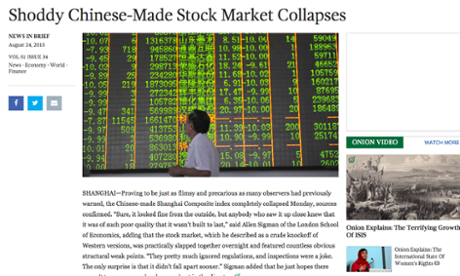
You have to laugh ... This from the Onion.
And by the way, you have to remember that falling stocks appear in green in China, not red as commonly used in western markets. I’m hoping someone can give a full explanation of why this is.
Updated
The Japanese are talking tough on the ugly (for them anyway) side-effect of the China situation, namely that the yen has gone back to seven-month highs as investors seek a safe haven.
We’ve now got some more intelligible quotes from the Japanese finance minister, Taro Aso, who warned market players against pushing up the yen too much further as the currency experienced “rough”.
He said that while there was no immediate plan for G20 and G7 nations to take coordinated action against the market turmoil, global financial authorities were in frequent contact with each other on market developments.
Of the yen spike, he said:
I would say they are rough, rather than rapid. For the economy to grow stably, it’s better for [currency and stock price] moves to be gradual and steady, rather than rough.
Updated
It’s going to be difficult to see where markets are going to end up today.
On the up side we have:
-
Hang Seng now 1.13% after 0.6% fall at the open.
-
ASX200 up 1.27% at 5,064.
- Kospi up 0.36%
But on the down side:
- Nikkei is still struggling – down 2.36%
- Shanghai Composite down 6.19%
Updated
China's central bank pumps $24bn of liquidity into the market
The Shanghai Composite index lost 6.4% to 3,004.13 points at the opening a few minutes ago after yesterday’s near-9% plunge sparked another global rout.
The CSI300 index was also down 6.3% at 3,070.01 points.
This is despite an injection of liquidity, Reuters reports.
The central bank made a large 150bn yuan ($23.43bn) injection into the interbank market on Tuesday morning during open market operations.
However, similarly large injections last week had little impact on stock market sentiment as the funds remain in the market for only seven days.
In fact, many investors worry the injections are being used as a substitute for the longer-term easing to bank reserve requirement ratios which would free up far more substantial sums of cash for long-term investment.
Updated
Back to stocks and some good news. Australian shares have continued to bounce back.
- ASX200 is up nearly 1% at 5,050 points
- Nikkei down 1.34%
- Hang Seng expected to open down 0.6%
We haven’t looked at commodities yet this morning, so here goes.
It’s looking slightly better with US crude up slightly at US$38.38 a barrel, although the US benchmark and Brent are still sitting on six-year lows.
Gold meanwhile steadied below a seven-week high early on Tuesday.
But it’s by no means certain. If this is just a correction – as Joe Hockey said this morning – then there’s nothing to worry about and the Fed should go right on ahead, shouldn’t it?
Toru Yamamoto, chief bond strategist at Daiwa Securities, said today:
There seems to be no consensus with the Fed on whether they are worried about acting too prematurely or too late.
However, Chris Weston at IG in Sydney is sure there won’t be a hike now but still thinks that someone has to do something:
The ferocity behind the selling is there for everyone to see and there is an all-out liquidation of equity holding. Clearly, the Federal Reserve are not going to hike rates in September and the market is now placing a 20% probability on this fate. Still, we are going to need to see something more inspiring than the Fed holding-off on hiking rates. The mere fact they are having to hold off is bearish in itself, but we need to see something coordinated and specifically coming from Asia given this is where the concern is stemming from.
China failed to cut reserve ratio requirements (RRR) over the weekend and this has hurt sentiment and cutting this ratio is a measure designed to fight fires; this alone is not going to significantly reverse sentiment.
Still, we will need to hear of easing measures fairly soon and we need to hear of commercial banks increasing liquidity to infrastructure projects. In general, the focus has to shift to something sizeable on the fiscal side.
China needs to convince the domestic market and the world that its economy is able to cope with further outflows and that its slowdown is under control.
Updated
It looks like a lot of volatility until the China market opens. Until then, perhaps we should have a quick look at the bigger picture, namely whether or not this market correction (let’s stick with that before we call it a crisis, or even a crash) means that the US Federal Reserve will still raise rates, as has been widely expected for months.
A former US treasury secretary, Lawrence Summers, is in no doubt, saying raising rates soon would be a “serious error”. He said in an opinion piece for the Wall Street Journal:
A reasonable assessment of current conditions suggests that raising rates in the near future would be a serious error that would threaten all three of the Fed’s major objectives: price stability, full employment and financial stability.
Updated
The ASX200 has gone into positive territory for the day helped by investors buying up bank stocks.
They have taken a fearsome beating in recent days – the financial sector was down 4.6% on Monday alone – so bargain hunters obviously think they’re now going cheap.
Investor champion Stephen Mayne clearly thinks so.
Now it’s the turn of Japan’s economics minister Akira Amari. As we reported just a little earlier, investors are buying the yen as a safe-haven asset, bossting it to a seven-month high against the US dollar, which is not really what PM Shinzo Abe wants to happen.
However, Amari is putting some heroic spin on it. He says the buying shows Japan’s economic fundamentals are strong, Reuters reports. A bubble had formed in China’s stock market and that stock prices are now adjusting lower, he said.
And he added that it was up to the Bank of Japan to decide whether or not to ease monetary policy again – ie more QE to force the yen back down.
The fightback is definitely on this morning. The ASX200 is now up 0.4%.
The Nikkei is still getting hammered though. Down 3.57% now.
China’s response/lack thereof now looks increasingly critical.
Japan urges China to take action
The Japanese finance minister Taro Aso has urged China to do something to stop the bleeding.

forexlive reports that Aso said:
Hope Chinese authorities take appropriate action to stabilise economy, which has big impact on global growth.
Recent yen moves are rough, rather than rapid.
He also said there are no plans for international coordinated action though.
Hopefully we’ll get a proper version of his quotes soon where he doesn’t sound like a robot.
But check this out. The Kospi index in Seoul is UP UP UP. Amazing stuff – it’s risen 0.12%. The fightback starts here.
The Nikkei in Japan is down around 2%.
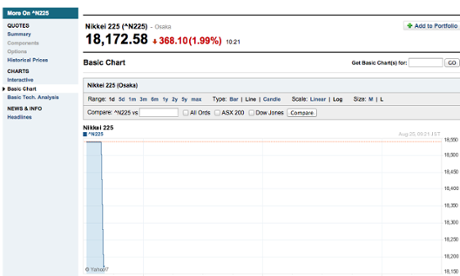
Or is the ASX rallying?
Much will clearly depend on what happens when the Chinese market opens later on this morning – in fact, in a little more than an hour’s time. No sign yet of any policy moves by the People’s Bank of China.
More on Australia, where the exposure to China is acute.
ASX200 is tanking again in Australia. Now down 1.5% with all sectors taking a beating, says CommSec.
Kospi down a little in Seoul.
Japanese and Australian markets open down
Not too bad in Australia – ASX200 down 0.6%. But Nikkei down 2.5% in Tokyo.
Tom Phillips is on deck in Beijing and he sends us this from the Global Times, a Beijing-run tabloid, which blames western doomsayers for some of the problems.
There seems to be only one reason for the tumble – investors lack confidence in China’s economic outlook. The newly released economic figures do not look good. It seems that the words “misfortunes never come alone” have come true.
But the stridently nationalist paper, which is controlled by the Communist party’s mouthpiece paper, The People’s Daily, warned against paying too much attention to western doomsayers.
There is no need to worry because of pessimistic voices from the outside world. China’s economy is in a bitter period of structural adjustments. We should become inured to face all sorts of problems with grace. This temporary lack of confidence will not snowball to become destructive.
The flip side of that is that other currencies seen as safe havens are doing much better. The yen, for example. That’s bad news for Japanese policymakers who want the yen to fall in value so its exports are cheaper.
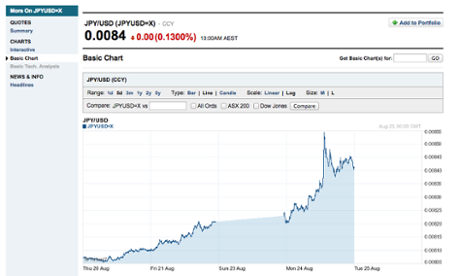
Here’s Reuters:
A senior Japanese government official said on Tuesday that recent exchange-rate moves “appear to be rapid” after the yen surged to a seven-month high against the dollar as investors fled risk amid a global stock market rout.
Asked whether a meeting on market moves was planned on Tuesday among the ministry of finance, Bank of Japan and the financial services agency, the official told reporters: “There is no plan to hold one today.”
But he added that the authorities may hold such a meeting in future as needed.
Australian dollar falls to new six-year low
I guess Hockey’s glass half-full view will be stress-tested a fair bit in the next few days. Very exciting stuff.
In the meantime, the Australian dollar – along with many other currencies exposed to the Chinese economy – is having a tough time.
The Aussie is down more 0.58% at US71.76c this morning after coming under pressure overnight.
'It’s a correction, not a crisis'
More from Australian treasurer Joe Hockey, who says this is a correction, not a crisis.
Daniel Hurst has the full story here, but here’s another snippett:
He said countries did not have the same “firepower” – or the capacity to cut interest rates and engage in stimulatory spending – as they did at the onset of the global financial crisis in 2008, but added: “In fact there is no crisis now. It is a correction.”
Hockey said despite the falls, the Chinese stockmarket was still 40% higher than it was 12 months ago “and there has been a lot of flighty money in the Chinese stock market, so that’s part of the equation”.
How the Pink Un has called it today.
SUMMARY – a wild 24 hours
if you’re just joining the blog and you want a ctach up on the events of the past 24 hours, here it is courtesy of my colleague Graeme Wearden
-
The US stock market has suffered its biggest sell-off in four years. The Dow Jones ended the day down 588 points, having shed more than 1,000 points in early trading.
- The S&P 500 and Nasdaq are both in correction territory tonight, down 10% on their recent peaks.
- In London, almost £74bn was wiped off the value of the FTSE 100 index, in a rout led by mining giants.
- European stock markets suffered their worst days trading since 2011.
-
The selloff began in Asia 19 hours ago, where Australia’s market suffered its biggest fall since 2009 and Japan’s Nikkei slumped over 4%.
- But China was the worst hit, with the Shanghai composite index dropping 8,5% in the biggest selloff since 2007.
To summarise the summary, it was a bad day for the markets.
In Australia, the federal treasurer Joe Hockey has moved to reassure people that all’s well and that the country can withstand the market volatility. He also hinted that China will wheel out the big guns to try to stop the rot. Question is, what will they do – if anything?
Anyway, my colleague Daniel Hurst will be filing soon on what Hockey has said this morning. But here’s a snippett:
I’m absolutely confident, absolutely confident that the fundamentals of the Australian economy and the global economy are still good.
Last week, I met with one of the most senior economic figures in China.
He reassured us, from his lips to our ears, that China would use whatever tools it has available to make sure that it grows relatively strongly this year ... There is no doubt.
The first key event of the day will be the opening across Asia and investors are expecting more steep falls. Futures are pointing to a 3.6% fall in the Australian market, taking the ASX200 well below 5,000 points.
Chris Weston from IG Markets said this morning:
The world’s capital markets are in meltdown, and investors are asking what can stop the panic. There is no getting away from the fact that this is going to be such a key session.
Our opening call is currently 4,820, which implies a 3.6% fall.
Here we go again
Good morning and welcome to the live blog on what promises to be another exciting day on the financial markets.
After wild swings on Wall Street and Europe, it will be Asia’s turn again this morning, starting with Australia, Japan, South Korea, Taiwan and Malaysia at 10am Sydney time (midnight GMT).
I’ll go through the main points in a minute but firstly a quick look at the scores on the doors, courtesy of Associated Press.
- Dow Jones industrial average: down 10.3% in August, and down 11% in 2015.
- S&P 500 index: down 10% this month, and down 8.1% this year.
-
Nasdaq: down 11.7% this month, and down 4.4% this year.
- FTSE 100: down 11.9% this month, down 10.2% this year.
- Germany’s DAX: down 14.7% in August, and down 1.6% in 2015.
- France’s CAC-40: down 13.8% this month, but up 2.6% this year.
- Japan’s Nikkei index: down 9.9% in August, up 6.2% in 2015.
- Hang Seng: down 13.7% this month, and down 10% this year.
- Shanghai Composite: down 12.4% this month, and down 0.8% this year.
Updated