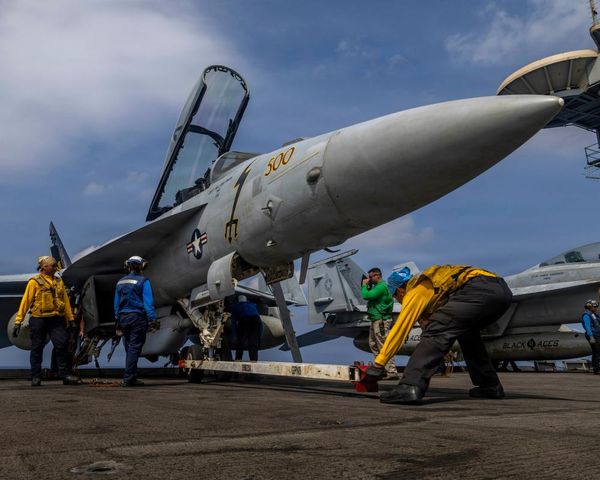
US-led forces conducted 16 air strikes in Iraq and seven in Syria on Saturday against Islamic State targets, the US military said, on the weekend which marked the one-year anniversary of the first such strikes.
Russia, meanwhile, called for the US to switch policy and recognise Syrian president Bashar al-Assad as a partner in the fight against Isis.
President Obama authorised the first strikes on Isis targets in Iraq on 8 August 2014; strikes in Syria began in September.
The strikes are the subject of continuing domestic debate – on Saturday the Republican House speaker, John Boehner, issued a statement in which he said the Obama administration “still doesn’t have the overarching strategy that’s needed to actually defeat these savage terrorists”, and called for a change of course instead of “punting this crisis to the next administration”.
On Sunday, Russian foreign minister Sergey Lavrov called for the US to work with Assad against the Isis rebels, who still control large areas of territory in the two countries.
In comments to Russia’s state television published by his ministry on Sunday, Lavrov recounted two meetings with Secretary of State John Kerry amid recent intensified high-level diplomatic contacts over Syria and the fight against the Sunni jihadis.
“Our American partners and some countries in the region persistently refuse to recognise Assad as a partner, which is rather strange,” Lavrov said.
“Assad was a fully legitimate partner in destroying chemical arms but somehow he is not in fighting terrorism,” Lavrov said, referring to a chemical disarmament deal brokered by Moscow and Washington earlier in the conflict.
Lavrov is due to discuss Syria and Isis with Saudi foreign minister Adel al-Jubeir in Moscow on Tuesday. The two will also discuss “closer coordination on global energy markets”, the Russian ministry said.
In the comments published on Sunday, Lavrov also said he had told Kerry there was a high risk that air strikes in Syria could hit the wrong target and aggravate the conflict.
The Russia-proposed coalition, Lavrov said, would “bring together all those already fighting on the ground” who oppose Isis. He named the Syrian and Iraqi armies, the Kurds and “the part of the armed opposition that represents Syrians”.
“Instead of settling their scores between one another, first one must deal with the common threat, and then seek to agree on how to live in their own country,” Lavrov said.
The US, its regional ally Saudi Arabia and Syrian opposition and rebel groups they back say Assad must go and say co-operation with him could be seen as legitimising his position.
In Iraq on Saturday, five strikes near Mosul, three near Ramadi and three near Sinjar destroyed excavators, tactical units, buildings and weapons, the Combined Joint Task Force said on Sunday in a statement. Other strikes were located near Kirkuk, Falluja, Tal Afar, Makhmur and Kabbaniyah.
The air strikes in Syria were concentrated around Hasaka, Aleppo and Kobani, where they struck a bunker, a tank, anti-aircraft artillery pieces and tactical units.