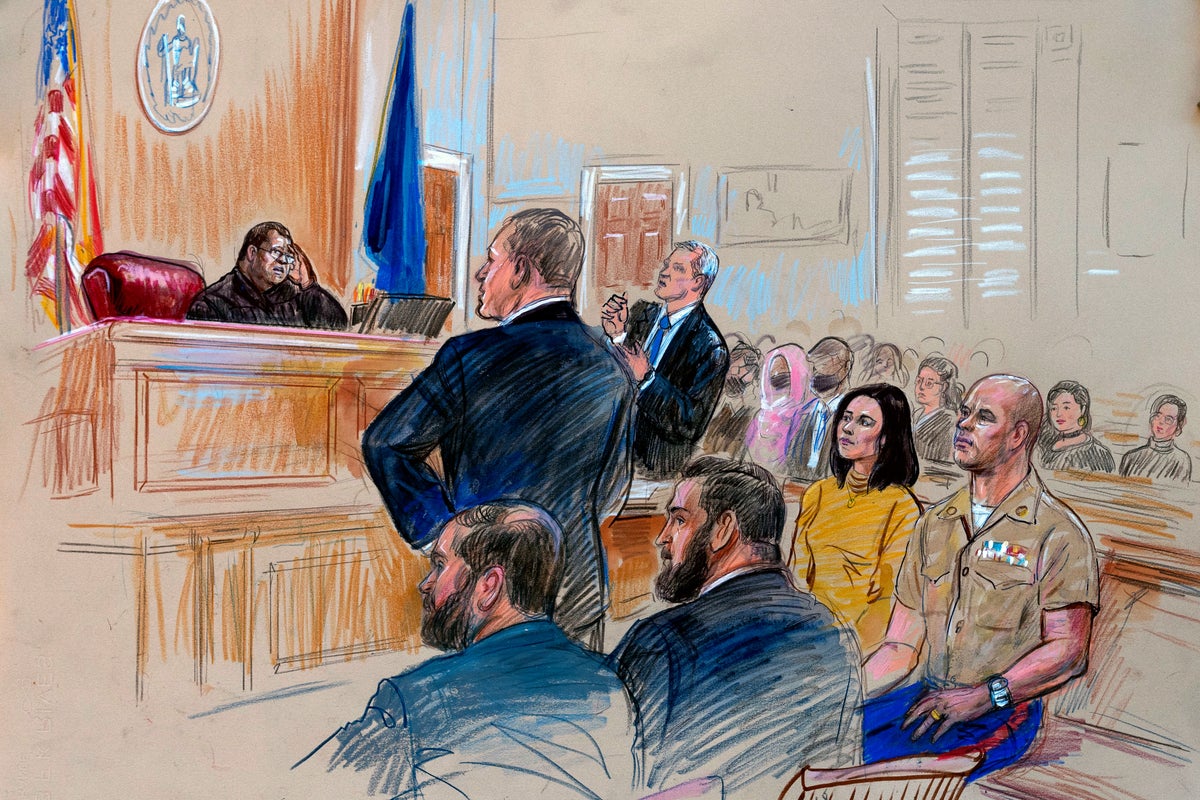
The judge wanted everyone in the courtroom to know that when he’d signed a war orphan over to an American Marine he thought it was an emergency — that the child injured on the battlefield in Afghanistan was on death’s door, with neither a family nor a country to claim her.
A lawyer for the federal government stood up.
“That is not what happened,” she told the judge: almost everything he’d believed about the baby was untrue.
This group had gathered 15 times by then, in secret proceedings in this small-town Virginia courtroom to try to fix what had become an international incident. Fluvanna County Circuit Judge Richard Moore had granted an adoption of the orphan to U.S. Marine Joshua Mast and his wife, Stephanie, while the baby was in Afghanistan, 7,000 miles away.
Now the U.S. government insisted the baby’s fate had never been the judge’s to decide; officials in President Donald Trump’s first administration had chosen to unite her with relatives months before Moore gave her away, according to once-secret transcripts of the November 2022 hearing.
Thousands of pages of those transcripts and court documents were recently released as a result of The Associated Press’ three-year fight for access after a 2022 AP report about the adoption raised alarms at the highest levels of government, from the Taliban to the White House. The newly released records reveal how America’s fractured bureaucracy allowed the Masts to adopt the child who was halfway around the globe, being raised by a couple the Afghan government at that time decided were her family, in a country that does not allow non-Muslims to take custody of its children. The documents show the judge skipped critical safeguards and legal requirements.
Mast, who cited a judge's orders not to speak publicly about the case in declining requests to comment, has said he believed — and still does — the story he told Moore about the girl, and insists he acted nobly and in the best interest of a child stuck in a war zone with an uncertain future.
Along the way, high-ranking military and government officials took extraordinary steps to help him, seemingly unaware that others in their own agencies were trying to stop him.
“The left hand of the United States is doing one thing,” another judge later said, describing the dysfunction, “and the right hand of the United States is doing something else.”
The documents reveal that the court and federal government have blamed each other for the legal predicament. The Justice Department has said what happened in this rural courthouse threatens the nation’s standing in the world and appears as an endorsement of child abduction.
“I’ll probably think about this the rest of my life whether I should have said, sorry, that child is in Afghanistan. We’re just going to stand down,” Moore said at the hearing three years ago. “I don’t know whether that’s what I should have done.”
A remarkably quick adoption
The baby was orphaned in September 2019 when U.S. Army Rangers, along with Afghan forces, raided a rural compound. The baby’s parents were killed. She was found in the rubble, about two months old, burned and with a fractured skull and broken leg. U.S. troops scooped her up and took her to the hospital at Bagram Air Base in Kabul.
American servicemembers fell in love with her there, as she recovered. She was a symbol of hope in a long, grinding war.
The raid that killed the baby’s parents targeted transient terrorists who came into Afghanistan from a neighboring country, the records show. Some soldiers believed she might not be Afghan and tried to make a case for bringing her to the U.S.
The State Department attempted to make its position clear: The embassy convened a meeting that October with members of the military and the Afghan government to explain that under international law the U.S. was obligated to reunite her with her family, according to documents. State Department officials wrote that Mast, a military lawyer on a short assignment in Afghanistan, attended that meeting.
He’d met the baby for the first time days before and remained determined the child should go to the U.S., according to emails filed as exhibits.
Mast called home, where his wife was with their three sons.
“With us having children of our own, we see how vulnerable and precious children are,” Stephanie Mast testified. “And we wanted to help in whatever way we could.”
The Masts, Evangelical Christians, decided to try to bring her to their home in Palmyra, Virginia.
Mast’s brother, Richard Mast, a lawyer with the conservative Christian law firm Liberty Counsel, filed a petition for custody in early November, and a Fluvanna County Juvenile and Domestic Relations Court judge quickly approved it. The judge declared that the child was “stateless,” echoing Mast’s assertion that her parents were nomadic terrorists, and the Afghan government would issue a waiver of jurisdiction over her within days.
Afghanistan never waived jurisdiction.
Still the Masts decided custody wasn’t enough. Several days later, Moore, the Fluvanna County Circuit Court judge, got an unusual weekend call from his clerk’s office about a request for an emergency adoption, according to comments the judge made on the bench and records obtained from the Virginia Attorney General’s Office. Custody orders like the one the Masts were granted are temporary, but adoption grants a child an entirely new birth certificate, assigning them new legal parents. Moore said he was told that the girl desperately needed medical care and adoption would help get her on a plane to America.
Though the baby was being cared for by the Defense Department, the federal government insisted it received no notice of Mast’s bid for adoption, the recently released records show. Had it been notified, government lawyers said, they would have told the judge that the child was not stateless, the government was at that time searching for her family and would soon decide she was Afghan and not the child of foreigners. She was also not in a medical crisis: A month before, exhibits show, her doctor described her as “a healthy healing infant who needs normal infant care.”
The Masts have said in court records that they did not mislead the court; they believed that the girl was the stateless daughter of transient terrorists and Afghanistan was neither interested nor capable of caring for her.
Moore did not respond to requests for comment.
On Sunday, Nov. 10, 2019, Moore granted the Masts a temporary adoption. Moore ordered the Virginia Department of Vital Statistics to issue a new birth certificate, making her the Masts’ daughter.
Adoption cases usually creep through the court system. Moore granted the Masts the temporary adoption in a weekend.
“Attempting to interfere inappropriately”
Two days later, an email arrived overnight at the U.S. Embassy in Kabul from State Department headquarters. The office had heard that Mast had been granted custody of the orphan, and wanted to know if that was true, the documents show.
Officials who had been working on uniting the girl with her family seemed stunned by the email. An Army colonel later wrote in a declaration that he believed Mast was “attempting to interfere inappropriately.”
Around that time, U.S. officials learned that a man came forward to claim the baby, records show. He told authorities he was the child’s uncle. He said the girl’s father was a local farmer, not a terrorist. His wife and five of their children were also killed. He said it was his family’s duty to take her in.
The Afghan government vetted his story. U.S. officials signed off.
Meanwhile, Mast’s tour ended. He returned home to Virginia, and set up a crib for the baby he was certain would soon be theirs, according to court testimony. The couple quickly found an ally in an aide for Republican Sen. Ted Cruz of Texas. The aide pressed Assistant Secretary of Defense Derek Maurer to ask immigration officials to rush documents the child needed to get to the U.S. An attached memo written by another military official pointed to proof of Mast’s claim to the baby: Mast had enrolled her in the military’s health care system as his dependent.
On the application for those benefits, Mast claimed the girl had lived with him in Virginia since Sept. 4, 2019, but she had never been on American soil, a government official wrote in a declaration. Mast also wrote that her injures were a result of child abuse.
The situation worked its way to Secretary of State Mike Pompeo. He signed a cable, dated Feb. 25, 2020, records show, dismissing the Fluvanna custody orders as “flawed.”
The cable said that any further delay in transferring the child could be perceived as the “U.S. government holding an Afghan child against the will of her extended family and the Afghan government.”
The next day, Mast filed a federal lawsuit to stop the reunification. The judge rejected his claims.
The U.S. put her on a plane to meet her relatives. They wept when they saw her, bundled in pink. The child’s uncle decided his son should raise the baby with his new wife and they quickly came to love this girl like their own daughter, they testified.
The Masts have insisted that this family is not biologically related to the baby and have questioned the process through which the Afghan government vetted them. The Afghan couple had celebrated the first step in a traditional Afghan marriage, a religious bond, but had not yet had a wedding reception, and the Masts argue they were unmarried at the time the child was given to them.
The AP agreed not to name the Afghan couple because they fear their families in Afghanistan might face retaliation from the Taliban. The court issued a protective order shielding their identities.
The Taliban, which now controls Afghanistan, was not in power when that country was making decisions about the child. Since taking over, the Taliban has been critical of what happened to the girl, calling it “worrying, far from human dignity and an inhumane act,” and urged the U.S. to return her to her relatives.
The Afghan couple testified they had no idea that on the other side of the globe an American judge still believed the girl was available for adoption.
Mast told Moore the child was given to an unmarried girl whose relationship to her was unclear. He testified that he maintained the child was the daughter of foreign fighters and suspected the family had ties to terrorism.
Moore said he did not learn that a federal judge had already rejected Mast’s claims to the baby. He would later say he vaguely remembered hearing that something happened in federal court but it didn’t register as important.
“I guess I assumed it was an administrative thing,” Moore said.
Mast continued to ask Moore to grant a final, permanent adoption.
Lawyers representing the government, the Afghan family and the child would note many defects in these proceedings; the attorney representing the child described the flaws as “glaring.” There is no Virginia law that allows a judge to adopt out a foreign child without her home country’s consent. A child must be put up for adoption by a parent or agency, and this child had never been. The court waived the requirement that the child be present when social services visited the adoptive parents’ home, that someone investigate her history, that whoever had custody be told this was happening.
In December of 2020, Moore granted a final adoption, deeming the Masts the baby’s permanent parents.
“She is an undocumented, orphan, stateless minor,” he wrote, “subject to this court’s jurisdiction.”
‘Is it even lawful for us to take her?’
In Afghanistan, the couple raising the girl received calls from strangers. Mast was working with Kimberley Motley, an American lawyer based in Afghanistan. Motley told the couple that a family wanted to help the girl get medical care in the U.S. But the couple refused to send the girl alone. Motley kept in touch with them for months, according to messages entered as court exhibits. Motley, through her attorney, declined to comment.
In the summer of 2021, the American military withdrew from Afghanistan and the Taliban took over. Mast contacted the couple directly, enlisting the help of a translator named Ahmad Osmani, an Afghan Christian who’d moved to the U.S. Osmani considered it his Christian duty to help the Masts, testifying that he believed it would be “a great picture to see a terrorist’s daughter become a believer and glorify God’s name.”
Mast and Osmani told the couple that they could get all three out of Afghanistan.
At the time, servicemembers were frantically evacuating Afghans, mostly those who helped the U.S. and would likely be targeted by the Taliban.
Amid the confusion, Mast asked colleagues in the Marines to add a baby and her caretakers to an evacuation list, the records show, claiming the State Department had sent her to an orphanage. She was living with the Afghan couple, and had never been to an orphanage.
A lieutenant colonel emailed other military officials to start the process of getting the family on a flight out. He didn’t learn that the military had worked to keep Mast away from this baby.
“Is it even lawful for us to take her?” asked a major in the Marines, according to a copy of the email.
Mast, who was copied on the chain, replied: “To clarify, she is completely clear on the Afghan side,” he wrote. “I am very familiar with the requirements after the last 18 months working the legal issues.”
Military officials asked no further questions, and soon the family was on a plane to Germany, where the Masts met them for the first time. The Afghans testified they had no idea the Masts planned to take her. The Masts have said they had tried to explain that they would.
Stephanie Mast testified that when she and her husband arrived in Germany, they “knew we had to speak to them and just tell them the truth.” She tried to explain “sacrificial love.” If the baby came with them, she told the Afghan woman, “she can have the best life possible.”
The Afghan man ripped off the wristband refugees wore and threatened to return to Afghanistan if the Americans tried to take the child.
The Afghan woman later said they convinced her that she’d misunderstood and persuaded them to continue to the U.S., and keep the baby with them.
The Afghans boarded a plane bound for Dulles International Airport, then a bus to Fort Pickett, a military base in Virginia turned makeshift refugee center. Meanwhile, the records show, Mast asked a State Department official he’d met in Germany to help connect him with other government contacts so he could track the family’s arrival.
Emails show employees with multiple government agencies sprung into action, including the State Department. The federal government would later say that these employees, like the military officials who evacuated the family, didn’t know that the very agency they worked for had tried to prevent Mast from taking the girl.
‘It’s like you are kidnapping her’
Rhonda Slusher, a State Department official, answered the phone at Fort Pickett. On the line was Joshua Mast.
He said he was going to come pick up his adoptive daughter, according to a declaration Slusher submitted in court. Slusher said she was told “there was no U.S. jurisdiction to hold the child,” and she should be given to Mast “at the earliest point possible.” Her supervisor instructed her to assist with “the transfer of the child,” she wrote in the declaration.
Mast told Slusher he was concerned the family she was being taken from “were going to be sad,” she wrote.
On Sept. 3, 2021, uniformed officers drove the Afghan family to a nondescript building near the camp’s front gate.
Slusher picked the baby up out of the car seat and insisted she hold her as the family went inside.
There, the Afghan woman later testified, another official, this one from the Department of Health and Human Services, told them: “you are not the parents of this child.”
“It’s like you are kidnapping her,” the Afghan man said.
The Afghan woman came toward Slusher.
“Please give me my daughter,” she said “She is my daughter.”
The baby cried and squirmed to get back to her, but Slusher wouldn’t let her go. The woman tried to grab the child, but Slusher pulled her hands away. The woman “crumpled to the floor crying.” She lay there for at least five minutes.
Slusher wrote in a declaration that she carried the baby outside, where Stephanie Mast was waiting in the car. Stephanie Mast fed the girl Goldfish crackers before they drove away with her husband.
“It is worth reiterating that this prolonged tragedy was entirely avoidable. The Trump administration blocked an attempt to unlawfully seize the child from her Afghan family in early 2020,” the Afghan couple’s attorneys wrote in a statement, adding that the Masts were able to take the child only because of America’s messy exit from Afghanistan. “The child and her relatives are victims of a crime and a tragedy no family should ever endure — a stark reminder that this withdrawal continues to have far-reaching and devastating consequences.”
'A possibly errant adoption'
More than a year after the Masts took the baby home, her fate was before Judge Richard Moore again.
The Afghan couple found a team of lawyers willing to represent them for free, and filed a petition in Moore’s court to challenge the adoption he’d granted. Moore could undo the adoption and give the child back to the Afghan family, or uphold it, and leave her with the Masts.
“I’ve never had a case where I was so uncomfortable with either decision,” he said at the November 2022 hearing, which would be his last hearing in the case before retiring.
The judge listened for five hours as the lawyers for the Afghan couple and the government said that the adoption he’d granted was so riddled with errors it shouldn’t be called an adoption at all.
Moore blamed the federal government — it had known as early as 2020 that the Masts were trying to get the girl and a court in Fluvanna County was involved, and they did not try to stop him from issuing a “possibly errant adoption,” he said.
“Clearly, there were procedural irregularities and deficiencies in this case. There’s no question about that,” the judge said from the bench.
Yet for a year, in hearing after hearing, the primary question became whether the Afghan couple had a right to challenge that adoption at all; whether they were truly her family and if the Afghan government’s decision to give her to them was valid once they arrived in the U.S.
The judge and the Masts’ attorneys questioned them about their origin and upbringing, their relationship to each other and to the child.
Moore repeatedly said he did not believe they were related to the girl, nor was he inclined to consider them parents. He said no court in Afghanistan was involved in determining who should get custody of the child there. The Afghan couple’s lawyers had resisted DNA testing, saying it couldn’t conclusively find a relationship between opposite-gender half-cousins. It was also irrelevant, they argued: After the Afghan government gave the child to them, an American court should not relitigate that choice.
At the last hearing he held in November 2022, Moore said there were many things he wished Mast had told him before he signed the adoption. But he still trusted the Marine.
“There’s no question in my mind. Their total involvement was to save this child,” Moore said.
A week later, Moore published his thoughts on the case in a written document, and reiterated his opinion that “anything they did improper grew” out of the Masts’ desire to help the child.
He was less sympathetic to the Afghans. The Afghan woman testified that she had two Afghan government identifications, one that included her real age and a second she obtained intentionally making herself younger to enable her to enroll in school. They “misrepresented certain facts and lied … for their own purposes,” Moore wrote.
The Masts, too, have described the Afghans as untrustworthy, even threatening. They submitted court records alleging the Afghan man was flagged in a database of suspected terrorists upon entry to the U.S., which they reported to law enforcement. Attorneys for the Afghans responded that the government said in a sealed letter to the court that the man was not the subject of the database entry. The man remains in the U.S. and frequently flies from Texas to Virginia for court hearings.
With Moore’s retirement, the Masts and the Afghans found themselves before a new judge, Claude Worrell.
Worrell rebuked the federal government for its “inconsistent” approach, noting it was arguing the baby should be immediately returned to the Afghans, while its own employees had repeatedly assisted the Masts along the way.
It did not take Worrell long to come to a wholly different conclusion than Moore. Worrell wasn’t concerned about biological relationships. What mattered, he said, was Afghanistan claimed her as its citizen, so got to decide her fate.
In March 2023, Worrell voided the adoption.
The Afghan couple went outside to a patch of grass in the parking lot and prayed. They thought they would soon bring the baby to their home in Texas, where they’ve kept a bedroom ready for her, decorated with butterfly decals.
The Virginia Court of Appeals has since upheld Worrell’s decision voiding the adoption, and the case went before the Virginia Supreme Court in February 2025. It has yet to issue a ruling. As the years dragged on, the child remained with the Marine and his family.
The Marine Corps held an administrative hearing in October 2024 to determine whether Mast violated military rules. A three-member panel found that he acted in a way that was “unbecoming” of an officer, but that didn’t warrant suspension or other formal punishment.
The federal government has indicated in court in recent months that it is reconsidering its role in the case, and Trump’s second administration could reverse his first administration’s opinion that Mast had no right to the child. The Justice Department did not respond to repeated requests to clarify its current position on the child’s fate.
It has been four years since the Afghan couple has seen her.
In July, she turned 6.
___
AP data journalist Angeliki Kastanis contributed to this report
—-
Contact AP’s global investigative team at Investigative@ap.org or https://www.ap.org/tips/.
Newly obtained emails undermine RFK Jr.'s testimony about 2019 Samoa trip before measles outbreak
Trump shares late-night video depicting Barack and Michelle Obama as apes
Pope, an avid athlete, extols physical and spiritual benefits of sport in Olympic message
Meet Dame Karen Pierce – the midlife woman pushed out of her job for Peter Mandelson
Mass executions in Iran being planned after Trump talks end, lawyers claim