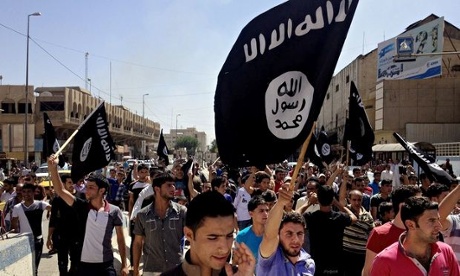
In a reversal of his campaign-trail assurances that the tide of war is receding, the final national security strategy of Barack Obama’s presidency declares terrorism “a persistent threat” amidst a “generational struggle for power in the Middle East”.
The 2015 National Security Strategy, released by the White House on Friday, resigns the US to an open-ended conflict against al-Qaida and now the Islamic State (Isis), as well as their undefined “affiliates”. It does not significantly discuss Yemen or Pakistan, the two most active theaters of drone strikes against al-Qaida.
While the document declares al-Qaida’s core leadership “decimated”, the strategy forecasts a continued global conflict against a “more diffuse” series of al-Qaida and Isis networks abroad, raising questions about what a counterterrorism approach that privileges decapitation strikes will durably achieve.
That diffusion, “may for now reduce the risk of a spectacular attack like 9/11,” said Obama’s national security adviser, Susan Rice, but raises the risk of smaller-scale attacks like in “Boston, Ottawa, Sydney and Paris”.
During a rollout speech for the strategy at the Brookings Institution in Washington, Rice argued for “perspective”, as the threats the US faces “are not of the existential nature they were in World War II or the Cold War.”
As the White House unveiled the strategy document, the US military announced 10 new airstrikes in Syria and eight in Iraq against Isis.
The White House calls its model – a now-familiar emphasis on airpower, particularly from armed drones, special operations raids, and pervasive surveillance, bolstered by regional proxies – a “more sustainable” approach than the two ground wars it has drawn down but not ended.
That model seeks to operate between two poles visible within the strategy document: preparing the US for a persistent twilight struggle against terrorist adversaries, while not overcommitting US resources like ground troops that arouse domestic, local and international opposition. Counterterrorism, the strategy document outlines, is one US security priority amongst several, including the prevention of nuclear proliferation, catastrophic climate change and cyberattacks.
But Obama’s preferred counterterrorism model remains under great stress, abroad and at home.
Obama had in the fall termed Yemen one of his models for counterterrorism success, but his Yemeni partner, Abd Rabbo Mansour Hadi, has been deposed by a separatist rebellion allied with Yemen’s previous president, which on Friday declared a new presidential council. The US military confirmed to the Guardian this week that it now has limited visibility into $400 million worth of arms and equipment it has sent to bolster its Yemeni counterpart.
“We seek a stable Yemen that undertakes difficult structural reforms and confronts an active threat from al-Qaeda and other rebels,” the document states.
Reinforcing Obama’s approach to combatting Isis, the document emphasizes bolstering Iraqi capabilities against the group and portrays US efforts against it in Syria as an adjunct. It describes the proxy force the US seeks to build in Syria as a “counterweight” to Isis and the “brutality of the Assad regime,” rather than an instrument to take territory away from either.
“The only lasting solution to Syria’s civil war remains political,” the document reiterates, a position criticized by both US hawks and Syrian opposition groups as signaling a meager American commitment.
At home, Obama is expected next week to offer long-awaited text of a post-facto legislative authorization of the war against Isis to Congress. A leading Democrat advocating congressional support for the war, Rep. Adam Schiff of California, has offered language that would set time constraints on the authorities underpinning both that war and the war against al-Qaeda.
Rice did not predict when the renewed war in Iraq would end, but said “degrading” Isis was a priority for Obama’s final two years in office.
The strategy document restates Obama’s preference for law enforcement to detain, interrogate and prosecute terrorists “outside of areas of active hostilities,” but states that it will use lethal force – “decisive action,” in the text’s phrase – when it considers such measures unfeasible. It does not elaborate on how the administration determines unfeasibility.
The document also pledges to “reform surveillance,” though the administration has recommitted itself to collecting communications and records of communications in bulk, and legislative efforts at constraining the controversial surveillance have stalled.
“The United States – not our adversaries – will define the nature and scope of this struggle, lest it define us,” the document states.