What do you want in a political leader? Someone who can win and who has experience? Or someone who you think is caring and honest?
That was the question Democrats in Iowa answered last night. One half of the party wanted a winner with experience. The other half wanted someone trustworthy and compassionate.
Hillary Clinton was overwhelming favoured by those who wanted a winner. Sanders was backed overwhelmingly by those who cared if a candidate is 'caring'.
As the figures in brackets show, 20 per cent of Iowan Democrats cared most about whether a candidate could win, with 28 per cent prioritising experience.
These were Hillary's core voters. 77 and 88 per cent of these voters backed her.
26 per cent wanted a caring candidate, with 24 per cent focusing on honesty.
These were Sanders' voters. 74 and 83 per cent of them backed him.
But who were these people? Were they young or old, rich or poor, liberal or moderate?
Hillary's voters were older, richer and more moderate.
The good news for her is that most voters are, and younger, poorer, more liberal voters are likely to get behind her in the general election - as they do all Democrats - if she can beat Sanders in these primaries.
So who's favoured now? Can Sanders really win, now that he's proven himself Clinton's equal?
Sanders' problem is that Iowa is an overwhelmingly white state, almost all of his supporters are white, and yet he still failed to win it.
Clinton leads him by a huge margin among non-white voters, who will play a huge role in future primaries, especially big, delegate-rich ones like New York, California and Florida.
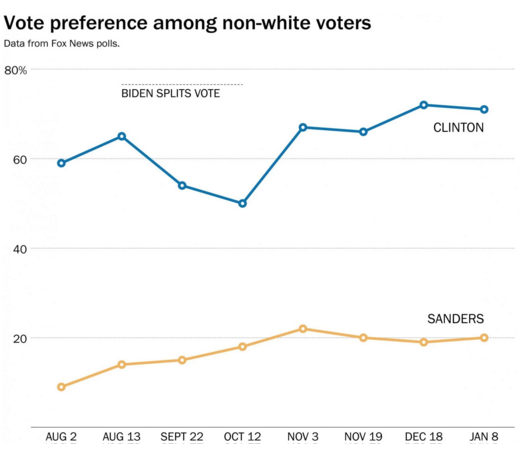
Non-white voters make up around 30 per cent of general election voters (13% black, 11% Hispanic and 6% Asian or other), and even more of Democratic primaries, as they vote disproportinately for the party.
Clinton also has more money than Sanders.
She has spent more so far, nearly 70% more, and yet still has $10 million more cash-on-hand, as well as funding from "super PACs", affiliated organisations which can raise limitless funds for a candidate (campaigns can only accept so much from an individual; super PACs can accept as much as they like).
But Sanders' coffers have been filled by small donors who can all give again to his campaign. In January, for instance, each donor only gave an average of $27; they can give up to $2,700.
In contrast, around 3 in 5 of Hillary's donors are 'maxed-out', they can't give anymore. (But they can give to super PACs; she won't run out of money.)
More than 1.3 million Americans have contributed to Sanders' campaign, a record number at this point in the campaign, even more than had backed Obama in 2008.
More money is set to flow into his accounts this week after his superficially strong showing in Iowa.
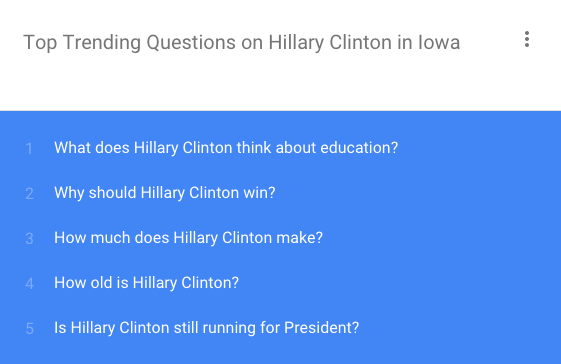
As Google data shows, many voters were last night asking "Why is Bernie Sanders so popular?" and the half-accusatory "Why should Hillary Clinton win?" (Along with other vital subjects…)

Yet we may look back on last night and the next week as the high point of the Sanders campaign.
Unless he can win more non-white voters he is likely to struggle.