Sometimes it seems as if victories for progressive social change are so few and far between and that protections such as fair pay and workplace rights are under such constant attack with the rise of zero-hours contracts that there is scant reason for optimism. So, when something emerges that challenges this state of affairs it deserves to be marked.
This is certainly the case with the efforts of the National Domestic Workers Alliance (NDWA) in the US and its indomitable director Ai-Jen Poo. When Poo was recently awarded a prestigious MacArthur “genius” grant the foundation explained that it was given for her role in “transforming the landscape of working conditions and labour standards” for some of the most vulnerable and marginalised workers in the States – namely the estimated 3 million domestic and care workers – housekeepers, nannies, and caregivers for older and disabled people.
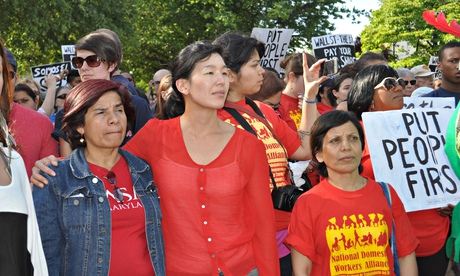
The transformation was no mean feat. In a sector where workers – most of whom are women – have historically been low paid, excluded from basic employment protections, denied rights such as maternity leave and sick pay and where abusive work practices have been commonplace Poo, along with thousands of workers, has forged a robust, truly change-making movement. That they have done so is all the more impressive as many of those involved have been immigrant workers taking great risks by speaking out. At its core, Poo explains, the struggle “is about dignity” and valuing the work that carers and domestic workers do but it is also linked to bringing about “big, bold, inspiring long-term change”.
Since the NDWA was formed in 2007 in New York City out of a grassroots campaign of mainly women and immigrant workers, what this improbable coalition – and the organisations it has formed alliances with ranging from employers’ networks to women’s advocates, and anti-poverty groups - has accomplished is extraordinary. All the more so bearing in mind the post-crash economy, the fact that wages for the average worker have been in decline for decades and that the trade unions have shrunk in size and influence.
Starting locally in New York, one of its major breakthroughs came with the introduction in 2010 by the state government of the Domestic Workers Bill of Rights.
This, according to the alliance, is what it meant: “For the first time in any state, domestic workers will be included in all of the major labour laws protecting other workers. This includes: overtime pay at time and a half your regular rate of pay, a minimum of one day of rest per week, protection from discrimination and harassment, and inclusion of part-time workers in disability laws.”
A number of other states, including California and Massachusetts, have subsequently introduced similar bills.
Last year, the NDWA also helped bring about the landmark decision by the federal government to introduce new rules that would extend rights such as paid breaks under the Fair Labour Standards Act to up to two million home healthcare workers nationwide, such as personal care assistants and nursing assistants.
As well as lobbying for change, the organisation encourages grassroots campaigning and mobilises thousands of workers to tell their own stories. Meanwhile, in less than a decade the NDWA has extended its reach and representation across the US to 26 cities and 18 states.
What has been achieved so far is remarkable, but Poo nevertheless cautions that “there is much more to be done”. The hurdles to change that she identifies for the immediate future should resonate beyond the US because they are not just about improving workers’ rights, but creating a wider consensus about how we value people.
She says: “The dominant notion that anything that requires a public investment is a bad thing is so toxic. We have to kick back at the economic narrative that drives the political narrative that we can’t afford to do certain things.. We have the wealth to meet the challenges, we just need the political will do so. Our work is about building a broad enough movement of people here to create the public demand for the kind of ambitious social change that we want to do.”