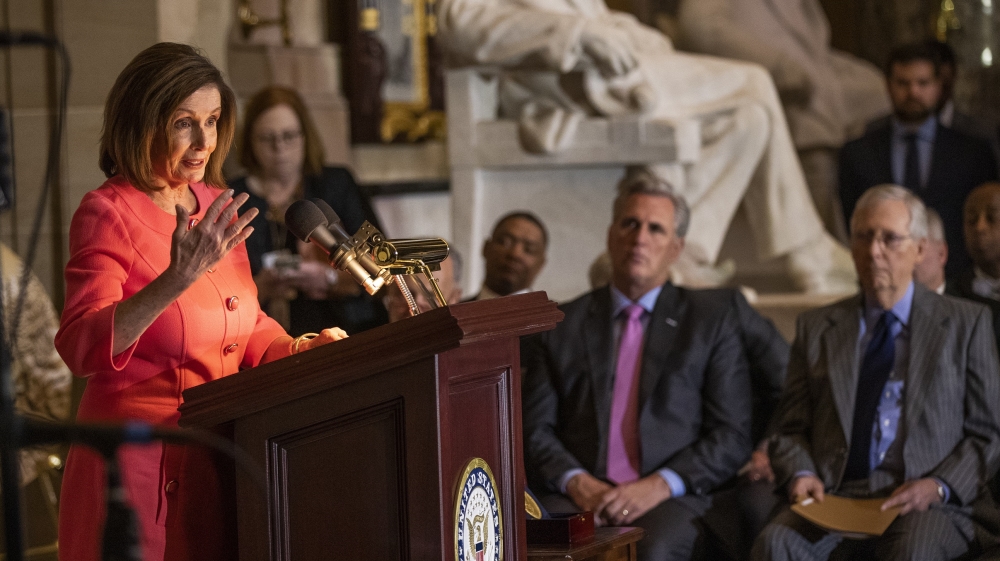
Washington, DC, United States - House Speaker Nancy Pelosi on Thursday announced the formation of a special committee of the US House of Representatives to oversee more than $2.2 trillion in spending that Congress has authorised to respond to the coronavirus.
The special oversight panel will ensure that the more than $2 trillion - and any additional funds Congress may provide - "are spent wisely and effectively," Pelosi said in a conference call with reporters.
More:
-
How many coronavirus cases does each US state have?
-
New York governor begs for help as coronavirus death toll climbs
-
Coronavirus: Trump pivots back to attack mode against critics
To be chaired by Representative Jim Clyburn, the third-highest-ranking Democrat in the House, the panel "will protect against price gouging, profiteering and political favouritism", Pelosi said.
"It will press to ensure that the federal response is based on the best possible science and guided by the nation's best health experts," Pelosi said.
The committee will have the authority to issue subpoenas to examine all aspects of the federal response to coronavirus, and to assure "taxpayers' dollars are being wisely and efficiently spent," she said.
Congress passed an historic $2.2 trillion rescue package last week, the third bill passed in response to the coronavirus pandemic.
Two earlier pieces of legislation provided emergency $8.3bn funding for healthcare providers and open-ended funding for expanded unemployment and welfare benefits for workers.
More than 280 million Americans are presently living under stay-at-home orders, effectively shutting down much of the nation's economy.
Unemployment has surged, with nearly 10 million workers filing jobless claims in the past two weeks. That already exceeds the 8.7 million jobs lost during the 2007-2008 financial crisis.
"Our nation faces an historic health and economic emergency as we confront the coronavirus epidemic," Pelosi said, outlining education and housing priorities for an infrastructure bill to help the US recover. "We need more for a strong recovery," she said.
President Donald Trump has indicated he supports an infrastructure spending bill of up to another $2 trillion, but Republicans in the House and Senate have signalled a reluctance to move on it.
Senate Republican leader Mitch McConnell said on Tuesday that he wants to take a wait-and-see approach to gauge how the spending Congress has already authorised works its way into the economy.
House Republican leader Kevin McCarthy told reporters in a conference call on Thursday that it's too soon to start talking about a fourth emergency spending bill.
"The Speaker is trying to talk about a fourth bill. I don't think that's appropriate right now," McCarthy said.
"The focus of the House right now should be, how do we implement it, how do we get it right," McCarthy said.
In addition to the special oversight committee for the emergency spending, some House Democrats are talking about authorising a commission to review how the pandemic caught the US by surprise.
House Intelligence Committee Chairman Adam Schiff is proposing legislation that would set up a bipartisan commission to review how the virus outbreak got started and how the Trump administration responded.
The commission would be similar to the 9/11 Commission established by Congress after the September 11, 2001 attacks to investigate the intelligence failures and other lapses that left the US unprepared.
To make the review as bipartisan as possible, it would be comprised of people from both political parties who are not currently in government and would probably start work early next year, after the November election.
"Obviously they were very ill-prepared for this pandemic," Schiff said in a US television interview on Wednesday.
"When it became publicly known, which was as early as late December, and then reports started coming in in January, of this new respiratory virus in China, we lost precious weeks in getting the testing ramped up," Schiff said on MSNBC.
"We weren't really prepared before this crisis hit. When it did hit, the administration moved very slowly. The president, even into March, was downplaying the significance of this and comparing it to the ordinary flu and talking about people being back in church by Easter [April 12]," he said.
Trump has been holding daily press briefings at the White House to inform the public of steps the administration is taking to address the crisis.
Government scientists warned at a White House briefing on Tuesday that the US could be facing between 100,000 to 240,000 deaths from the coronavirus.
More than 5,600 US deaths have been recorded from the coronavirus as of Thursday, according to researchers at Johns Hopkins University.