Good morning, I’m Tim Walker with today’s essential stories.
President denounces ‘ridiculous partisan investigations’
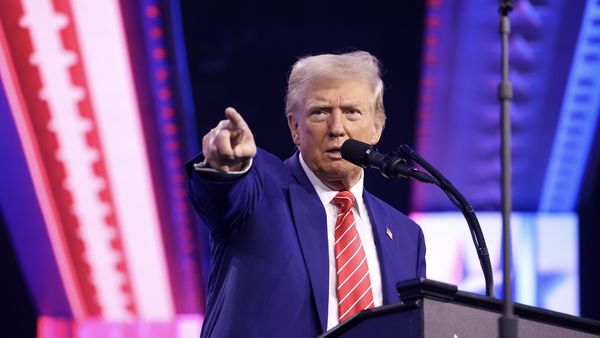
Donald Trump began his second State of the Union address on Tuesday by calling on both parties in Congress to “embrace the boundless potential of cooperation”. But the rest of his speech did little to encourage unity as he threatened the economy would be harmed by “ridiculous partisan investigations” – an apparent reference to the Mueller inquiry – and restated his commitment to building a wall on what he called the “lawless” US-Mexico border: the very issue that caused the recent government shutdown and saw the State of the Union delayed by a week.
North Korea. Trump confirmed he would meet Kim Jong-un for a second summit in Vietnam at the end of February, also suggesting that, without his presidency, the US would now “be in a major war with North Korea”.
Key takeaways. Sabrina Siddiqui identifies five key points in Trump’s speech, from his foreign policy pledge to avoid “endless wars”, to a preview of his 2020 campaign strategy.
Women in white lead opposition to Trump’s agenda
Trump earned a rare standing ovation from the whole chamber when he noted the progress of women in the US workforce – including those in Congress, at least 100 of whom had worn “suffragette white” partly as a rebuke to his leadership. Meanwhile, it was Stacey Abrams – the recent loser of Georgia’s close and controversial gubernatorial race – who delivered the Democratic response to Trump’s speech, saying “immigrants, not walls”, make the country stronger.
Trump the unifier? Richard Wolffe argues that the president has, in fact, succeeded in bringing Washington together over the past 12 months – in horror.
Brazilian dam workers warned of disaster before deadly collapse

More than 140 people are dead and almost 200 still missing after the collapse of a dam in January at a mining facility near Brumadinho in Brazil’s Minas Gerais state. Three mine workers told the Guardian they warned of a disaster after the dam suffered a leak last July, which they say compromised its safety. It was the second fatal dam collapse in under four years at a facility owned by the Brazilian mining multinational Vale, whose spokeswoman said in an email that “there was no leak in the dam” at Brumadinho.
Mining waste. Some 600 people were in the mine’s canteen and administrative area when the dam collapsed on 25 January, releasing 11.7m cubic metres of waste mud and ore.
LGBTQ domestic abuse victims unprotected in North Carolina

The attorney general of North Carolina, Josh Stein, has told the Guardian it is time to fix his state’s statute regarding domestic violence, which currently applies only to people whose abusers are “persons of the opposite sex”. That makes the tar heel state the last in the US to take a domestic violence victim’s sexual orientation into account when considering whether they can access a protective order, as Alexandra Villareal reports.
Southern comfort. South Carolina and Louisiana both extended their domestic violence protections to LGBTQ people in 2017.
Crib sheet
Elizabeth Warren has apologised “for furthering confusion on tribal sovereignty and tribal citizenship” after the Washington Post reported that she listed her race as “American Indian” on her registration for the Texas state bar in 1986.
A red carpet event for the New York premiere of Liam Neeson’s film Cold Pursuit was cancelled on Tuesday after the actor’s admission that he once sought to kill a black man after a friend told him she had been raped by a black attacker.
A 21-year-old woman has died from smoke inhalation in Nepal after being forced to sleep in a windowless shed because she was menstruating. She is the fourth person known to have died already in 2019 as a result of the illegal practice, known as chhaupadi.
Environmental campaigners have offered Pope Francis a $1m donation to the charity of his choice if he accepts their challenge to go vegan for Lent.
Listen to Today in Focus: rescued from Syria after Isis fell
Mahmud and Ayyub Ferreira were abducted by their father in 2014 and spirited to Syria to live under the Islamic State. Human rights lawyer Clive Stafford Smith and the Guardian’s Joshua Surtees explain how they helped reunite the boys with their mother.
Must-reads

The inside story of Friends
Twenty-five years after its TV debut, Friends is a mega-hit for a second time as the world’s most-streamed show. Sirin Kale hears the behind-the-scenes history from its supporting cast and crew, while young Guardian readers explain why it still strikes a chord.
Parkland’s drama students start over
A year after the shootings at Stoneman Douglas high school in Parkland, Florida, HBO is airing a new documentary that follows the school’s drama students as they rehearse for their annual children’s musical in the shadow of the tragedy. Adrian Horton reports.
Forget standing desks and get moving
Doctor James Levine, a leading expert on sedentary behaviour, sparked the trend for standing desks. But now he says most people missed the point: “It’s not the furniture that makes the difference” to health, he tells Christopher Keyes. “It’s the behaviour.”
How globalised music created a new kind of star
The rise of acts such as the Korean boyband BTS and the Puerto Rican singer Ozuna means English is no longer pop’s lingua franca. The likes of Katy Perry and Justin Timberlake are being replaced by global stars oblivious to genre boundaries, writes Caroline Sullivan.
Opinion
Washington and Moscow have mutually withdrawn from the nuclear weapons treaty that kept Europe safe for 30 years, a move that demonstrates Trump’s disdain for the EU. Yet the response in Westminster has been muted by Brexit, says Rafael Behr.
A global monument to the triumph of diplomatic rationality over militaristic paranoia is being pulled down.
Sport
Bryce Harper and Manny Machado are two of the best hitters in the MLB, yet both men remain without a team just a week before Spring Training. That’s because no team is prepared to pay for them, says Hunter Felt, despite the league pulling in $10bn a year.
MLS and the Scottish Premiership are both unable to compete financially with the big European leagues, which is why they have developed an unexpectedly close transatlantic relationship, writes Graham Ruthven.
Sign up
The US morning briefing is delivered to thousands of inboxes every weekday. If you’re not already signed up, subscribe now.
Support the Guardian
We’d like to acknowledge our generous supporters who enable us to keep reporting on the critical stories. If you value what we do and would like to help, please make a contribution or become a supporter today. Thank you.