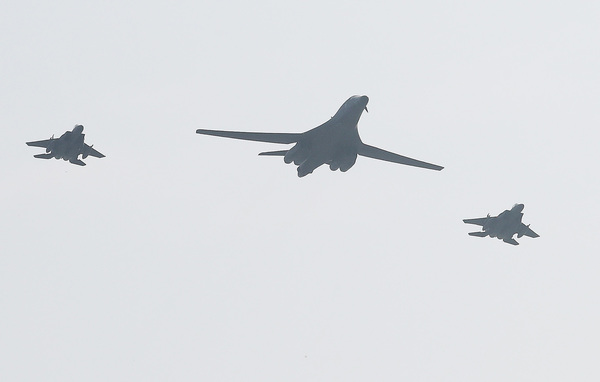
TOKYO _ Two U.S. Air Force B-1B strategic bombers capable of delivering an atomic weapon conducted training with both Japan and South Korea on Tuesday in response to North Korea's fifth nuclear test last week.
The Guam-based bombers trained with Japanese aircraft, which later conducted a handoff in international airspace with South Korean fighter jets, according to a statement from the U.S. Forces Japan. The American and South Korean aircraft then conducted a low-level flight in the vicinity of Osan, south of Seoul, it said.
"These flights demonstrate the solidarity between South Korea, the United States, and Japan to defend against North Korea's provocative and destabilizing actions," U.S. Pacific Command chief Harry Harris said in the statement. "North Korea continues to blatantly violate its international obligations, threatening the region through an accelerating program of nuclear tests and unprecedented ballistic missile launches that no nation should tolerate."
The U.S. and its allies have threatened to increase sanctions against North Korea, which has increased the frequency of ballistic missile and atomic-weapon tests in a bid to establish a credible nuclear deterrent. China, the main ally of North Korea, on Monday questioned the effectiveness of sanctions and called on the U.S. to help ease tensions.
The B-1B Lancers, long-range supersonic strategic bombers, returned to Guam after the flight over South Korea, according to the statement.
The U.S.-Japan exercise was the first of its kind in response to a North Korean provocation, according to Major John Severns, a spokesman for the U.S. Forces Japan. "Today's operation was a novel example of the capabilities of all three nations," he said by email.
The U.S. flew a B-52 long-range bomber over South Korea in a similar show of force after North Korea's fourth nuclear test in January.
Separately Tuesday, the U.S. reconfirmed its commitment to defend South Korea against North Korean threats, saying in a statement after a meeting of the nations' defense officials that it has "extended deterrent capabilities, including conventional, missile defense, and nuclear capabilities."
"The U.S. also reaffirmed its long-standing policy that any attack on the United States or our allies will be defeated, and any use of nuclear weapons will be met with a response that would be effective and overwhelming," according to a statement released by South Korea's Defense Ministry.