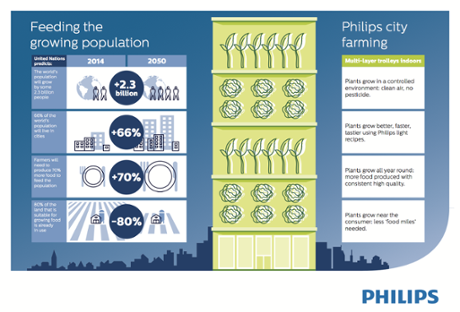
By 2050, some 70% of the world’s population will live in cities. At the same time the amount of land suitable and available for growing food will be less. An estimated 109 hectares of new land (about 20% more land than is represented by the country of Brazil) will be needed to grow enough food to feed the growing population, if traditional farming practices continue as they are practiced today. As a result, we need to grow more food and we will need to manage it in a better way.
The extreme weather patterns across the world have devastated crops and created higher food prices. Due to poor practices in harvesting, storage and transportation, as well as market and consumer wastage, it was estimated that 30–50% (or 1.2 to 2bn tonnes) of all food produced never reached human stomachs in 2013.
It is becoming more difficult for farmers to keep up with urban growth and at the same time, consumers are becoming more conscious of how their food is being produced. This is driving innovation of new farming technologies that allow plants to grow without sunlight in indoor environments close to or within cities.
Growing food in an urban environment is a rapidly emerging trend that helps to counter city decay and at the same time applies the circular economy principles. The new way of living in the future requires us to grow more food using minimum space, grow it using the minimum amount of pesticides to keep us healthy, and deliver it in the most minimum distance possible..
Reducing the mile from farm to fork
The land available for vegetable growing in Europe is dropping every year. At the the same time occupation of office buildings in Europe is declining. In the Netherlands, the number of vacant offices was estimated to reach a quarter this year, according to a survey by the Dutch ABN AMRO bank, with flexi-working as the main reason.
Inspired by circular economy thinking, many farmers and companies have already started considering alternative spaces like supermarkets, distribution centres or even office buildings as modern city farms. New technologies in LED lighting have made city farming possible by helping grow crops sustainably in relatively small places, indoors, in multi layers and in shorter times. One can only imagine the benefits if only 20 buildings dedicated to city farming would be sufficient to provide the whole city of New York with fruit and vegetables. City farming will also help the environment by keeping transport to a minimum when locally grown products are again closer to city dwellers’ forks.
Green Sense Farms, a Chicago-area commercial grower, has developed one of the largest indoor commercial farms using LED grow lights tailored to their specific crops. This innovative farming model allows them to harvest 20-25 times a year, using 85% less energy. As a result, it has seen an increase in crop yields and reduced operating costs, while being able to provide consumers with locally grown, fresh vegetables throughout the year.
Grow wise and bright in your office
Philips has been active in horticultural lighting since 1936 and is now using its leadership in LED lighting to develop food production for future that addresses a number of trends and concerns in society: awareness of how the food we eat is grown, the effect it has on our planet and the distance it travels from farm to fork.
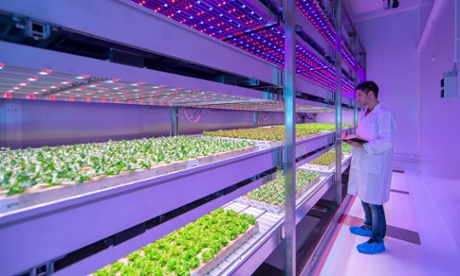
The recently established Philips GrowWise City Farming Center located in Eindhoven, The Netherlands, features four-layered mechanized planting racks in each of its eight climate rooms resulting in a total growing surface of 234 square metres. Each plantation layer at the facility has Philips GreenPower LEDs installed, that contain blue, red and far red LEDs and are designed and formulated specifically for growing crops and allow for the fine tuning of tailor-made light treatment. In addition, because LEDs run at cooler temperatures, they will be placed closer to the plants and optimally positioned, ensuring complete uniform illumination of the plant.
Food production in unoccupied buildings will never meet the demand capacity, but are foremost meant to bring citizens closer to nature. It will shape the city’s identity as people again interact in their neighbourhoods and utilize spaces which otherwise may become redundant.
It is 5.30pm – have you plucked your salad on your way down from the board room?
Content on this page is paid for and produced to a brief agreed with Philips, sponsor of the circular economy hub