If you stand on one of Australia’s southern shorelines at this time of the year, you might be lucky enough to spot a southern right whale (Eubalaena australis) swimming in the shallow waters.
These ocean giants have migrated from the Southern Ocean and Antarctica to breed, give birth and to rest. If you’re really lucky, you may even see one of them resting upside-down.
At first glance, this perplexing behaviour, which has not been reported in other large whales, may make you think the animal is sick or injured. But our new paper, published in the journal Mammalian Biology, suggests quite the opposite.
It may actually be an indicator of a healthy mother carefully managing her energy reserves during one of the most energetically demanding periods of her life.
A balancing act
Southern right whales migrate long distances, greater than 6,000 kilometres. That’s like travelling the distance from Perth to Sydney … and back.
If that didn’t sound difficult enough, southern right whales are not feeding when they are on the calving grounds in Australia. The whales are known as capital breeders, meaning they feed intensively for half the year on their feeding grounds, before migrating to their calving grounds where they rely on stored energy in their blubber.
Mothers with newborns require the largest amount of energy compared to others. They therefore face a delicate balancing act to conserve enough energy to be able to return to the feeding grounds while producing enough milk to feed their hungry, growing calf.
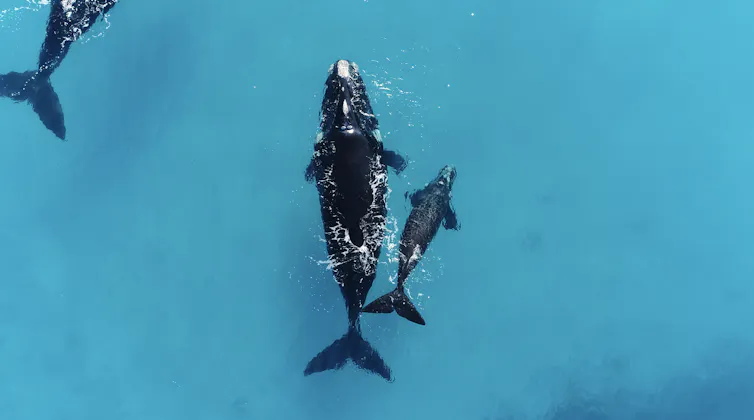
To better understand this balancing act, we took to the skies with our drones to film the behaviours of whales along the Great Australian Bight.
Hundreds of drone flights and many batteries later, we collected hours upon hours of footage of the whales nursing and resting.
What really sparked our interest was an unusual behaviour we observed: whales lying upside-down on the surface or just below the surface.
To our knowledge, no other large whale has been recorded resting this way.
Why do southern right whales rest upside-down?
The first clue as to why the whales are resting this way lies in who is resting this way.
Whales who were observed resting upside down were only mothers with newborn calves and one mother who was in the late stages of pregnancy. The behaviour wasn’t observed in other adults, juveniles or calves.
We saw this behaviour in 25% of the mothers we observed, suggesting this behaviour may be linked to the energetic demands of reproduction. When these mothers did rest this way, they did so for roughly 19% of their time we followed them.
One reason for this behaviour could be that upside-down resting helps mothers regulate how much milk they feed their calf.
When mothers rest upside-down, the calf is unable to reach their mammary slits where the milk is. Mothers therefore may rest in this position when they are feeling low on energy and need a break.
Another possible reason for mothers to rest upside-down is to help prevent overheating.
Unlike some other whales and dolphins, these whales completely lack a dorsal fin. Dorsal fins often play an important role in controlling internal temperature, by exposing blood vessels that are close to the skin to the cool air.
By lying upside-down at the surface and exposing her belly and pectoral fins out of the water, she could be increasing the surface area of skin that’s in contact with the sea breeze, helping her cool down, like us dipping our legs in a cold pool on a hot day.
Beauty sleep at a cost
Regardless of its purpose, upside-down resting places southern right whales in a vulnerable position.
Rotating the right way up is no easy feat, especially when you can weigh upwards of 40 tonnes. By resting the “wrong way up”, it takes the whale longer to rotate to breathe and swim away quickly if a threat approaches (such as boats or ships).
As southern right whale populations stall and are yet to recover from historical whaling, understanding unique behaviours such as upside-down resting help inform how we better protect this species.
If you are lucky enough to see a southern right whale resting upside-down this winter, remember these animals are undertaking one of the most energetically demanding periods of their lives and it’s best to give them space and not disturb them.
Take a moment to appreciate how perplexing and unique this behaviour is. You are one of the few people to witness one of Australia’s upside-down resting whales.
This article was originally published on The Conversation. Read the original article.