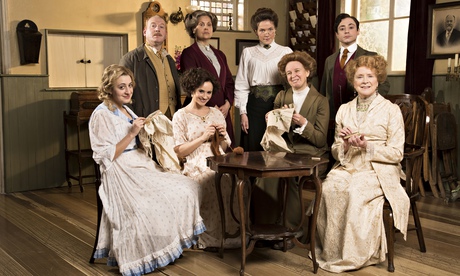
The women of the Banbury Intricate Craft Circle (Politely Demands Women’s Suffrage) are on hunger strike in support of their suffragette sisters languishing in prison. But the temptations of the flesh prove too much in Jessica Hynes’s hugely enjoyable Up the Women (BBC2). With an impressive female cast, including Judy Parfitt, Emma Pierson and Vicki Pepperdine, the comedy, set in 1910, also features a typically commanding turn from Rebecca Front as iron-knickered, stick-in-the-mud Helen – the only suffrage naysayer among the women who meet regularly to eat cake, do their samplers and discuss the fight for equality. They are led by Margaret (Hynes), a passionate blue-stocking whose dreams of joining the movement are frustrated by adherence to social convention and, more often, cowardice.
For a comedy about suffragettes, Up the Women actually had little to do with the women chaining themselves to railings, instead focusing on the ones who didn’t quite make it to the frontline. Basically, Dad’s Army complete with village hall setting and motley band of social oddments, playing at war. Instead of going to prison and marching on parliament, the craft circle busied themselves with the minutiae of Edwardian life, occasionally playing at activism but with little commitment. Hence the hunger strike that ended abruptly when Gwen (Pepperdine) arrived with a backpack full of cheese.
Following its move from BBC Four (the first series was a three-episode run on the channel), a few more dodgy puns have appeared. But the core of the show remains Hynes’s strongly drawn characters, with Margaret in particular standing out as a sort of kindly Captain Mainwaring, full of high ideals but ultimately lacking the courage to make a stand. On her well-intentioned hunger strike, she confides in her diary: “Where once I gave a bun scant attention, now it haunts my every thought.” It transpires that she abstained for only an hour.
Meanwhile an arranged marriage was in the offing for young Emily (Georgia Groome), Helen’s spirited daughter. When she resisted, Helen thundered: “A young girl of society should be concerned with hemlines, table mats and the cost of iron ore, not wasting her youth changing the world.” The dialogue was peppered with frequent little joys of unforeseen silliness and just the sound of women using long words without apology was exciting, never mind the commissioning of a sitcom written by and starring some of the funniest females in the country. Long may it continue.
The quest for women’s suffrage aside, another woman was engaged in a seemingly ridiculous quest of her own, to find a horse called Martin. In Kyrgyzstan. In The Secret Horse: Quest for the True Appaloosa (BBC4), Scott Engstrom, a stud-farm owner living in New Zealand, had for years been determined to prove that her favourite breed of horse, the True Appaloosa, originated not in Spain, as was commonly thought, but Asia, hoofing its way across the Bering Strait in ancient times to reach American soil.
While watching a TV programme filmed in Kyrgyzstan, Engstrom spotted an Appaloosa horse and sprang up from her chair. She tracked down the presenter of the programme, Conor Woodman, and convinced him to join her in a search for that horse.
When the trail to Martin went cold, she and Woodman trekked through one of the world’s highest mountain ranges on horseback to reach a tribe of nomads believed to be herders of the mysterious breed. Only Engstrom cared whether she found these horses and retrieved a DNA sample to prove her theory, but thanks to Woodman’s careful pacing of the story, I who have no feelings about horses, wanted and needed her to succeed.
The adventure became increasingly ridiculous, from a visit to a shaman, to a recently crashed lorry leaking petrol by the side of the road, to the gradual revelations about Engstrom’s incredible life: five husbands, the beloved horse she lost to a lightning strike and now this far-fetched quest through the wilderness. She was a country song waiting to be written.
Finally, with 10 minutes left, an exhausted, altitude-sick Engstrom spotted the fabled herd and I wanted to gallop round the paddock whinnying with joy myself. Such a strange, specific tale that unexpectedly burrowed into my heart.
• This article was amended on 22 January 2015 to correct the spelling of Conor Woodman’s name, from Connor as an earlier version said.