The potential size of the social enterprise market is a topic the sector has found difficult to answer, but if our new research is anything to go by, it could well be significant.
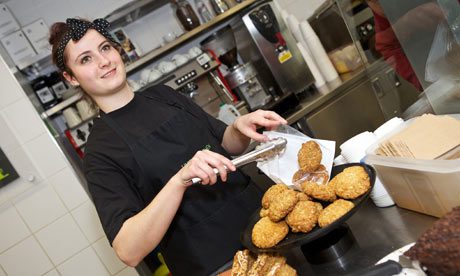
While we at the Camden Society have been helping people with disabilities to access employment and training since the 1980s, it's only more recently that we created Unity Kitchen as a self-sufficient social enterprise to generate trading income to fund training opportunities, employment and paid Apprenticeships.
And as we have expanded, we wanted to explore the potential market for social enterprises like ours and carried out research to get a clearer idea of the scope for expansion. We were very pleasantly surprised by the results!
The public want more choice for their lunch and want to feed their social conscience as well as their hunger. And we believe social enterprises can help make this a reality.
Our research with ICM found that 3% of people working in the UK currently bring their lunch in from home everyday, but given the choice they would buy it from an outlet that benefitted their local community in some way.
It might sound like a relatively small percentage, but when you apply this to the entire workforce, we're talking about over 700,000 people. And based on our research suggesting those who do currently buy lunch while at work spend £4.54 a day on average, this tots up to a new market worth over £3.3m every day.
In order to cater for this new group buying lunch while at work , more than 5,500 new catering social enterprises would be needed which, based on the size of our Unity Kitchen outlets, would create over 38,500 new jobs for disadvantaged people around the UK.
Much as we would like there to be 5,500 new Unity Kitchens, unfortunately it is not really something a charity of our current size could achieve single-handedly overnight.
We believe our findings reveal a significant window of opportunity for anybody involved with, or interested in, the social enterprise sector. We wanted to share our findings to encourage other similar organisations to make the most of this window of opportunity and tap in to this market.
There are three things that need to happen to seize this opportunity: increased support from local and national government for new social enterprises, more charities to set up similar schemes and a commitment from local businesses and workers to use these outlets.
To address the first point, more local authorities need to take the lead of Southwark Council, who has helped us set up our largest outlet fulfilling the staff canteen and in-house catering contract for the Council's head office in Tooley Street.
When tendering for a new catering supplier in 2010, Southwark Council wanted a contract-provider which promised not just value for money, but also social value for money. Unity Kitchen fitted the bill and was appointed to fulfil its three-year catering contract.
As well as providing quality and affordable food, Unity Kitchen provides paid Apprenticeships and employment opportunities for people with learning disabilities living in the local area. And any profit is also reinvested in providing additional opportunities for people with disabilities across London.
Every Unity Kitchen opened creates new jobs for local people with disabilities, many of whom who were otherwise in receipt of day services funded by the Council, therefore saving taxpayers' money. For one lady in her early fifties, Unity Kitchen has provided the first paid employment she has ever had in her life.
The introduction of the Public Services Act 2012 earlier this year requires the public sector "to give greater consideration to economic, social or environmental wellbeing" when procuring services, placing greater impetus on local authorities, hospitals and schools to follow in the footsteps of councils like those in Southwark and Lewisham, which already commission our services.
This new legislation, coupled with public demand for more catering social enterprises, bodes well for charities and organisations like ours.
Time is ripe for enterprises that can make a valuable and positive contribution to the community while also meeting the appetites of hungry workers.
We hope our market research will help Unity Kitchen to create more opportunities for people with disabilities, and that by sharing our findings we'll give like-minded organisations the courage to do the same. This really is a win-win situation for everybody involved.
Denise Largin is chief executive of The Camden Society
This content is brought to you by Guardian Professional. To join the social enterprise network, click here.