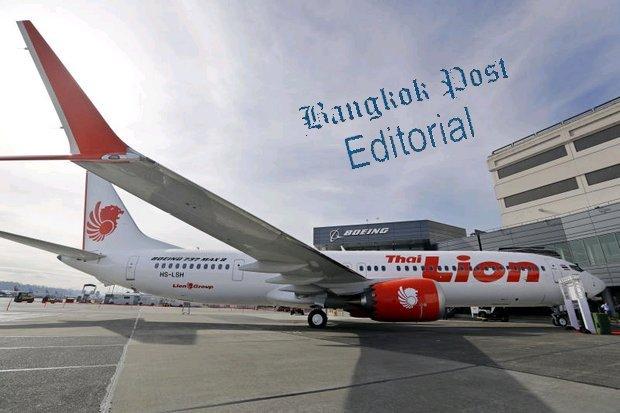
The second crash of the newest Boeing passenger jet should sound alarm bells throughout the aviation industry. In less than five months, two Boeing 737 MAX aircraft have dived suddenly, crashing and killing everyone aboard. The first such incident was last October, when an Indonesia Lion Air jetliner went down, killing 189 passengers and crew. Sunday's similar crash of an Ethiopian plane killed all 157 people aboard.
The crash of Ethiopian Airlines Flight 302 cannot be treated as simply another air accident. The investigation into the crash has not ruled out pilot error. There is always a chance of coincidence. But the two crashes of Lion Air and Ethiopian Airlines are so similar that extremely disturbing questions arise. First and foremost, for the millions of people who fly every day, is safety.
The statement on Monday by the chief of the Thai aviation regulator was therefore rather shocking. Chula Sukmanop, director-general of the Civil Aviation Authority of Thailand (CAAT) was asked what action he intended to take. For now, he said, there will be no action. He refused to order or suggest the grounding of the three 737 MAX aircraft flown by Thai Lion Air.
Such orders are admittedly serious, with heavy and costly implications for the airlines involved. And Mr Chula can cite other countries which have decided against grounding all Boeing 737 MAX aircraft. However, there are two important points raised by Mr Chula's far too offhand dismissal of the recommendation.
The first is that China grounded all 737 MAX aircraft immediately after the Ethiopian Airline crash. This is not a trivial matter. China is the most important customer of Boeing, and the new 737 jetliner is currently Boeing's most important airplane. Suspension of flights by Beijing -- and it was a mandatory order, not just a suggestion -- therefore has special weight.
The other troubling part of the CAAT chief's decision was the lack of justification. China said it was concerned about passenger safety and confidence, so it grounded the airliners. Canada's regulator, to cite one example, said the government was concerned but was awaiting more information before "jumping to conclusions". Only China, Ethiopia and Cayman Airways, which has two of the subject aircraft, have voted to ground their planes.
While both views are logical and defensible, the Thai regulator gave neither. He stated only that it is up to each country to decide whether to ground the plane. That is correct but demands more information. Mr Chula failed to give a reason for not grounding the three Thai Lion Air aircraft while investigations proceed on the very troubling two crashes.
So the situation for some Thai airline passengers boils down to the old adage of caveat emptor, buyer beware. The country's aviation regulator won't say if all flying is safe or whether some flights are riskier than others. Passengers have to somehow make up their own minds about flying in this particular model of aircraft.
The CAAT owes us a better answer. And so does Boeing. There were extremely disturbing stories after the Lion Air disaster of shoddy pilot training and missing information in flight manuals produced by Boeing. Airplanes are complicated machines and new aircraft are subject to bugs. Boeing is in danger of losing worldwide consumer confidence.