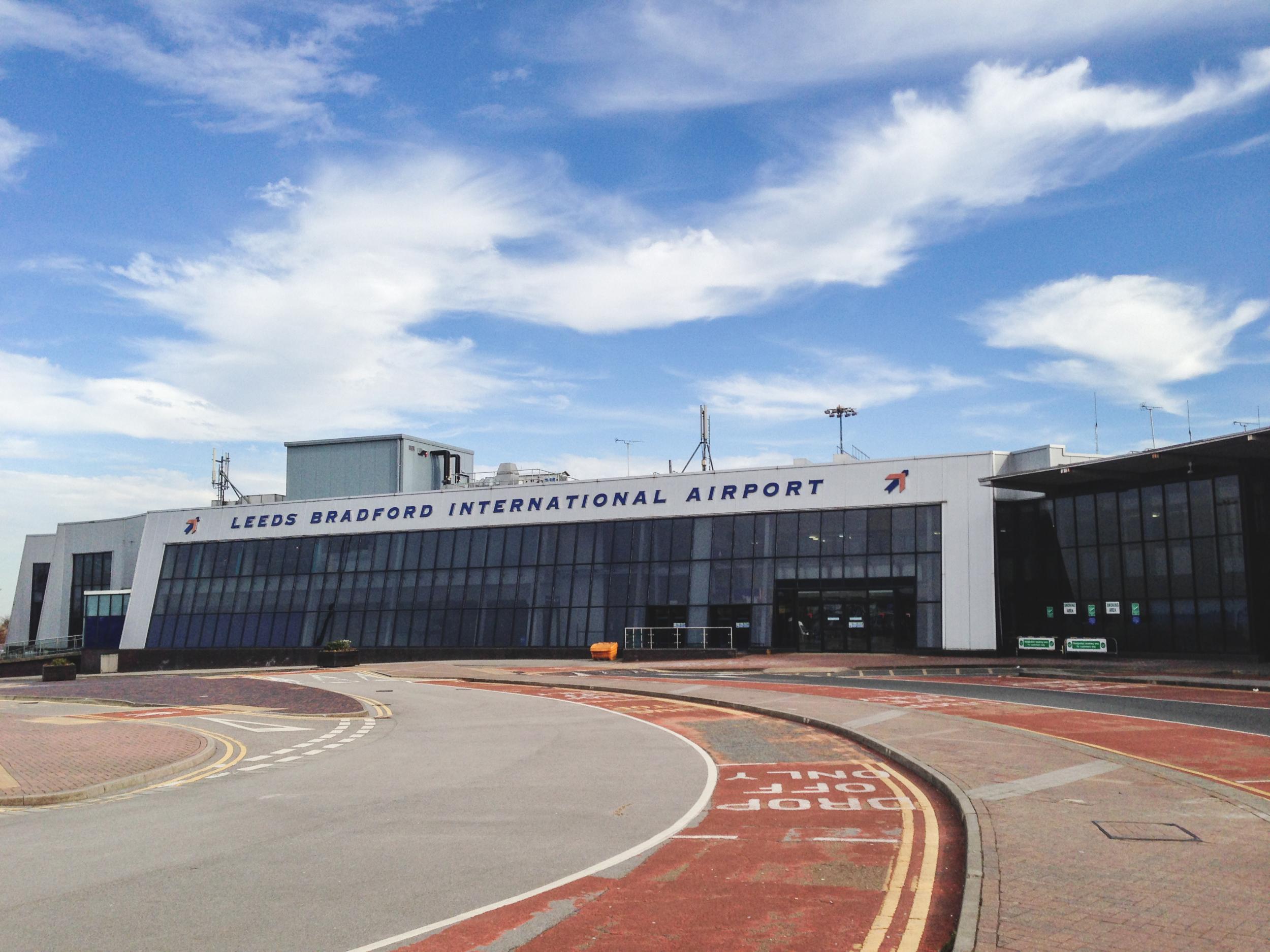
Incident occurred at Leeds Bradford airport
An unknown object came within 10ft of hitting an aircraft coming in to land at Leeds Bradford airport.
A report revealed that the object presented a “high” risk of collision with the plane during the incident on 1 September.
According to the UK Airprox Board, which investigates near misses between aircraft, “the object appeared without warning and there was no time to act.”
The pilots of the Boeing 737 both reported seeing a bright light and an object which appeared to be moving towards the jet, “almost head on, slightly up and to the left”.
Upon reporting the incident, the pilots were told by Air Traffic Control (ATC) that the police helicopter had earlier observed lanterns in the area.
However, neither pilots believed what they saw was a lantern.
The near-miss was categorised as “A”, the highest risk level.
Just three days later, on 4 September, another “A” level incident was recorded.
As an Airbus A320 jet was taking off from Manchester Airport, the pilots reported seeing what appeared to be a large drone, which passed so near to the plane that it only “narrowly” missed hitting the nose and windscreen.
The drone was reported as being about 50cm in length, blue in colour, and appearing to weigh around 10kg.
It passed close to the First Officer’s windscreen, according to the pilot, and was spotted when the aircraft was flying at 8,000ft – 20 times the legal flying height for drones in the UK (400ft).
The incident was recorded as presenting a high risk of collision.
“The Board considered that the pilot’s overall account of the incident portrayed a situation where providence had played a major part in the incident and/or a definite risk of collision had existed,” said the report.
In 2019, there were 328 “airprox” incidents – where an aircraft has a near-miss with another aircraft or an object – amounting to an average of around six incidents a week, or almost one per day.
Some 146 of these were considered to carry a risk of collision, meaning that, on average, “there was either a risk of collision in UK airspace or safety was much reduced below norms about two to three times a week.”