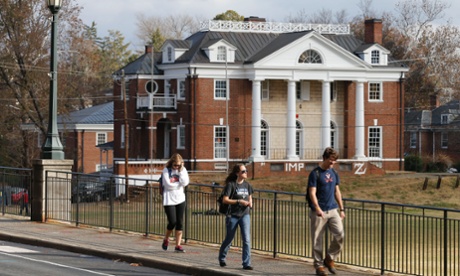
The leadership of fraternities on the University of Virginia campus say they support the decision to suspend all Greek activity until January, a move announced by the university’s president over the weekend following a Rolling Stone account of a brutal planned gang rape at the Phi Kappa Psi house.
“It makes me personally sick to my stomach to think about what happened that one night in that specific frat house,” the Inter-Fraternity Council president, Tommy Reid, told reporters on Monday morning, according to the school’s newspaper. Reid said the suspension will give the Greek community “time to develop” but it isn’t a solution in itself.
On Saturday, the university’s president, Teresa Sullivan, announced that all Greek activities are suspended until 9 January. In the same statement, she called on students to contribute to a revised student sexual misconduct policy.
“We need the collective strength of the members of our community to ensure that we have the best policies,” Sullivan said in a statement on Saturday.
Rolling Stone’s story has caused a furor on campus, where it reported that students are pressured to remain silent about sexual assault, and that administrators are more interested in protecting the school’s reputation than in helping victims.
The story also described what appears to be a planned gang rape at the Phi Kappa Psi house in September 2012, in which a female student alleges she was assaulted by seven men.
Charlottesville police have also been called upon to investigate, though so far only protesters have been arrested on campus. Police said that two men and two women were arrested on Saturday, after allegedly refusing to leave the Phi Kappa Psi portico.
Pressure on the university to resolve the matter is likely to be intense, not only from students and the media, but federal government regulators who control the university’s purse strings.
The US Department of Education began investigating the University of Virginia for Title IX violations in June 2011. The federal law requires American schools to provide learning environments free from harassment, and ties compliance to federal student aid funding at colleges and universities.