In June 2012, the process improvement unit at Sheffield was established to help the university improve its business processes. We worked with the student counselling service to improve both wait times and the referral of services.
The challenge
We were approached by the counselling service to help reduce their waiting lists, ensure clear referral to the range of services they offer, and use their space in the most efficient way. We held a four day rapid improvement event with staff from all parts of the service. At the end of the event, the team identified a new process whereby students would have a simple online registration and be offered an half an hour triage appointment within 10 working days.
The team also identified improvements to the waiting room which was converted into a self-service area for students, and a further improvement to hold informal sessions to support students using the self-help resources. They are now operating without a waiting list, removing a huge administrative burden from the service and offering a vastly improved service to students.
The team worked incredibly hard to get things in place for the start of term. The achievements so far are:
• More students (19%) seen compared to 2012-13
• Fewer missing appointments (reduced by 53%)
• Greater clinical autonomy for counsellors to manage their own caseload
Process improvement – why it's important
We're here to help the university run the most efficient processes it can, so that more of its resources can be spent on learning, teaching and research. We were created as a response to external pressure for greater efficiencies in universities (see the 2011 Diamond Report) and in response to other institutions such as Cardiff and St Andrews demonstrating success with lean methodology.
Staff and students at the University of Sheffield want to spend more time on value adding activities and ensuring that we do things as efficiently as possible, so that we can continue to grow our services. There is an understanding that increasing student numbers, greater regulation and financial pressures mean that we must operate with less waste.
What we do
We facilitate process improvement projects, run training in improvement tools and techniques, and are working with our steering group and others to develop a culture of process awareness and continuous improvement in the university.
We make processes more efficient by improving flow (reducing batching, reducing number of handovers in a process, error proofing), reducing variability (standardising processes), eliminating waste (removal of transport, overproduction making too much of something) and helping people to do things right first time (no rework).
Principles of process improvement
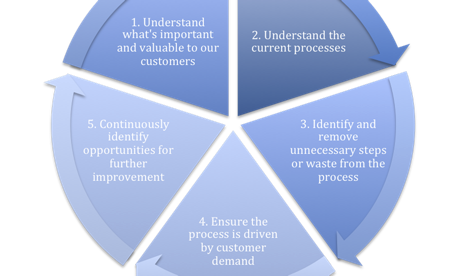
In practical terms this means that we try to create a process which does three things. Firstly, smooths out the peaks and troughs, secondly, does not rely on the supplier pushing the work through the system, but allows its customer (however defined) to pull the work, and lastly, treats with respect everyone involved in the process and its improvement.
Other examples of our work
We have worked with many areas in the university: projects have included improving the student change of status process (where a student can choose to change course, take a period of leave of absence etc); the maternity leave notification process (improvements have also been mirrored with the adoption; paternity and surrogacy processes); and payment of casual workers. To find out more take a look at:
• http://www.sheffield.ac.uk/piu/casestudies
• http://www.sheffield.ac.uk/piu/currentprojects
Rachel E McAssey works in the Process Improvement Unit at the University of Sheffield – follow it on Twitter @SheffieldUlean
Content on this page is provided by the Efficiency Exchange