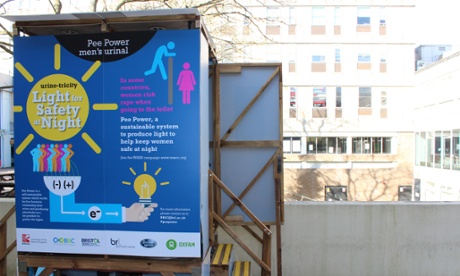
A prototype toilet has been launched on a UK university campus to prove that urine can generate electricity, and show its potential for helping to light cubicles in international refugee camps.
Students and staff at the Bristol-based University of the West of England are being asked to use the working urinal to feed microbial fuel cell (MFC) stacks that generate electricity to power indoor lighting.
The project is the result of a partnership between researchers at the university and Oxfam, who hope the technology can be developed by aid agencies on a larger scale to bring light to refugee camp toilets in disaster zones.
“We have already proved that this way of generating electricity works,” said research lead Professor Ioannis Ieropoulos, director of the Bristol BioEnergy Centre, which in 2013 demonstrated MCF stacks generating enough electricity to power a phone. “The project with Oxfam could have a huge impact in refugee camps.”
The technology uses microbes which feed on urine for their own growth and maintenance. “The MFC is in effect a system which taps a portion of that biochemical energy used for microbial growth, and converts that directly into electricity - what we are calling urine-tricity or pee power. This technology is about as green as it gets, as we do not need to utilise fossil fuels and we are effectively using a waste product that will be in plentiful supply,” said Ieropoulos.
The urinal - conveniently located near the Student Union bar - resembles toilets used in refugee camps to make the trial as realistic as possible. The equipment that converts the urine into power sits underneath the urinal and can be viewed through a clear screen.
Andy Bastable, Head of Water and Sanitation at Oxfam, commented: “Oxfam is an expert at providing sanitation in disaster zones, and it is always a challenge to light inaccessible areas far from a power supply. This technology is a huge step forward. Living in a refugee camp is hard enough without the added threat of being assaulted in dark places at night. The potential of this invention is huge.”
An estimated 6.4tn litres of urine is produced by humans across the globe every year, so researchers believe it has great potential as a cheap and readily available source of energy. Ieropoulos said the unit installed at the university would cost around £600 to set up.