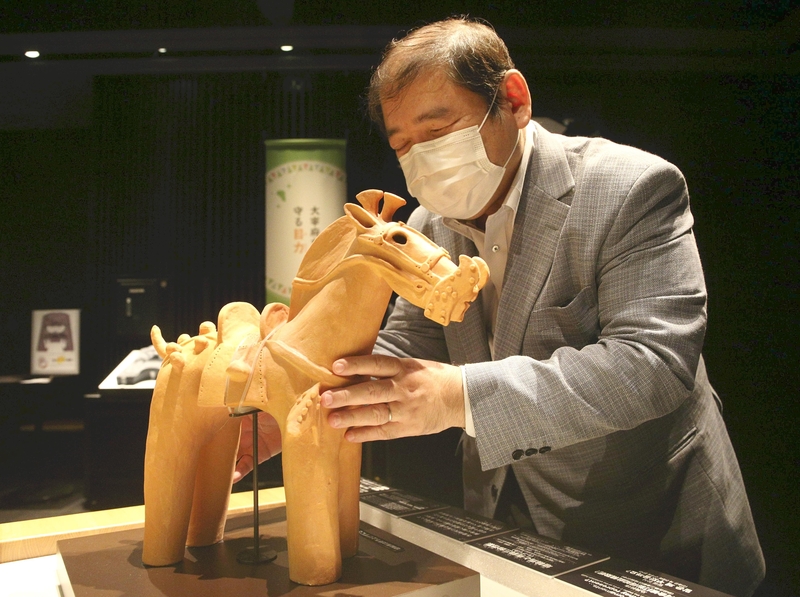
FUKUOKA -- In late July, Atsushi Fujikawa, a 59-year-old association official of Chuo Ward, Fukuoka, touched a replica of a horse-shaped haniwa clay figure dating back to the Kofun period (ca 300-ca 710) at the Kyushu National Museum in Dazaifu, Fukuoka Prefecture.
"The head is big," Fujikawa, who is blind, murmured. "I wonder if the thing protruding out is a harness."
Replicas of dotaku bronze bells and the head of a Buddhist statue are among other displays shown beside original items at a special exhibition titled "Narabete Wakaru Honmono no Himitsu" (The secrets of real items found through their comparison with replicas), which runs through Sept. 5. Visitors must disinfect their hands before touching the exhibits. Disposable plastic gloves are also available, and museum staff disinfect their hands on a regular basis to ensure thorough infection control measures.
"If more exhibits can be enjoyed through one's sense of touch, museums will become something familiar to the visually impaired," Fujikawa said.
Museums and art galleries are beginning to resume their showing of tangible exhibits, which had been postponed due to the spread of the coronavirus. This is driven by the idea of universal museums, where people can enjoy exhibits regardless of their disabilities and other needs. Amid fears of a fifth wave of the coronavirus, those involved in creating a universal museum are seeking a model for a place where everyone can experience culture.
The Kyushu National Museum held a similar exhibition last autumn but prohibited visitors from touching exhibits -- a departure from its initial plan.
"We now know the risk of contact infection can be reduced through thorough infection control measures," said Sayoko Kato, a senior researcher at the museum. "To make the museum enjoyable for everyone, we must display tangible exhibits."
Fukuoka is among the areas under a state of emergency to prevent the spread of the virus from Friday through Sept. 12. The museum said it will continue to implement infection control measures such as taking temperatures at the entrance, asking visitors to wear masks and restricting group visitor entries.
The National Museum of Ethnology in Suita, Osaka Prefecture, will hold the "Universal Museum: Exploring the New Field of Tactile Sensation" from Sept. 2. The exhibition, which focuses on tangible exhibits, was originally scheduled to be held last autumn but was postponed one year because of the pandemic.
Museum Associate Prof. Kojiro Hirose, the chair of the exhibition's organizing committee, has been involved in research and promotion of universal museums for about 20 years based on the belief that everyone should have the opportunity to experience culture.
Osaka Prefecture is under a state of emergency until Sept. 12 due to the spread of the virus.
"Holding an exhibition on the theme of contact during this time comes with responsibility," said Hirose, who is blind. "We want to take thorough measures such as disinfection to hold the exhibition."
He added it is meaningful to offer tangible exhibits while appropriately assessing the pandemic situation.
"I hope this special exhibition will be a good opportunity to spread the idea of a universal museum," he said.
Guidelines published in May last year by the Japanese Association of Museums in Tokyo state that although museums should avoid showing tangible exhibits, in principle, they can display them by introducing thorough infection control measures when necessary.
"More and more facilities nationwide are resuming showing tangible exhibits," said Masayuki Handa, executive director of the association. "From the perspective of a universal museum, we welcome the moves as far as they are held alongside thorough infection control measures. The association would like to support these facilities so they can share their work."
Read more from The Japan News at https://japannews.yomiuri.co.jp/