From ball bearings to the Alérion wood bicycle, from Papin’s pressure cooker to the web-enabled updated one by SEB, from the propeller to Dyson’s bladeless ventilation fan, the history of industrial technology and its many inventors and designers is a long one. Now, in a remarkable exhibition in Paris, Invention/Design, they’re all coming into fascinating focus.
Organised by Lyon-based Sismo Design, the show at the Musée des Arts et Métiers compares inventions of the 17th, 18th and 19th centuries with the work of modern-day designers. Unusually for an industrial design event, there’s only one chair on display, albeit something rare: a chair of stamped cookware metal created by celebrity designer Ron Arad.
In this age of 3D printers and knowledge-sharing, the question the exhibition poses is whether modern design is quite as innovative as either designers or we assume it is.
“All those famous thinkers, inventors and others industrialists who make up the history of technology – it’s through them that the designs of today get conceived,” says Antoine Fenoglio, who curated the show with his Sismo co-founder Frédéric Lecourt. “By bringing the two worlds together, we want to explain what our discipline is actually about: not just dressing up objects, but giving form to an understanding of the way things are.”
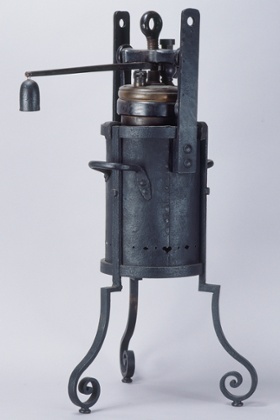
The exhibition features 100 objects from the collection of France’s Conservatoire Nationale des Arts et Métiers. At the entrance stands the famous pressure cooker invented by Denis Papin (1647-1712), next to several later versions including a 3kg Cocotte Henry IV (1949) and a Nutricook auto-cooker (2013) that has a built-in mobile app.
“Denis Papin was the first to be interested in the power of expanding gas,” Fenoglio explains. “He invented an autoclave called the steam digester that reduced animal bones to jelly, and yet he died a complete unknown, homeless, in London. Someone later took over his patent and turned the product into a kitchen device for SEB, the Société d’emboutissage de Bourgogne.”
More than three centuries later, the Papin cooker has evolved into one that now connects to the internet, but the essentials remain the same: a container strong enough to withstand pressure, a cover that locks in place, and a small valve for the steam to escape. The new device even echoes the original cooker’s handle, despite the fact it’s no longer used to close the pot. By sticking to tradition while updating the device, its designers seek to reassure consumers, allowing the new-look pressure cooker to take its place in the private domain of private kitchens.
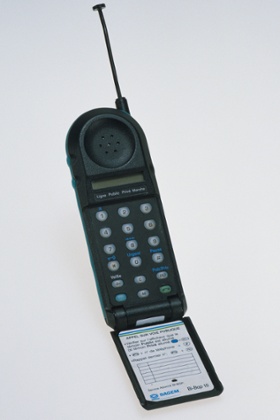
Inventions don’t always survive. Take the Bi-Bop (1991-1997), France’s first mobile phone. It never caught on, because to make or receive a call the user had to be near an outdoor telephone terminal. The first videophones weren’t a hit either, as businesses found the cost wasn’t worth the end result: heavily pixellated and hard-to-see faces. “They were forerunners of new technology but they arrived just a little too late and were overtaken by others,” says Lionel Dufaux, who manages the collection at the museum.
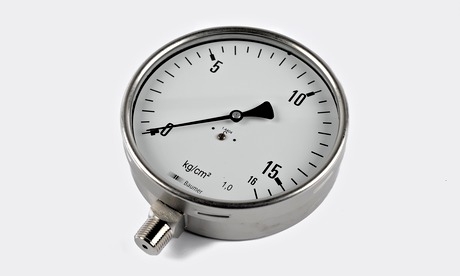
Sometimes it’s the simplest inventions that last the longest. The manometer, an instrument that measures pressure, hasn’t changed in shape or concept since it first appeared in 1855. Then there’s the wall-mounted CD player: Naoto Fukasawa designed it for Muji in 1999 “with an eraser”, keeping only what he deemed essential. With three basic controls – on, off, volume – it’s become a ubiquitous household item.
One other factor that helps inventions find their market is science fiction. In Stanley Kubrick’s 2001: A Space Odyssey (1968), Dr Floyd talks to his daughter back on Earth via videophone, a feat that later turned out to be entirely practicable. In Steven Spielberg’s Minority Report (2002), Tom Cruise stands in front of a giant computer screen and moves information around by waving his hands and pointing.
“From 2005 to around 2010 we saw a profusion of technical devices and gestural interfaces, all making more or less specific reference to that movie,” says Nicolas Nova, co-founder of the Near Future Laboratory, in Geneva. “That’s proof positive of how strong an influence science fiction can have.”
Breakthroughs in technology were often inspired by another, more basic source: nature. In 1897, for instance, French aviation engineer Clément Ader applied what he had learned from studying bats to come up with the Avion III, while in 1851 Joseph Paxton transformed his passion for water lilies into the architecture of the Crystal Palace of the Great Exhibition in London.
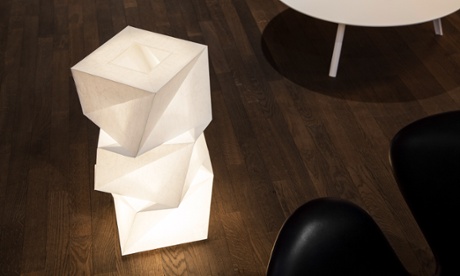
Others bridge disciplines. Japanese fashion designer Issey Miyake uses mathematics to come up with his origami-style lamps for the Italian company Artemide. France’s Polyfloss Factory, an inventors’ collective, recycles polypropylene waste in a candyfloss machine, producing fibres that can then be used to insulate homes or be melted and formed into everyday objects such as vases.
“Tomorrow’s designer will be like yesterday’s inventor: at the same time an engineer and a practitioner, someone who shares knowledge and goes in unexpected directions,” predicts Fenoglio. Aesthetics, he says, will be the last of the designer’s worries. Or will they? As the exhibition makes clear, even as far back as Papin, looks mattered. Engraved into the metal of the inventor’s pressure cooker are several small hearts – a detail meant to charm the patrons he sought at Europe’s royal courts, perhaps? No one knows.
Invention/Design: Perspectives is at the Musée des Arts et Métiers, Paris, until 6 March 2016
This article appeared in Guardian Weekly, which incorporates material from Le Monde