Even with strong competition from Unreal Engine 5 and Godot Engine, Unity remains the most popular single piece of game development software. The October 2024 release of Unity 6 delivered better visual quality, the ability to handle more complex projects and machine learning to speed up workflows.
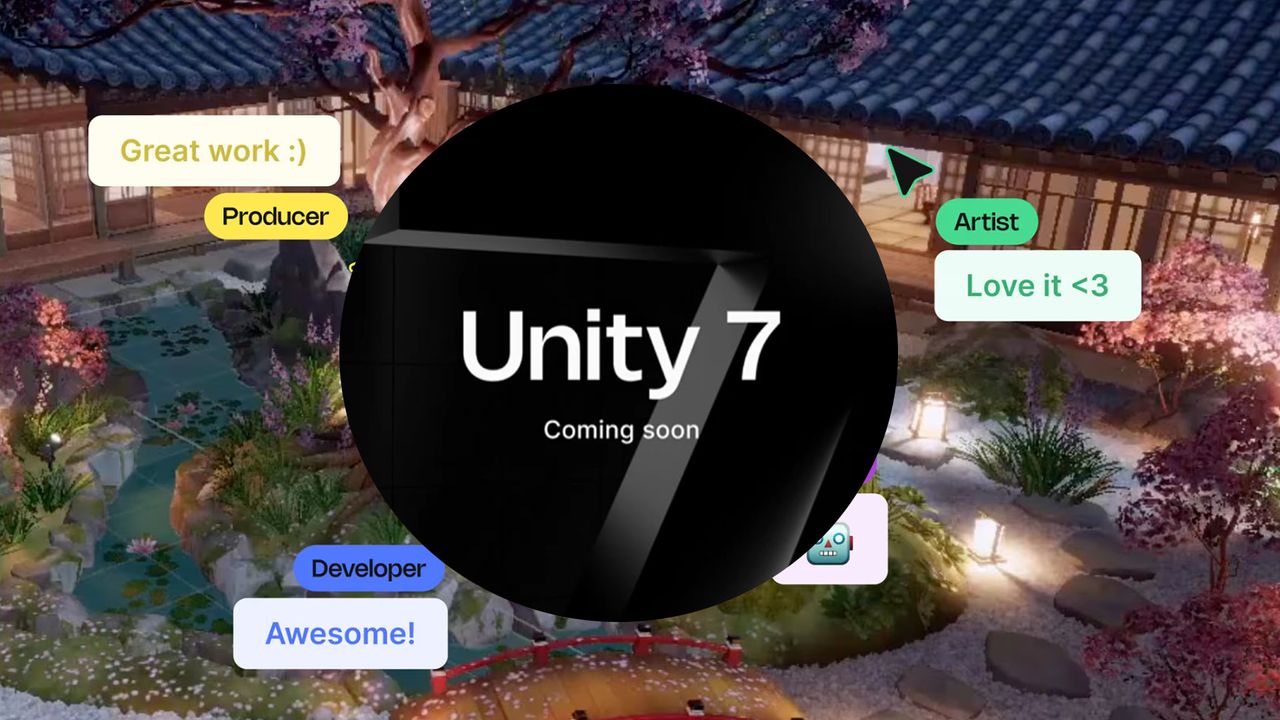
Recent updates have included an upgraded Unity AI for text-prompted development. Now Unity Technologies has announced Unity 7.
There's a strong feature list: up to 90% faster shader compile times, realtime global illumination, a close-to-instant Play Mode and a public CLI for non-editor collaboration. But perhaps the biggest advance is an architectural decision rather than a feature: the transition from Unity 6 should be seamless.
Introducing Unity 7 - built for a faster-moving, more open industry where creators, cross-functional teams, and coding agents can seamlessly collaborate across every stage of the development cycle. Featuring: - Create faster: Modernized CoreCLR foundation with a near-instant… pic.twitter.com/IorJE9ToAkJuly 21, 2026
The process of upgrading to a new game engine can be a nightmare for developers, breaking projects that were already well underway. But the foundations of Unity 7 will be shipped progressively in Unity 6 first to ease the path.
That includes the new CoreCLR scripting runtime and the Surface Cache GI rendering system, which provides real-time illumination. The company says this will mean zero rebuilding when it comes to moving projects to the new engine.
In his presentation at Unite Seoul 2026 (above), Jason Mann said developers building games on Unity 6 are "already on a path" to Unity 7. The shift to Unity 7 itself will simply be "where the foundation becomes the default" in an engine that will be "faster, more open and more collaborative than ever before".
In theory, there will be nothing to break during the transition because the architecture underneath will remain the same.
Unity 6.7 LTS introduces a public experimental release of a coreCLR desktop player so developers can begin validating code and testing their projects for compatibility using the existing .net version and C#9 instead of waiting for the Unity 7 Alpha.
Until now, Unity's C# scripting environment has run on Mono, the old open-source implementation of the .NET runtime. CoreCLR should be significantly faster. A partial domain reload system in Unity 7 will reload only assemblies that change instead of resetting the whole scripting state, allowing that near-instant Play Mode. CoreCLR's JIT compiler produces more optimised native code, reducing the recompilation cost per shader variant.
Unity 7 is expected to enter early beta testing in December. The full release slated or the first quarter of 2027, which will be around a year before Unreal Engine 6 enters Early Access.
You can find or more on the Unity website. Whichever engine you decide to use for your project, you might also want to check out the best laptops for game development.