Summary
As Macron epic delivery ends, it also wraps up the opening session of the first virtual UN general assembly.
We’re going to close down the blog now, but here is a look back at a morning of speeches:
- World leaders appeared in pre-recorded videos for an unprecedented general assembly debate during the Covid-19 pandemic. Without the usual bustle and theatrics of the event, the normally-full chamber was virtually empty.
- The morning was very much a fight between the multilateralism foundations of the UN and the nationalism and populism of Donald Trump and his allies.
- Trump and Brazil’s far-right president, Jair Bolsonaro, also used their slots to divert attention from their response to the pandemic, which has seen the two states see more total deaths than any other country.
- Bolsonaro used his speech to attack the media, who he accused of having “politicised the virus” by spreading panic.
- The US president said China had “unleashed this plague upon the world”, referring to Covid-19 as the “China Virus”.
- China later rejected the attacks as “baseless”.
Macron says US pressure campaign on Iran has failed
Macron is now criticising the US for withdrawing from the Iran nuclear agreement and for its sanctions.
“The maximum pressure strategy, which has been underway for several years, has not at this stage made it possible to end Iran’s destabilising activities or to ensure that it will not be able to acquire nuclear weapons,” Macron said.
“This is why France, along with its German and British partners, will maintain its demand for the full implementation of the 2015 Vienna Agreement and will not accept the violations committed by Iran.”
He adds: “We will not compromise on the activation of a (sanctions) mechanism that the United States on its own, leaving the agreement, is not in a position to activate.
“This would undermine the unity of the Security Council, the integrity of its decisions and it would run the risk of further aggravating tensions in the region.”
Remember, our diplomatic sources say this last speech of the morning session could be 40 minutes. Strap in.
Macron is seeking to assert himself as a global leadership figure as Trump and others step away from UN multilateralism in favour of nationalism and isolation.
He says he will outline five main priorities for France.
The first is “combating weapons of mass destruction and terrorism”, with Macron referencing Iran and France’s support for the nuclear agreement despite the US withdrawal.
French President Emmanuel Macron is up on the screens to end the morning session of the opening day of the general assembly, which has seen some of the world’s most powerful countries take the virtual stand.
Iran’s Hassan Rouhani has focused his talk on attacking the US for ending the nuclear agreement and imposing severe economic sanctions on his country.
The Iranian nation has not only resisted maximum pressure, but has also flourished and advanced while pursuing its historic and civilization role as a pivot of peace and stability.
— Hassan Rouhani (@HassanRouhani) September 22, 2020
Duterte was the first leader to exploit the rule that allows video graphics in their speeches.
His address was mixed with photos of Philippine forces and of the president himself, signing documents.
Rodrigo Duterte of the Philippines has appeared on the
podium
video screen.
Known for his striking speeches – including once comparing himself to Hitler – the president has started with a fairly standard UN speech, focusing on calling for international cooperation in fighting the pandemic and resolving global disputes, such as the South China Sea issue.
“I therefore call all stakeholders in the South China Sea, Korean Peninsula, Middle East, and Africa. If we cannot be friends as yet, then in God’s name let us not hate each other too much,” he said.
Qatar’s leader, Sheikh Tamim bin Hamad Al-Thani, starts by criticising recent moved by his neighbours, the United Arab Emirates and Bahrain, for signing accords with Israel.
The Washington-back deals were seen as ignoring the Palestinians, who have rejected Trump as a peace mediator.
Events have slowed down a bit with Jordan and South Korea, both of whom are reiterating their long-standing policies.
Jordan’s King Abdullah called for rehabilitation of the ailing Israel-Palestine two-state solution.
Moon Jae-in, of Korea, is talking about peace on the peninsula and global cooperation.
Putin says Russia’s vaccine is “reliable, safe and effective”.
Others are not yet convinced:
Vladimir Putin of Russia is up next.
He begins by arguing that the five permanent members of the UN Security Council should retain their “veto power” over UN resolutions despite calls for it to be reformed. Many members states say the veto rule is undemocratic.
Of course, Russia is one of those five permanent members.
Cuba is also giving China a run for its money in the video-call-background-competition (that I made up).
Díaz Canel has chosen to sit in front on a melange of palms and ferns, with the foliage somehow made even more verdant by green studio lights.

Cuba accuses Trump of 'unprecedented arrogance'
Nope! We’re back to drama.
Cuba’s president has just launched a snappy tirade against Donald Trump.
Miguel Díaz Canel Bermúdez accused Washington of “unprecedented arrogance”, promoting trade wars and using “financial blackmail” by withdrawing funds from UN agencies.
The US, he said, had “an abundance of practically uncontrolled expressions of hatred, racism and police brutality.”
Matamela Cyril Ramaphosa, President of South Africa, was next.
2020 will be remembered for the Black Lives Matter movement, he said, going on to talk in generic terms about global cooperation.
“When history faithfully records the global response to the worst health emergency of this century, let it be said that we stood and acted as one, that we provided leadership, and that we gave the peoples of all nations hope and courage.”
Compared to Trump and Bolsonaro, his speech was much more subdued. Let’s see if that lasts.
As Chile’s talk continues beyond the 15-minute deadline, Julian Borger has some analysis on China’s news-making speech:
Xi Jinping adopted the role of the adult superpower in the room in his address, presented in front of a painting of the Great Wall. Unlike Trump, he spoke the language of multilateral diplomacy. And he made news, declaring that China’s carbon dioxide emissions would peak by 2030 and the country would reach carbon neutrality by 2060, targets the EU has been urging Beijing to agree to.
Xi also announced some donations to UN funds - $50m to UN’s Covid-19 relief fund, and $50m to the UN’s Food and Agriculture Organisation.
As it was a pre-recorded speech, there was no reaction to Trump’s attack, but there were some digs at unilateralism without naming the US or its president.
No country should “be allowed to do whatever it likes and be the hegemon, bully or boss of the world”, Xi said, which is a bit rich given China’s military build-up in the South China Sea and its aggressive posture on the border with India, not to mention its mass incarceration of Muslims.
“Burying one’s head in the sand like an ostrich or trying to fight globalization with Don Quixote’s lance will go against the trend of history,” the Chinese leader said, with a western literary reference apparently aimed at Trump. “The world will never return to isolation and no one can sever the ties between countries.”
Sebastián Piñera Echenique, the president of Chile, is now defending his government’s crackdown on protests this year.
You can read more about that here:
Trump’s UN speech is already and predictably being promoted as an election video:
Thank you, @POTUS!#UNGA pic.twitter.com/D6VeBbJUFZ
— America First Policies (@AmericaFirstPol) September 22, 2020
Chile speaking now. After that, we have:
- South Africa
- Cuba
- Russia
- Jordan
- South Korea
- Qatar
- Philippines
- Iran
- France
...and we have photos of Xi Jinping’s background:

Some more analysis, this time from our diplomatic editor, Patrick Wintour, on Turkey’s talk:
President Recep Tayyip Erdoğan used his general assembly address to set out Turkey’s bitter objections to its exclusion from the East Mediterranean, but said he was ready to resume talks bound by international law to address their contested maritime claims in the eastern Mediterranean and Aegean. By his recent rhetorical standards, the speech was one of Erdoğan’s mildest.
His speech came at a highly sensitive time in the talks process following a video conference earlier on Tuesday between Erdoğan, German Chancellor Angela Merkel and EU Council President Charles Michel.
Merkel is trying to mediate a deal whereby Turkey and Greece restart bilateral talks on their disputed maritime claims, and in return Turkey at a planned meeting of the EU Heads of State is given assurances about modernising the Turkey-EU customs union. In a bid to pave the way for talks, Turkey pulled back one of its navy surveillance ships for what it described as routine maintenance, but was clearly a diplomatic gesture.
Erdoğan told the UN his priority was to settle disputes by international law on an equitable basis. He warned no attack, harassment or intimidation of Turkey will be accepted.
The dispute has widened into a conflict between Turkey as upholder of the Palestinian cause, and the Arab Gulf States, such as the United Arab Emirates that have struck a peace deal with Israel. Turkey is also defending the rights of Turkish Cypriots on the divided island. Without mentioning France, Greece’s main supporter, he said futile attempts to exclude Turkey would have no chance of success, and blamed the dispute on Greece’s maximalists demands since 2003.
He also called for a regional conference in the Mediterranean including the Turkish Cypriots to promote a dialogue between the Med’s coastal countries. Turkey feels it was excluded when an East Med gas forum was set up last year that left out Turkey.
Updated
Xi says there is no point trying to fight globalisation.
He is also calling for “a green revolution”. He wants carbon neutrality before 2060.
Sidenote: China wins my vote for “best video call background” so far. Xi is sitting in front of a painting of the Great Wall of China. Other leaders have to step it up.
China 'rejects the baseless accusations' after Trump speech
Before introducing President Xi Jinping, China’s UN representative just complained that the country was being blamed for the pandemic.
“China resolutely rejects the baseless accusations,” he said.
I wonder if those were off-the-cuff remarks after Trump’s earlier attack.
Before we get to the next speaker, here is some snap analyis on Trump’s address from my colleague, Julian Borger:
Trump’s speech was a barnstorming seven minutes, less than half the time he was allotted, and in a tone just short of yelling. It was a speech designed for a virtual campaign rally and that is its destiny, to be played on repeat on Republican social media.
Much of the speech was a ferocious attack on China. He named the country 11 times in all. In the first few seconds he had named Covid-19 the “China virus”, and called for Beijing to be held accountable.
Having dismissed the pandemic as affecting “virtually nobody” at a rally yesterday, he called the fight against it as a “great global struggle” comparable to the second world war. And Trump went on to make a series of false claims about what the US government was doing about the pandemic.
The first was the biggest. He said “we launched the most aggressive mobilization, since the second world war.”
In fact, the federal government has handed over leadership to the states, and its main impact was to broadcast misleading information, downplaying the threat. Trump was speaking just after the US passed the milestone of 200,000 dead from the pandemic - a statistic he did not mention.
There will be some relief in the UN, where there were fears that the US president would announce the severing of more US funding of the organisation. Instead the hostile fire was directed mostly on China. The brevity of the speech limited the number of targets.
Erdoğan is jumping from Middle East crisis to Middle East crisis.
He is complaining about what he says is Turkey’s disproportionate role in Syria’s refugee crisis, then brings up conflicts in Libya, Yemen and Iraq.
Erdoğan later criticises Trump’s Israel-Palestine “peace plan”, released in January. The Turkish president calls it a “document of surrender” that is detrimental for Palestinians.
Recep Tayyip Erdoğan of Turkey has started with a rather technical talk on bolstering multilateralism.
He is repeating his long-standing call to reform the UN Security Council.
By the way, if you feel like watching along, you can see the speeches here:
The #UNGA General Debate is underway - watch it live. https://t.co/WdhsaIZtek.https://t.co/FeALnb5ws3
— United Nations (@UN) September 22, 2020
My colleague Julian Borger has some details on the famously-broken 15-minute time limit for speakers. Trump had a quickie, but expect a longer show by France’s Macron.
There is a 15 minute limit for leaders speeches at #UNGA today. According to UN sources, Trump has sent a 7-minute video. Macron has sent a 40-minute epic. Most leaders sticking to the 15-minute brief.
— Julian Borger (@julianborger) September 22, 2020
...and that was it for Trump. He abruptly stopped well short of his 15-minute time slot.
Trump’s speech is undoubtely a message to US voters.
He video from the White House is a list of what the US leader sees as his achievments over the past four years.
“I am proudbly putting America first,” he says.
This seems to be a wholesale attack on China.
Trump has quickly switched to slamming the country for pollution.
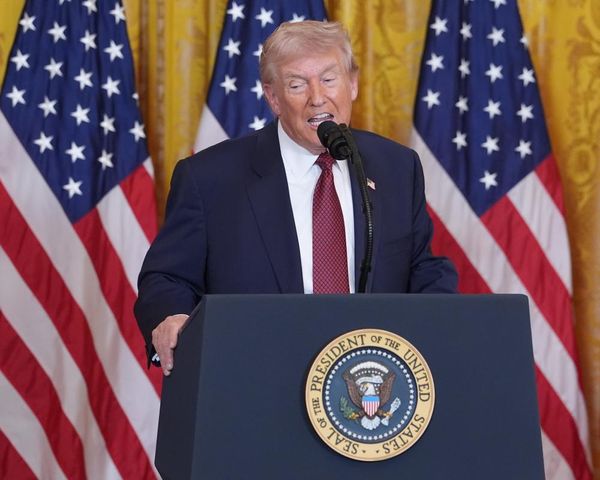
Trump opens by talking of war against "China Virus"
The US president has begun his speech with an immediate slur against Beijing, accusing it of contributing to the pandemic.
“We must hold accountable the nation that unleashed this plague upon the world,” he says, callling the coronavirus the “invisible enemy” and “the China Virus”.
US Representative Kelly Craft says she has the “awesome honour” to introduce Donald Trump.
Bolsonaro praised Brazilian agribusiness and truckers – two key support groups.
“The man in the field never stopped,” he said, blaming disinformation for the deluge of bad news about fires in the Amazon and Pantanal wetlands region.
“We are victims of one of the most brutal disinformation campaigns on the Amazon and Pantanal,” he said. “We are leaders of tropical forest conservation.”
In fact, the Pantanal, the world’s largest wetland, is facing the greatest devastation in its history. The area burned this year is equivalent to the size of the State of Israel — 3 million hectares or 20% of the entire biome. Bolsonaro blamed fires on backwoodsmen and indigenous. But extensive research from scientists and environmental groups, together with media reports, including in the Guardian, have shown that in many cases, Amazon fires are caused by farmers clearing land for pasture and, increasingly, clearing virgin forest.
The Amazon has seen more fires this year than the whole of 2019, according to NASA data, Mongabay reports. In Brazil, Federal Police are investigating four farms for fires in the Pantanal.
Diplomats feared this new Zoom-style virtual general assembly with pre-recorded messages would mean world leaders might use it as a televised opportunity to speak to their own people, rather than each other.
This may have proved true: Bolsonaro is talking about pension reform.
Bolsonaro attacks media for 'politicising virus'
Bolsonaro gets stuck in with an attack on the media, who he accuses of having “politicised the virus” by spreading panic and calling for people to “stay home”.
The far-right president has repeatedly trivialised Covid-19 pandemic, and even contracted the virus himself in July.
Bolsonaro pre-recorded his speech last Friday, before he flew to Mato Grosso state and his plane was forced to abort its landing because of smoke from fires.
He is talking about Covid-19. “First of all, I want to lament every death that happened,” Bolsonaro said. That is a different tone to his comments earlier during the pandemic when asked about deaths, he replied with “so what?” and “I’m not a gravedigger.”
Uh oh... technical hitch at the first (hurdle) speech by Brazil’s Jair Bolsonaro.
He appeared on screen for a few minutes to talk about the virus and then cut.
It has just restarted from the beginning.
Bozkır also talking about gender equality.
Made me recall a depressing line from our main UN story today:
According to the latest running order, 50 men will address the assembly before the first woman gets a chance to speak, Slovakia’s Zuzana Čaputová.
The new president of the general assembly, Volkan Bozkır of Turkey, is now speaking about the merits of multilateralism and the dangers of the pandemic.
He just coughed... a bit worrying. But let’s hope it is just a dry mouth from speaking.
As we get going, you might want to check out some decent primers for the UN general assembly.
My colleague and diplomatic editor, Patrick Wintour, wrote a deeply-reported piece this past weekend looking at the pitfalls of “Zoom diplomacy”.
He quoted one diplomat with four decades of experience who explained how hard it is to move forward without meeting face-to-face:
The French say you cannot truly build a relationship of trust until you have had lunch with them three times. Through video calls you can maintain existing relationships, you cannot cultivate new ones.
Definitely also have a read of today’s preview by our trusted world affairs editor, Julian Borger.
He writes how this virtual assembly could not come at a worse time for the UN, which has never seemed so beleaguered as it has today.
Trump especially has attacked the world body, in May announcing he is severing all ties with one of its main agencies, the World Health Organisation (WHO).
If you want to go back to basics, have a look at Julian’s evergreen explainer from last year:
Guterres ends dramatically by asking the world to “vanquish the five horsemen”.
So no small feat...
The secretary general is going on to talk about his call for a global ceasefire by the end of the year. He says there have been encouraging signs in Afghanistan, Sudan and Syria.
He then condemns countries acting selfishly during the pandemic, including those making vaccination “side deals exclusively for their own populations”.
“Such ‘vaccinationalism’ is not only unfair, it is self-defeating,” he says. “None of us is safe, until all of us are safe.”
He warns that women have been disproportionately represented in the sectors “hit hardest by job losses” in the pandemic.
“Unless we act now, gender equality could be set back by decades,” he warns.
Very odd to see the normally-full chamber, virtually empty. Country representatives are all in masks and sitting at a distance from each other.
Guterres: “Populism and nationalism have failed”
Guterres makes some fairly targetted criticisms of world leaders, likely directly at Trump, saying that “populism and nationalism have failed” and that “we must be guided by science and tethered to reality”.
More concerning words from Guterres on the pandemic:
“For the first time in 30 years, poverty is rising.
Human development indicators are declining.
We are careening off track in achieving the [UN] Sustainable Development Goals.
Meanwhile, nuclear non-proliferation efforts are slipping away — and we are failing to act in areas of emerging danger, particularly cyberspace.”
UN Secretary General António Guterres, has begun his speech in extremely-2020 fashion by using some seriously apocalyptic analogies.
He said he has previously warned of the “four horsemen in our midst – four threats that endanger our common future”.
They are:
- The “highest global geo-strategic tensions in years”.
- An “existential climate crisis”.
- Deep and growing global mistrust.
- The dark side of the digital world.
It gets worse. Guterres says a “fifth horseman was lurking in the shadows … joining the four other horsemen and adding to the fury of each.”
That is, of course, the coronavirus pandemic.
“Every day, the grim toll grows, families grieve, societies stagger, and the pillars of our world wobble on already shaky footings,” says Guterres.
“We face simultaneously an epochal health crisis, the biggest economic calamity and job losses since the Great Depression, and dangerous new threats to human rights.”
Welcome to the (virtual!) UN general assembly
Greetings, and welcome to the United Nations general assembly live blog.
Oliver Holmes here, watching and digesting the often-vitriolic speeches by global leaders so you don’t have to.
The 75th general assembly will certainly be different this year.
Normally the week-long event would be a lively “general debate” between member states, with opportunities for diplomatic breakthroughs (and breakups) in the corridors and the cafe of the UN headquarters.
This year’s pandemic has put an end to any discussion, and instead, leaders have pre-recorded video messages that will be aired on a big screen behind the famous green marble podium.
Less drama, possibly, and you certainly won’t get to see heads of state laughing at Donald Trump as he brags of his achievements.
However, no doubt there will be surprises as we enter the unknown – the rules allow the use of video graphics in the recorded messages, so we may see some flourishes from the more creative leaders.
Everything will kick off at 9am local time in New York (2pm in London) with opening remarks by the UN secretary general, António Guterres, who will no doubt give everyone a good telling off.
After that the new president of the general assembly, Volkan Bozkır of Turkey, will make some short remarks before handing over to the big hitters.
As is customary, Brazil will be the first country to speak, with its president, Jair Bolsonaro, expected to follow up on his fiery 2019 speech. Donald Trump will follow, no doubt talking less to the world and more directly to US voters as he approaches a tough election.
Later we’ll have Turkey, China, Russia, Iran, and France – all before the lunch break.
I’ll be blogging the big first day, while my colleagues around the world send in analysis.