Afternoon summary
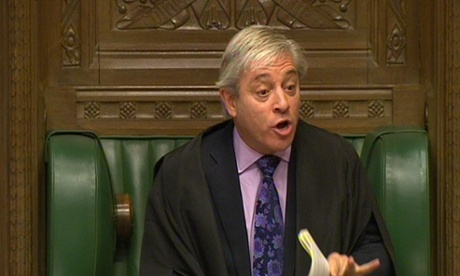
- John Bercow has been re-elected Commons Speaker without any opposition, promising to continue as the “backbenchers’ champion”. Although there had been speculation about Tory MPs trying to block his re-election, this did not materialise and not a single MP spoke out against his re-election. As MPs assembled for the first time since the election, Bercow told them:
It has been an honour to serve as Speaker for almost six years and I would be honoured to do so for a little longer if colleagues kindly agree.
I will strive to ensure this House remains at the heart of our democratic system. All of its members, newcomers and veterans alike, should be part of the cast, not merely an audience.
Finally, if there are five words I would like carved on my political tombstone - assuming such items are not now forever unfashionable - they are ‘he was the backbenchers’ champion’.
That’s all from me for today.
Thanks for the comments.
Updated
On the Newsnight blog Christopher Cook has been looking at the case for making the NHS a proper seven-day-a-week service. He says setting this as a target will make it easier for the government to force the health unions to agree to productivity savings.
(For example of what those productivity savings might entail, this story from my colleague James Meikle in January, about NHS England proposals to cut payments for staff working antisocial hours, is instructive.)
Labour leadership latest - A round-up
I’ve already covered Harriet Harman’s speech on the Labour leadership contest. (See 10.50am.) Here are some of the day’s other developments in the race.
- Senior Labour figures have expressed concern that the growing parliamentary support for the two leadership frontrunners has left the potential modernising candidates struggling to gather the 35 nominations they need to make the ballot paper, Patrick Wintour reports. The shadow health secretary, Andy Burnham, and the shadow home secretary, Yvette Cooper, are understood to have secured more than 100 nominations between them, while the shadow education secretary, Tristram Hunt, is yet to declare because he is well short. Liz Kendall’s allies insist they have the required numbers, but expressed concerns at weekend reports from allies of Burnham that they plan to attract so many nominations that some candidates are excluded.
- Yvette Cooper’s team have released the names of 14 MPs who are backing her.
Lot of backers for Yvette emerging: Stephen Pound, Kevan Jones, Chris Bryant, Kate Green, John Healey, Spellar, Vernon, Seema Malhotra
— Jason Beattie (@JBeattieMirror) May 18, 2015
Others backing Yvette: Paula Sherriff, Jess Phillips, Khalid Mahmood, Sharon Hodgson, David Hanson and Shabana Mahmood
— Jason Beattie (@JBeattieMirror) May 18, 2015
Cooper has also given an interview to ITV’s Lorraine Kelly.
Yvette Cooper decides to talk with the country beyond GuardianLand. pic.twitter.com/Kv0Vo7GQQM
— Paul Richards (@Labourpaul) May 18, 2015
-
The Unite union has rejected claims that it is putting pressure on Labour MPs not to nominate any of the “modernising” candidates like Liz Kendall, Mary Creagh or Tristram Hunt (if he decides to run). The Labour MP Barry Sheerman, whose daughter works for David Miliband, alleged this. In response, a Unite spokesman said:
We utterly reject these unsubstantiated allegations Barry Sheerman has made against Unite. They are false and totally without foundation. It is time for Barry Sheerman to either present his evidence to the appropriate authorities in the Labour party or do the honourable thing and withdraw them.
Updated
And here’s a Vine of the moment David Cameron almost got hit by Black Rod.
Speaker's re-election - Best speech, worst speech, best joke and best insight
That was mostly ceremonial, but in some respects it was quite illuminating.
For all the excitable talk before the election about how a minority government would result in Tory MPs trying to boot out John Bercow, it was interesting to see that in the end not a single MP spoke out against his re-election. Given that William Hague’s attempt to change the rules at the end of the last parliament to make it easier for Bercow to be challenged ended in ignominious failure, it is perhaps not surprising that the Tories decided to take a more forgiving approach. And Jacob Rees-Mogg made a good argument as to why a sitting Speaker should be left alone.
We knew the Lib Dems only won eight seats, but this session illustrated quite how invisible they are going to be in this parliament.
Here are some other highlights.
Best speech
Harriet Harman, easily. Admittedly, it was rather similar to the speech she gave at the opening of the last parliament, but some things are worth saying more than once and her advice to new MPs was very sound. (See 3.06pm.) I don’t know if she’s interested, but when John Bercow stands down, she would probably make an outstanding candidate for Speaker.
Worst speech
Angus Robertson, the SNP leader at Westminster. He is judged to have been a bit too haughty. Here is some Twitter reaction.
From the BBC’s Tim Reid
Robertson joke at "fairness" for smaller parties, the Lib Dems and .. the sole Tory and Labour Scots MPs, doesn't go down too well
— Tim Reid (@TimReidBBC) May 18, 2015
From the Scottish Daily Mail’s Alan Roden
Wow. Angus Robertson. Talk about misjudging the mood.
— Alan Roden (@AlanRoden) May 18, 2015
From the former Labour MP Anne McGuire
It was a great pity that Angus Robertson didn't show a little more grace in his speech. I shouldn't have been surprised but I lived in hope
— Anne McGuire (@AnneMcGuire97) May 18, 2015
Best joke
This was in David Cameron’s speech. He was talking about Sir Gerald Kaufman’s classic book, How to be a Minister.
There is even some advice for a party leader who didn’t make it to this chamber. The Father of the House writes in this book: ‘If you are contemplating resigning, be entirely sure you really want to go’.
Best insight
Nigel Dodds’ point about all four nations of the UK now voting for different parties as their main representatives. (See 3.10pm.) This is a striking fact, that says a lot about the fragmentation of the UK, and I’m surprised I haven’t heard it made before.
Updated
I missed this earlier. According to the BBC’s Ross Hawkins, David Cameron was almost clobbered by Black Rod.
Cameron flinches to avoid being clonked by Black Rod's rod pic.twitter.com/9PRRzw1Flo
— Ross Hawkins (@rosschawkins) May 18, 2015
Here’s an interesting spot from Tom Newton Dunn.
An extremely grateful and friendly handshake between Osborne and Bercow behind Speaker's chair. Perhaps a deal has been done.
— Tom Newton Dunn (@tnewtondunn) May 18, 2015
Alasdair McDonnell, the SDLP MP, and Jonathan Edwards, the Plaid Cymru MP, give short speeches on behalf of their parties.
Bercow is about to wind up when someone points out that he has forgotten the Lib Dems. He calls Alistair Carmichael, the Lib Dem MP. Carmichael says that he appreciates Bercow’s support for backbenchers much more now than he did when he was a minister.
Gavin Barwell, a Tory whip, moves that the Commons adjourns until tomorrow. And it does.
Nigel Dodds, the DUP leader at Westminster, says it is important the rights of smaller parties are respected. All four nations of the UK have returned voted for different parties as their main representatives. That is unprecedented, he says.
Angus Robertson, the SNP leader at Westminster, congratulates Bercow on behalf of his party. He says the SNP look forward to opposing austerity. The SNP have 56 MPs and are now the third largest party, he says. But they still support the rights of smaller parties - like the Liberal Democrats.
Updated
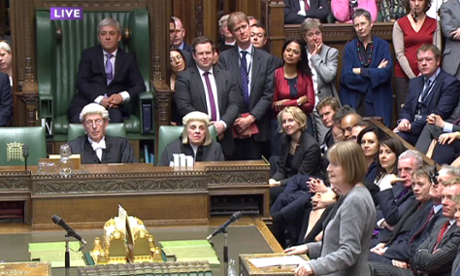
Harriet Harman's speech
Harriet Harman, the acting Labour leader, is responding now.
She also congratulates Sir Gerald Kaufman. But she does not want to descend into patriarchy, she says. There is also a mother of the House. It is her. Together, they will provide good parenting.
She says Labour applied for the government job, but it did not get it. It will provide the opposition.
She says when she was first elected, just 3% of MPs were women. Now it is almost 30%.
She says new MPs should remember that they are not trainee MPs. They are MPs, and they have a right to be heard. She says they should ignore all those who tell them to keep quiet, for the next five or ten years or so.
She says John Bercow is the best Speaker there has been since she has been an MP. He stands up for backbenchers.
Bercow is her fifth Speaker. And Cameron is her fifth prime minister. MPs can guess who is her favourite.
David Cameron's speech
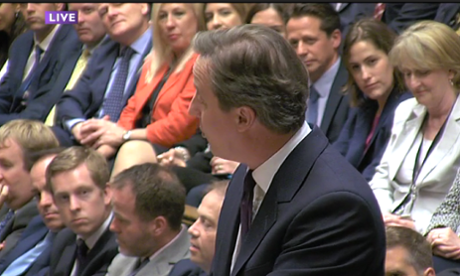
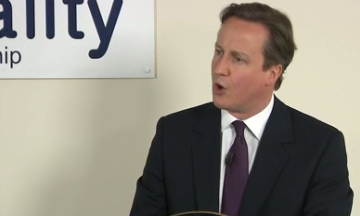
David Cameron is speaking now.
He welcomes John Bercow, and says after the election the media were not sure whether 330 or 331 Conservatives were elected. That was because people did not know whether Bercow was a Conservative, he says.
And he congratulates Sir Gerald Kaufman. His book, How to be a Minister, is recommended, he says. It includes chapters on getting on with Number 10 and getting on with the unions, so there is something there for everyone.
He pays tribute to Harriet Harman. There seems to be a pattern; men make a mess, and she comes along to clear it up. Perhaps she should get the job permanently, he says.
He says he welcomes the fact the Commons is more diverse. He will lead a one nation government, he says.
Sir Gerald Kaufman proposes Bercow for election.
By acclamation, a large number of MPs say aye. No one says no. Bercow is “dragged” to the chair by the Labour MP Valerie Vaz and the Conservative MP Sir Peter Bottomley.
Bercow thanks Kaufman, and says he will ensure MPs can hold the government to account.
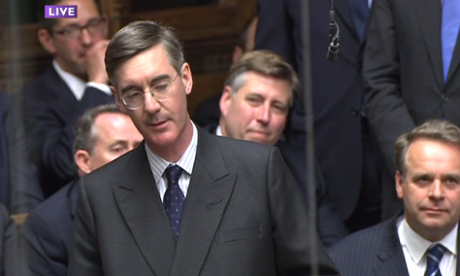
Jacob Rees-Mogg, the Conservative backbencher, is not proposing the motion for Bercow to be re-elected.
He says it is traditional for serving Speakers to be re-elected. Speakers are the champions of the House, against the Lords, against the judiciary, and against the executive.
He says if Speakers could not be sure of being re-elected, they would have to worry about what the government thought.
A Speaker needs to know about Erskine May. Rees-Mogg says he thought he knew Erskine May well when he was in the last parliament. But Bercow always knew the rules better.
Bercow was also good at getting business through swiftly.
And he ensured MPs could debate what they wanted to debate. There has been a rise in the use of urgent questions.
Bercow also has a very good knowledge of MPs.
Bercow is a “moderniser”, Rees-Mogg goes on.
This is a word I use with some caution.
(Rees-Mogg is an arch anti-moderniser, so this gets a laugh.)
Rees-Mogg says Bercow is impatial in the House, but partisan for the Commons outside it.
Bercow says he wants to be 'backbenchers' champion'
Sir Gerald Kaufman says he now has to find out whether John Bercow is willing to be chosen as Speaker.
Bercow thanks Kaufman, and congratulates Kaufman on his service. Next months will mark 45 years’ of Kaufman service to the House.
Bercow says he has been Speaker for six years. He would be honoured to serve for a little longer if MPs agree.
The Commons should be central. MPs should be part of the cast, not just the audience.
If there are five words that should be carved on his tombstone, assuming such items are not now unfashioned, they are:
He was the backbenchers’ champion.
Here is more on the SNP/Dennis Skinner spat.
So Skinner wins, SNP Margaret Ferrier gives way. But Angus Robertson takes up the old LibDem leader seat
— Paul Waugh (@paulwaugh) May 18, 2015
As SNP try to take trad Labour Miners bench...Skinner "I've been here 45yrs mate" SNP MP to Dennis Skinner, "44 to long" #TartanTories #SNP
— Tom Blenkinsop (@TomBlenkinsop) May 18, 2015
Ahem. I'll try that again. Dennis *Skinner* was given his seat back by the SNP, and he's chatting nicely to Chris Law MP next to him.
— Jamie Ross (@JamieRoss7) May 18, 2015
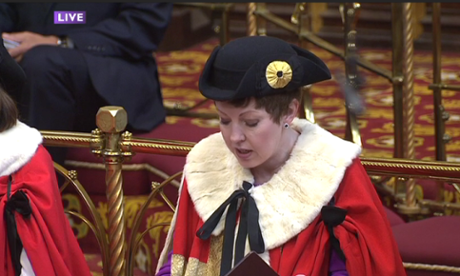
In the Lords Lady Stowell, the leader of the Lords and the Lord Privy Seal, has just read out the Queen’s Commission.
Essentially, it’s a message from the Queen saying she is sorry she can’t be there herself, but would they kindly form a parliament and elect a Speaker etc.
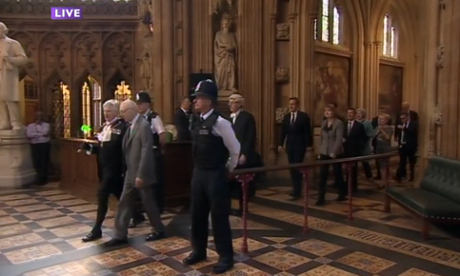
Black Rod has arrived in the Commons chamber.
He summons the Commons to the Lords chamber to hear the Queen’s commission read.
Led by Sir Gerald Kaufman, MPs are now heading for the Lords.
Almost scuffles as SNP MPs removed from Labour front bench. No love lost there then.
— Michael Fabricant (@Mike_Fabricant) May 18, 2015
Sir Gerald Kaufman, who, as the longest-serving MP, is father of the House, is taking the chair (the clerk’s chair, not the Speaker’s) to preside over the election of the new Speaker.
But Dennis Skinner has seen them off.
DennIs Skinner's got his corner front row seat back! SNP alongside him
— Kevin Maguire (@Kevin_Maguire) May 18, 2015
Election of the Speaker
The new Commons is about to assemble to elect its Speaker.
Lunchtime summary
- David Cameron has claimed that his plan to get the NHS working on a proper seven-day-a-week will not necessary incur extra cost. In a Q&A after his speech this morning, he said:
I saw this in operation (in Salford) and they are working increasingly on a seven-day basis. The scanners are working at the weekend, the MRIs are working at the weekend ... everything is working at the weekend. And as a result, actually, they’ve been able to reduce their costs and provide a better service.
Will it be easy to achieve? Of course not. Will it require a lot of hard work to put it in place? Yes, it will. But it’s definitely the right ambition and people shouldn’t automatically assume that working something on a seven-day-a-week basis means it’s more expensive.
After all, huge amounts of taxpayers’ money have been put into the CAT scanners and the MRI scanners and doesn’t it make sense to ensure they are being used on a whole-week basis?
He also argued that shift changes, not longer working hours, would enable the NHS to offer a proper seven-day service.
-
Health experts and opposition politicians have said the government will need more money to deliver its seven-day NHS vision. Professor Chris Ham, chief executive of health think-tank the King’s Fund, said the extra £8 billion promised for the NHS would not fund all the government’s promises. Dr Mark Porter, chair of the BMA, accused Cameron of “empy headline grabbing”. Porter said:
Crucially, the £8bn promised by the prime minister is the bare minimum needed for the NHS to simply stand still and will not pay for extra services.
The real question for the government is how they plan to deliver additional care when the NHS is facing a funding gap of £30bn and there is a chronic shortage of GPs and hospital doctors, especially in acute and emergency medicine, where access to 24-hour care is vital.
Without the answer to these questions this announcement is empty headline grabbing and shows that even after polling day, politicians are still avoiding the difficult questions and continuing to play games with the NHS.
Andy Burnham, the shadow health secretary, said people should take Cameron’s promises with “a large pinch of salt” (see 12.34pm) and Norman Lamb, the Lib Dem former health minister, said it was “fanciful” to think Cameron could achieve his aim without finding more money for the NHS. (See 12.38pm.)
-
Len McCluskey, the Unite general secretary, has said that his union has no plans to disaffiliate from Labour. He spoke out after it emerged that a call for Unite to break the link with Labour may be debated at its party conference in July. McCluskey said:
We have no plans to disaffiliate from Labour. The party has never been more united.
-
Harriet Harman, the acting Labour leader, said the party had to listen to voters and accept what they were saying if it were to regain power. She made the argument in a speech in which she said the Labour leadership hustings would be opened up to people who were not party members so that voters could see which candidates were best able to appeal to outsiders. (See 10.50am.)
- Yvette Cooper, the Labour leadership contender, has told ITV’s Good Morning Britain that having a female leader would offer “a chance to do politics differently, to get rid or to challenge and shake up the Westminster old boys’ club”.
- Ivan Massow, a Conservative businessman, has launched his campaign to be the Conservative candidate for London mayor with a YouTube cartoon in which he introduces himself as “gay, ex-alcoholic and dyslexic”.
-
Ukip and the Greens have joined forces to present a petition demanding electoral reform to Number 10 Downing Street.
.@natalieben and @Amelia_Womack this am delivered a petition calling for electoral reform http://t.co/mpEac9NCzJ pic.twitter.com/b0phoeHb5o
— The Green Party (@TheGreenParty) May 18, 2015
Nigel Farage, the Ukip leader, also set aside his differences with Douglas Carswell, the Ukip MP, to stage a photocall with him with the petition.
.@DouglasCarswell and I signing @electoralreform's cross-party petition for electoral reform. The campaign is vital pic.twitter.com/rAY0Lara4B
— Nigel Farage (@Nigel_Farage) May 18, 2015
Updated
Simon Stevens, the NHS England chief executive, shared a platform with David Cameron this morning and spoke just before the prime minister. In his speech, Stevens said the NHS was entering “probably the most challenging period in its 67 year history”.
Norman Lamb says Cameron's 7-day NHS plans cannot be achieved on existing budget
Norman Lamb, the Lib Dem former health minister and contender for the Lib Dem leadership, has said that David Cameron will not be able to deliver his plans for a proper seven-day=a-week NHS without spending even more than the £8bn promised. As Denis Campbell and Matthew Weaver report, Lamb said:
The idea that you can just achieve this without additional resources is just fanciful ...
The seven-day NHS can’t be delivered within existing resources. It needs additional resourcing. At the moment we are well staffed through five days but have a lower staffing ratio on the weekends, and that would have to change.
Andy Burnham, the shadow health secretary, has said people should take David Cameron’s promise to create a proper seven-day-a-week NHS with “a large pinch of salt”. In a statement he said:
In 2010, the Conservatives promised seven-day GP opening but failed to deliver it. In fact, for most people, it has got harder to get a GP appointment on David Cameron’s watch. Patients deserve better.
Over recent years, David Cameron has overseen a crisis of morale within GPs. With many GPs retiring and too few in training, there’s a risk things may get even worse.
This year, the NHS is facing a huge financial deficit. David Cameron must produce a credible and funded plan to stop things getting worse before people will believe his promises of improvements.
David Cameron's NHS speech - Summary
Here are the main points from David Cameron’s NHS speech.
-
Cameron claimed that the NHS could deliver a proper seven-day-a-week service by changing shift patterns, without staff having to work longer hours.
So 7-day care isn’t just about a better service – it’s about saving lives ...
While our hospitals are working hard Monday to Friday to get patients better sometimes it can feel as though Saturdays and Sundays are more about just somehow getting through to Monday.
Diseases don’t work weekdays 9 to 5.
And neither can we.
When you have sat through a night in the hospital watching a loved one and praying for the morning, when you have spent a weekend longing for the week, you know just how important these changes are.
And let’s be absolutely clear.
This isn’t about NHS staff working seven days a week.
It’s about different shift patterns - so that our doctors and nurses are able to give that incredible care whenever it is needed.
-
He reaffirmed his commitment to giving patients access to GPs seven days a week.
By the end of this financial year 18 million patients will have access to a GP at mornings, evenings and weekends.
By the end of this Parliament I want that for everyone.
-
He said he was “angry” about claims that he did not care about the NHS.
My love of the NHS my respect for the NHS, my commitment to the NHS runs through every sinew of my body.
- He accused Labour of not telling the truth about his record on the NHS during the election. Labour said the Tories would cut the NHS, that the number of doctors and nurses had fallen, and that the Tories would privatise the NHS. Those claims were all untrue, he said.
-
He defended the involvement of private providers in the NHS.
When people ask about other healthcare providers being given the chance to deliver some services as part of the NHS I say think of organisations like Age UK, Whizz-Kidz and Macmillan Cancer nurses.
Shouldn’t we have that sort of incredible care and support available for free on the NHS?
Of course we should.
Tony Blair and Gordon Brown both thought so too.
They didn’t privatise the NHS - and neither will I.
BBC News and Sky have given up their live coverage, but there is a live feed on the BBC website.
Cameron says David Prior has done a great job as head of the Care Quality Commission. That is why he has been made a health minister.
Cameron says he is ending it here. He needs to save some of his voice for welcoming the new Speaker in the Commons, he says.
But he says he will be making many more speeches on the NHS.
Cameron's Q&A
David Cameron is taking questions now.
He was coughing quite a lot through his speech, as was Harriet Harman through hers. Our political leaders have got the post-election lurgy.
Q: You promised 7-day access to GPs in 2010. How will you fund these plans. They are not even in the Simon Stevens plan for the NHS?
Cameron says 7.5m people already have access to GPs seven days a week. By the end of this year that number will be in the “teen millions” (ie, at least 13m, I presume). By the end of this parliament everyone will have access to a GP seven days a week.
Q: Will there be no further top-down reorganisation of the NHS?
There is no need for that, says David Cameron. But he is in favour of taking further bureaucracy out of the NHS where he can.
Q: But how will you fund seven-day access to GPs?
Cameron says having wider opening hours does not necessarily require extra funding.
David Cameron is delivering his NHS speech now.
I will spare you the minute-by-minute coverage, but I will post a summary of the key points shortly, and I will cover the Q&A in detail if I can.
In the comments there is an interesting post from Dogoodnow saying how he/she had found it nigh on impossible to become a registered Labour supporter by looking at the party’s website and through other means.
But somewhere in the nooks and crannies of the Labour website there is a link allowing you to sign up as a registered supporter. Here it is.
A party spokesman said he was not sure why the page was so hard to find, but that the website was being re-designed and that soon the “registered supporters” page would feature very prominently.
In a Q&A after her speech, Harriet Harman, the acting Labour leader, said she did not think that any of the unions, like Unite, affiliated to Labour would cut their links with the party.
I don’t think there is going to be a break between Unite or any of the unions that are affiliated to the Labour party. We have had a lot of soul searching to do across all parts of our party and we will have robust discussions. But, no, I don’t think there is going to be a disaffiliation.
But she did tell the BBC that there should be “no no-go areas for discussion” when asked if the union link should be considered as the party rethinks its future.
Harriet Harman's speech on the Labour leadership election - Summary
In the 1980s some in the Labour party took the view that, in politics, there should be “no compromise with the electorate”. Whether or not anyone used the phrase seriously is not clear - it sounds like an urban myth, but I once heard a party official claim to remember the person how coined it - but the slogan stuck because it summarised a view that was, if not widely held in the party, at least more common than it should have been.
Harriet Harman’s speech today was more interesting than the pre-briefed excerpts suggested and at its heart was a robust attack on “no compromise-ism”. To win again, Labour must listen to the public, she argued.
Here are the key points.
-
Harman said Labour had to listen to voters and accept what they were saying.
There is one lesson we can and must heed right away. When it comes to elections the public are the boss. We do not question their decision. We heed it.
-
She said that, as the party elected a new leader and deputy leader, it had to focus on who would appeal most to the electorate at large.
As we conduct this debate, as we elect our leader and deputy leader, we must have the public in the forefront of our minds. We must let the public into our minds and into the process as we make the decisions about who is our next leader and how we go forward. So we are going to start that with how we do the leadership elections. When I stood for the leadership it was a cosy contest in front of people who - like us - love politics and love Labour. Very different from the rest of the country!
We asked ourselves - who do we like? That was the wrong question. We should have asked - as we made our choice - who does the country like ...
If there is one thought that should drive the thinking as we elect a new leadership team it is this - which of them has the best qualities and leadership skills most likely to win over the support of the public?
-
She suggested that the party may have done better if it had chosen Alan Johnson, not her, as deputy leader.
Who knows, if we had done that [focus on who would appeal most to the public] perhaps Labour would have chosen Alan Johnson rather than me!
-
She said the leadership hustings would be opened up to people who were not party members so that voters could see which candidates were best able to appeal to outsiders. And she said they would take place in towns where Labour lost for the same reason.
We cannot just hold hustings in our Labour heartlands, we have to go to areas where we didn’t win. Because ultimately we are electing the team that we think can lead not just the party but lead the country. And that must be our guiding thought. Last time our hustings - in front of Labour members - were in cities where Labour won. We must have those hustings now in towns and suburbs where Labour lost.
- She said that more than 30,000 people had joined Labour since the electoin and that she wanted to use the contest to expand the membership further.
-
She said that some factors were essential if Labour were to succeed.
Let me be clear, I am not saying that we are in the same circumstances we found ourselves in after 1992. That was then, this is now, and it’s a very different era. But some things are always necessary for our party do well.
A strong and charismatic leader in touch with the values of the majority.
A talented and largely united team.
Values and policies that speak to people’s concerns and choices.
A big picture message about change and how to meet the challenges of the time.
Local connections which give people confidence in Labour and demonstrate we are on their side.
However, she stressed that she was not arguing for a return to Blairite New Labour. Conditions had changed, she said.
I remind you of all this, not to say we should be New Labour, Old Labour, Blairite, Brownite, Blue Labour or even Pink Labour. These labels are unhelpful in what is a different era.
-
She said that 1992 showed that, even after a terrible defeat, Labour could bounce to win power within five year.
What experience and history tell me is that sometimes it is from that exact same wreckage that the next victory does indeed emerge. That is how we must approach our thinking and our development over the next five years.
-
She said there was no public enthusiasm for a Conservative government.
How did last Friday morning feel for us? Terrible. But did you notice something else? Did you notice the seeming lack of any real joy or delight among the public that David Cameron was back?
This is not to re-run the arguments of the campaign. It is simply to say that it was not so much that he won but that we lost.
- She said that she was commissioning a study of why Labour lost.
-
She said that she would be “neutral” in the Labour leadership contest.

Updated
This is what Harriet Harman had to say about Jim Murphy’s attack on the Unite leader, Len McCluskey, at the weekend.
It wd be surprising if people did not express exasperation - @HarrietHarman on Murphy attack on Len kiss of death" Mcluskey
— norman smith (@BBCNormanS) May 18, 2015
The full text of Harriet Harman’s speech is now on the Labour website. I will post a summary shortly.
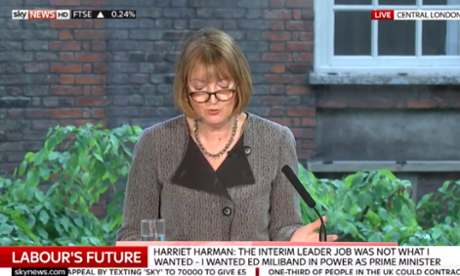
Harriet Harman, Labour’s acting leader, is delivering her speech on the Labour leadership contest now.
She started by arguing that Labour could come back from its defeat and win in 2020. In 1992 Labour also suffered a surprise defeat, which led many people to think it would be out of power for good, but five years later it won a landslide, she said.
I will post more from the speech when I’ve seen the full text.
On the Today programme earlier Len McCluskey’s comments about Labour (see 9.05am) were criticised by Margaret Prosser, a Labour peer, former party treasurer and former deputy general secretary of the TGWU union (which merged with Amicus to become Unite). She told the programme.
I feel really cross when I’m hearing Len [McCluskey] speak because the union belongs to me as much as it does to him, and nobody has asked me, or, as far as I can tell, any of the rest of the membership, what their views are about all of this. And, frankly, the idea that the whole focus of Labour’s proposal or offer ought to be around organised labour is just daft.
Of course I’m absolutely committed to the role of organised labour, and the role of trade unions. There’s absolutely no doubt about that. But if Labour is going to win an election in the United Kingdom, it’s got to get the votes of people in the south of England, many of whom are not trade union members and don’t know the first thing about trade unions and whose lives operate in a rather different fashion. We have to be able to say that a government, a Labour government, is going to be there for all kinds of people. Just focusing on one group is completely silly and what happened on May 7 demonstrates that.
Good morning. It looks as if two issues are going to dominate today.
The future of Labour
Len McCluskey, the leader of the Unite union, is all over the papers today following his warning that Unite may rethink its relationship with Labour if the party picks the wrong leader. Here’s the Guardian’s version of the story, and the Times has splashed on something very similar.
Monday's Times front page: Union holds Labour to ransom over leadership #tomorrowspaperstoday #bbcpapers pic.twitter.com/sieX2ooFQ8
— Nick Sutton (@suttonnick) May 17, 2015
This morning the BBC has revealed that Unite is expected to debate breaking the link with Labour at its conference in July.
The @unitetheunion say they expect to debate ending historic link with Labour at July conference
— norman smith (@BBCNormanS) May 18, 2015
But McCluskey is not backing the move.
Sources at @unitetheunion say Len McCluskey will "not support such a change."
— norman smith (@BBCNormanS) May 18, 2015
Harriet Harman, Labour’s acting leader, is giving a speech this morning about how the leadership election will be conducted. Some extracts have already been released, and Harman will be announcing that non-members will be encouraged to attend the hustings.
So I want to see party meetings where members bring non-members. Where someone who voted Labour brings along someone who voted Tory or SNP Or didn’t vote at all. And I want to see the contenders show how they make their case to those people. And I think we should let the public in on all of that.”
Let’s welcome non-supporters into our discussions too. Not to vote in our internal elections but to be a part of them. That’s why our hustings have got to be different.
We need robust tough televised hustings which involve the public.
We have begun talks with broadcasters about how we make these happen. We are very open and keen to make this work. As interim leader, I have one principle here - let the public in.
David Cameron’s NHS speech
David Cameron is devoting his first big speech since the election to the NHS. As Nicholas Watt reports in his preview story in today’s Guardian, that is deliberate.
David Cameron will pledge to deliver the world’s first seven day-a-week universal health service that will guarantee care to patients “wherever they are and whenever they need it”.
In a sign of Downing Street’s determination to occupy territory seen as the preserve of Labour, the prime minister will use his first major speech since his re-election to promise that the NHS will be safe in his hands for “every generation to come”.
The prime minister will say in a speech at a GP centre in the Midlands that the Tories will deliver on their manifesto commitment to provide an extra £8bn a year in funding to the NHS by the end of the parliament.
The Independent today is splashing on a story based on the Royal College of Nursing (RCN) chief executive Peter Carter saying nurses would resist any changes to payments they receive for working outside office hours. Carter told the paper:
I would particularly give a really strong warning to the Secretary of State: any attacks on unsocial hours, weekend working payments, would be strongly resisted.
The membership is quite clear: unsocial hours, weekend working, Christmas Day and bank holidays - they get a very modest higher level of remuneration. Any attack on that and I do fear it would result in industrial action.
Monday's Independent front page: Nurses may call strike over seven-day NHS plans #tomorrowspaperstoday #bbcpapers pic.twitter.com/khuMAWPHmY
— Nick Sutton (@suttonnick) May 17, 2015
Jeremy Hunt, the health secretary, told the BBC this morning that the RCN was jumping the gun”. He said:
We haven’t made any proposals whatsoever about changing nurses’ terms and conditions ... Eight days into a new Government, I hope you’ll forgive me if I don’t negotiate on air about every single aspect of doctors’ and nurses’ conditions. That’s not our proposal.
I think the RCN should talk to their members and, rather than grandstanding like this, should come and talk to me. They want the NHS to be the safest in the world, I want that and it’s what patients who use the NHS want, and I’m sure if we work together we can find a way of delivering that.
Chris Ham, chief executive of the health thinktank the King’s Fund, told the Today programme that Cameron’s inititative was welcome, but that the NHS would need more money.
This is absolutely the right thing to do – we know sadly that death rates in hospitals are higher at weekends than during the normal working week. So we need to get senior doctors [and] consultants there Saturdays and Sundays as well as other parts of the week, to provide the highest possible standards of care, and the government should be congratulated for wanting to do that. But there’s a price tag attached, and it’s promised and extra £8bn a year by 2020 - again that’s to be welcomed - but will really help to keep existing services running; it won’t fund all the new commitments we’ve heard of during the election campaign, including seven day working.
But Hunt told the today programme that the extra £8bn pledged by the Tories was just a “minimum”.
Jeremy Hunt points out David Cameron will commit to a 'minimum' of £8bn extra for the NHS #r4today
— Paul Waugh (@paulwaugh) May 18, 2015
Agenda
Here is the diary for the day.
9.15am: Harriet Harman delivers her speech.
11.25am: Cameron delivers his NHS speech.
2.30pm: The Commons meets for the first time since the election, and elects the Speaker. John Bercow is expected to get re-elected.
As usual, I’ll be covering all the breaking news as it happens, as well as bringing you the best comment and analysis from the web.
If you want to follow me on Twitter, I’m on @AndrewSparrow.