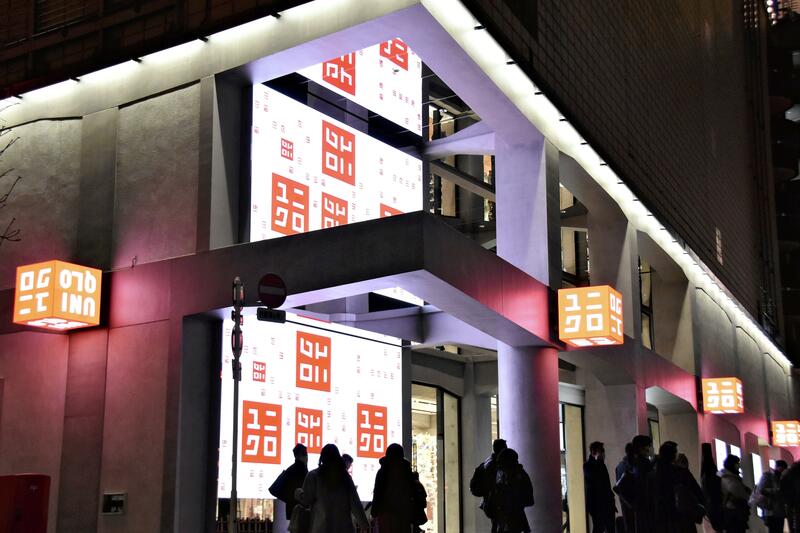
Fast Retailing Co. announced Thursday that it will cut the prices of all products in its Uniqlo and GU casual clothing stores by about 9% starting March 12. Companies have been rethinking their pricing strategies in response to the mandatory "total price labeling" of products and services, which will require labels to include consumption tax, starting in April.
The company has been labeling clothing and other items with the pre-tax price followed by the notation "plus tax." Thus, a product labeled with a price of 1,990, yen for example, now actually costs 2,189 yen at the checkout with the 10% consumption tax included. But from March 12, the tax-inclusive price tag will show 1,990, yen which is effectively a discount.
Uniqlo's mainstay is everyday clothing, and its performance has been strong even amid the spread of the novel coronavirus. However, in 2014 and 2015, the company gradually raised its prices due to the weakening yen and increased raw material costs, causing some customers to leave.
In response to the public's growing frugality, Uniqlo will now offer more value for money by lowering prices.
When the consumption tax was introduced in 1989, there were no regulations on price labeling, and price labels with or without tax were mingled together.
To make it easier for consumers to understand the amount they are actually paying, total price labeling was made mandatory in 2004. But in 2013, when the tax rate was set to increase to 8% in April 2014, tax-exclusive labeling was allowed as a special measure.
This special measure will expire at the end of March.
Read more from The Japan News at https://japannews.yomiuri.co.jp/