In 2008 Unilever’s factories sent 140,000 tonnes of waste to landfill – roughly 30 Big Bens in volume.
That year marked the start of the company’s commitment to send zero non-hazardous waste to landfill, aiming to keep waste to 2008 levels despite projected growth. The original idea was to do this by 2020 but the multinational overshot its target.
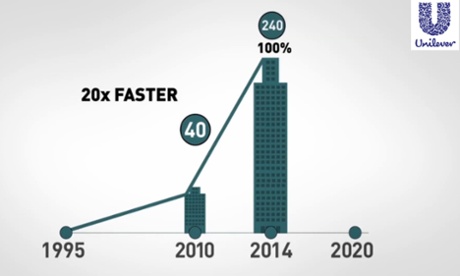
Getting all UK manufacturing sites to zero non-hazardous waste was the first big win and by 2010, 40 of Unilever’s sites were at this level. Just four years later the company had achieved this at over 240 sites. Now all of its factories send zero waste to landfill, saving €220m (£159m) and creating 1,000 jobs in the process.
How did Unilever achieve zero waste to landfill so quickly – and with little to no capital investment? It developed a number of repeatable solutions.
In the UK it replaced several waste contractors with one nationwide partner to manage manufacturing waste, repeating this approach in Europe, then North America. In developed countries more than half the waste was tackled through traditional recycling and by sending the small residual volumes to be turned into energy.
But those solutions weren’t always feasible in developing countries where Unilever often faced huge hurdles, either through difficult geopolitical or social environments, or lack of infrastructure.
So a wide range of innovative local solutions emerged. In the Philippines sludge from the waste-water treatment process was converted into decorative building blocks. Kenya repurposed laminated wrapper waste into a versatile construction material for roofing and fencing. In Russia and Australia, where distance plays a significant role in getting anything done, suppliers collect waste materials for reblending. The increase in recycled cardboard alone has cut emissions equivalent to taking 10,000 cars off the roads.
As the zero-waste project took hold, Unilever realised the programme had created momentum. Asking its people to tell their own stories in order to spread knowledge and expertise across the globe had a viral effect among employees and factories. Individuals took responsibility for achieving zero waste – not because Unilever had told them to, but because they wanted to.
The Guardian judges applauded Unilever’s achievement, saying: “It’s an impressive example of a big impact and a coordinated shift in business practices.”