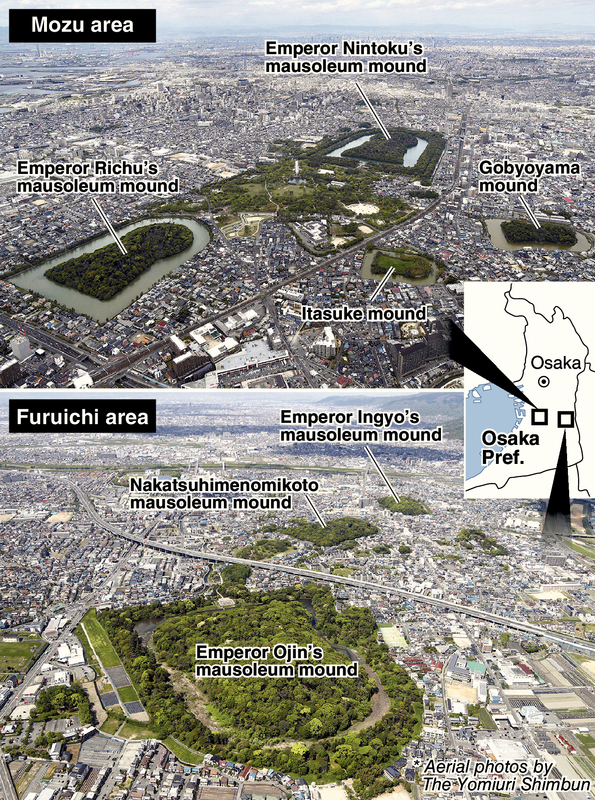
A UNESCO advisory panel has recommended adding a group of ancient tombs in Osaka Prefecture to the World Cultural Heritage list, Japan's Cultural Affairs Agency announced Tuesday.
Collectively called the Mozu-Furuichi tumulus clusters, the sites are expected to be officially approved at a meeting of the World Heritage Committee starting June 30 in Azerbaijan.
The group of burial mounds, or kofun in Japanese, was built from the late fourth to the late fifth centuries -- amid the height of the Kofun period (ca 300-ca 710) -- on the southern Osaka Plain, which was a political hub at the time.
The Mozu-Furuichi tumulus clusters comprise 49 mounds of various shapes and sizes, including rectangular tombs in the 20-meter range. They also include the country's largest keyhole-shaped mound: Emperor Nintoku's mausoleum, also known as Daisen Kofun, which is 486 meters long.
The sites are spread over two areas: the Mozu clusters in the city of Sakai that include the Emperor Nintoku mausoleum, and the Furuichi clusters spreading over the two cities of Habikino and Fujiidera that include the Emperor Ojin mausoleum -- also known as Kondagobyoyama Kofun -- the second-largest in Japan with a length of 425 meters.
The International Council on Monuments and Sites (ICOMOS) praised the sites for reflecting sophisticated funerary practices and the stratified political and social structure of the period. It also said the manner in which the sites have been preserved and managed warranted their recommendation.
There had been concern that the status quo of not allowing scientists to enter the sites' 29 mausoleums, in principle, to identify the deceased would hamper efforts to prove the worthiness of the sites as a World Heritage site. However, no such complaint was raised by ICOMOS.
In recent years, almost all sites recommended by ICOMOS have been adopted by the committee to be registered as a World Heritage site.
If adopted, the tumulus clusters will be the 19th sites in Japan to be recognized as cultural heritage sites after "Hidden Christian Sites in the Nagasaki Region" in Nagasaki and Kumamoto prefectures last year. If natural assets are included, the clusters will become Japan's 23rd World Heritage site overall.
Read more from The Japan News at https://japannews.yomiuri.co.jp/


.jpg?w=600)