Summary
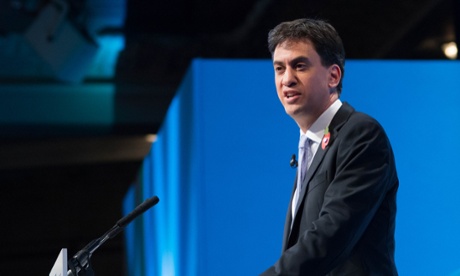
- Ed Miliband has faced a setback 24 hours ahead of what is billed as an important speech with the publication of a poll showing Labour three points behind the Conservatives, and Miliband’s own personal ratings hitting a record low.
- Ministers have welcomed employment figures showing that unemployment is down that that pay (excluding bonuses) is now rising faster than inflation for the first time in five years. (See 9.46am and 10.17am.)
- Police are examining a claim that a senior Liberal Democrat ordered a personal assistant to destroy a document containing allegations of abuse and mismanagement against the late paedophile MP Cyril Smith. As Rajeev Syal reports, Liz Lynne, who is standing to become the party’s president, is alleged to have told her constituency aide Deborah Doyle to get rid of a document detailing allegations of a coverup at the Knowl View children’s home in Rochdale.
That’s all from me for today. I’ve got a meeting this afternoon.
Thanks for the comments.
A Rochester byelection round-up
Here’s a Rochester byelection round-up.
-
The Conservatives have challenged the Ukip candidate, Mark Reckless, to say whether he agrees with Nigel Farage’s suggestion that the NHS should be turned into an insurance-based system run by private companies.
Hi @MarkReckless , do you agree with @Nigel_Farage that we should break-up NHS & move to a health insurance system? http://t.co/Ft1b2YUBJF
— CCHQ Press Office (@CCHQPress) November 12, 2014
There are two particular details of the Ashcroft poll that should really haunt their dreams.
The first is that Ukip, once an amateurish shambles of a party, is getting better at the ground game. It has matched the Tory machine blow for blow in Rochester. Some 81 per cent of Rochester voters have had literature, direct mail, visits, telephone calls or emails from the Conservatives. And 84 per cent said the same of Ukip. OK, it’s one by-election, and Ukip would surely struggle to match the Tory effort nationwide. But it still suggests the insurgents are professionalising, quickly.
By essentially withdrawing from this battle Labour is again easing the rise of Ukip. Were Labour taking the contest more seriously then Ukip’s lead would be significantly diminished and the race would be far more competitive. But they are not.
This is striking given that Labour controlled this area as recently as 2010, is the main party of opposition and has an impressive candidate in Naushabah Khan. The Labour candidate is especially strong when set against the abrasive Conservative candidate Kelly Tolhurst. Having watched both candidates in a televised debate last night (watch it here) it is the former that appeared as the better candidate. I am convinced that the Conservatives got this wrong -they should have stood a calmer, more inclusive and ultimately a more experienced candidate that non-Ukip voters could rally around. This mistake might be repeated in Thanet South where the Conservatives are again standing a similar ‘Ukip-lite’ candidate against Nigel Farage.
-
And Rafael Behr offers this take on David Cameron’s calls for voters in Rochester to back the Tories tactically to keep Ukip out.
So Cameron message in Rochester has now become: we agree with Ukip, if you disagree with them vote for us!
— Rafael Behr (@rafaelbehr) November 12, 2014
Peter Riddell, director of the Institute for Government, has an interesting take on today’s poll.
Latest @IpsosMORI poll shows just 61 per cent support for two main parties. So one big party and third may not add up to Commons majority
— Peter Riddell (@_peterriddell) November 12, 2014
All recent polls show need to start thinking now about how a minority government would work with more than one other party in the Commons
— Peter Riddell (@_peterriddell) November 12, 2014
Riddell may well be right. I’m starting to think that the most important post-election calculation will not be whether the Conservatives have more seats than Labour, but whether the Conservative/Lib Dem/DUP/Ukip total is bigger than the Labour/Lib Dem/SNP/Green total.
Anthony Wells at UK Polling Report has written a post on today’s poll. As usual, he’s full of good sense. We should keep things in perspective, he says.
Here’s an extract.
As usual it’s the unusual poll that gets the attention, when it should be the trend. The fieldwork for the poll was conducted between Saturday and Monday when the media was full of stories about Labour having a leadership crisis, so naturally enough people have concluded that Labour’s leadership row has damaged them in the polls.
Except the MORI poll wasn’t the only poll conducted at the weekend. ICM also had a poll in the field at the same time, which showed Labour one point ahead (though down three on the previous month). Lord Ashcroft also had a poll conducted at the weekend, which showed a one point Conservative lead, but no change from the previous week ...
The fact that this is the largest Conservative lead and the lowest Labour score for years is meaningful in its own way. It’s reflection of a general trend that has shown Labour drop from an average lead of around six points at the start of year, to an average lead of around about one point now.
And Isabel Hardman has written about the poll at Coffee House. Here’s an extract.
The Labour leader does need to reassure his party that going neck-and-neck and sometimes behind the Tories is not a symptom of Labour’s weaknesses but a feature of the era of multi-party politics which means that no mainstream party can expect a poll lead. That the Tories are on 32 per cent is hardly a sign of strength, either.
Here are the full Ipsos MORI figures, based on those certain to vote, which I’ve taken from the survey summary (pdf).
Conservatives: 32%
Labour: 29%
Ukip: 14%
Lib Dems: 9%
SNP: 8%
Greens: 7%
And here is some Twitter comment on the poll.
From Rob Ford, an academic
Re Con 3 pt lead with MORI - MORI have tough turnout filter, low Lab enthusiasm may be depressing their share more with them
— Rob Ford (Britain) (@robfordmancs) November 12, 2014
From May2015, the new New Statesman election website
The Tories are polling at a lower level than Michael Howard managed when crushed in 2005. Scarcely winning. Crosby gets you 32% and no more?
— May2015 (@May2015NS) November 12, 2014
Our 4-day avg of the polls puts Lab & Tories on 31.9%. That would mean 315 LAB, 273 CON, 30 LD, 3 UKP (incl Ashcroft) pic.twitter.com/Ip1pMMrjJS
— May2015 (@May2015NS) November 12, 2014
From the Times’ Sam Coates
Ed Miliband's make or break speech tomorrow needs to tackle poll deficit after Ipsos Mori: Con32 (+2) Lab 29 (-4) LD 9 (+1) Ukip 14 (-2)
— Sam Coates Times (@SamCoatesTimes) November 12, 2014
From the Daily Mirror’s James Lyons
Ipsos Mori poll would give Labour 308 Mps, Tories 278, LDs 34 and "others" 30 according to BBC seats calculator http://t.co/YleGd7hA98
— JamesLyons (@_James_Lyons_) November 12, 2014
Here’s Bobby Duffy, the Ipsos MORI managing director, on the figures.
The interviewing for this poll was conducted at the height of the very public discussion of a possible challenge to Ed Miliband’s leadership of the party – and it looks like it’s had a significant effect on public opinion. The Labour leadership will clearly hope that this marks a low point - they’ve lost the lead to the Conservatives in overall voting intention, but they’re still within touching distance, despite all the negative coverage.
The figures for Labour, and Ed Miliband’s, readiness to enter government are very poor.
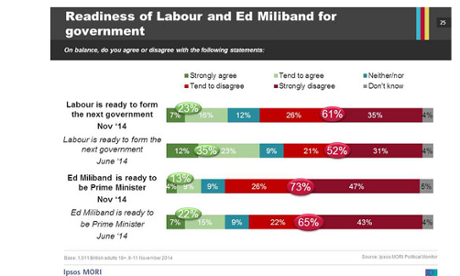
According to the pollster, on this measure, Ed Miliband is doing even worse than William Hague and Iain Duncan Smith. (Their bold.)
More than five times as many Britons disagree that Ed Miliband is ready to be Prime Minister than agree. Three in four (73%) disagree that Mr Miliband is ready to be Prime Minister, including 53% of Labour supporters; just 13% of Britons (and 35% of Labour supporters) think he is ready. This is the lowest proportion to back the Leader of the Opposition as ready for the premiership that we have recorded, going back to Tony Blair in 1994. William Hague’s lowest score was 18% in May 2000, while Iain Duncan Smith had 16% agree he was ready to be Prime Minister in September 2003. Fewer Britons think Mr Miliband is now ready to be Prime Minister now (13%) than was the case less than a year into his leadership in May 2011 (17%).
You can read full details of the poll on the Ipsos MORI website here.
Many pollsters use turnout weighting, but Ipsos MORI only use figures from those certain to vote for their headline figures. On this measure, the Tories are three points ahead. Amongst all those expressing a voting intention, Labour and the Tories are both on 30%.
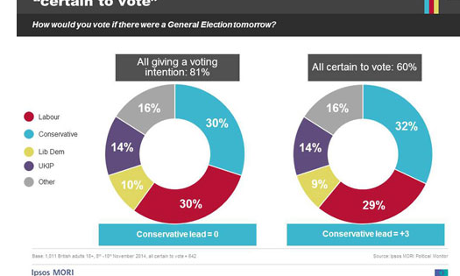
And here’s an extract from the Ipsos MORI commentary. (Their bold.)
Support for the Labour Party is at the lowest level since the final days of Gordon Brown’s premiership, November’s Ipsos MORI Political Monitor reveals. Labour are down four points to 29%, their first score below 30% of the vote since before the last general election, while the Conservatives are up two points to 32%, giving them a three-point lead. This is a turnaround since last month, prior to recent media rumours of a Labour leadership challenge, when Labour held a three-point lead on 33% over the Conservatives’ 30%. UKIP are down two points from last month’s high on 14%, while the Liberal Democrats are up one point to 9%.
Updated
Joe Murphy, the Evening Standard’s political editor, has more on the Ipsos MORI poll.
Just 13% of public think Ed Miliband is "ready to be PM". 73% say he not, reveals @ipsosMORI in tonight's @standardnews
— Joe Murphy (@JoeMurphyLondon) November 12, 2014
But as @IpsosMORI 's own Bobby Duffy points out, the poll was taken after days of public in-fighting in Labour's ranks ...
— Joe Murphy (@JoeMurphyLondon) November 12, 2014
Tory 3-pt lead is biggest since 2010 ... but what a pathetic low vote share at just 32% #WaroftheWeak @IpsosMORI @standardnews
— Joe Murphy (@JoeMurphyLondon) November 12, 2014
Tories have 3-point lead over Labour, says Ipsos MORI poll
An Ipsos MORI poll gives the Tories a three-point lead.
That Evening Standard/Ipsos MORI poll in full: CON - 32 (+2) LAB - 29 (-4) LD - 9 (+1) UKP - 14 (-2)
— May2015 (@May2015NS) November 12, 2014
You can read all today’s Guardian politics stories here. And all the politics stories filed yesterday, including some in today’s paper, are here.
As for the rest of the papers, here’s the PoliticsHome list of top 10 political must-reads, and here is the ConservativeHome round-up of all today’s political stories.
And here are four articles I found particularly interesting.
In economics it is well known that there is a market failure, or shortage, in scientific research. The cost of the research is borne by the small number who conduct and pay for it, while the benefits go to everyone. As a result, not enough research is done.
In exactly the same way, there is a market failure in political coups. Those who pay the cost of a coup (the people who initiate it) don’t get enough of the benefit (which is spread). So coups are under-supplied.
Let’s use this model to look at some modern coups that happened or failed to happen. It was obvious that Gordon Brown was going to lead Labour to defeat in 2010. The entire party would benefit from his departure and everyone knew it. Yet the coup failed to happen. This was entirely predictable.
Mr Brown and his allies had the ability to exact revenge, not just immediately but for some time to come. So rebelling against him was potentially very costly for anyone who tried to get rid of him and failed. Anyone who moved against him and succeeded could not be certain to benefit from it personally ...
Contrast this with the coup against Tony Blair. It wasn’t in the party’s interest but it was in the interest of many individuals. The gain to Labour was non-existent but rebels were guaranteed a reward and protection by Gordon Brown. So the coup happened.
Scotland has been protected from hundreds of millions of pounds of public spending cuts because of a “flaw” in the formula used to calculate its grant from London, an independent think-tank said on Wednesday.
The Institute for Fiscal Studies said the treatment of business rates by the Barnett formula, which calculates changes in the block grant based on UK government spending decisions, “might be considered unfair to England and Wales”.
Business and energy minister Matthew Hancock revealed that the Government is preparing to announce plans for a ‘sovereign wealth fund’ to hold the revenues from fracking for the north of England.
Such state-owned funds have been set up in the Middle East and Norway to generate huge sums from the proceeds of oil and gas exploration.
They invest in assets such as stocks, property, infrastructure and precious metals, with proceeds able to fund public spending. Chancellor George Osborne is expected to unveil details of a fund in his autumn statement next month.
Ken Livingstone and George Galloway will tonight ride to the rescue of a beleaguered mayor who faces being stripped of his powers by Eric Pickles.
Labour’s united front against Lutfur Rahman will be smashed as Mr Livingstone and a fellow member of the party’s national executive join a parade of left-wingers at a rally demanding an end to the “witch-hunt” of Britain’s first elected ethnic minority mayor.
Some insiders are dismayed that Labour figures will be sharing a platform with Mr Galloway, whose inflammatory anti-war rhetoric led to his expulsion from the party.
You know what Nigel Farage thinks about immigration and the EU. But what about the BBC, or welfare? My colleagues have produced this video guide to what Nigel Farage really thinks ...
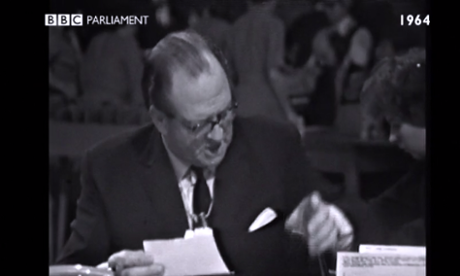
If anyone is a bit bored with Sky or BBC News this morning, I’d thoroughly recommend the Parliament channel. They’re showing the results programme from the 1964 general election.
Updated
And here is some more Twitter comment on the employment figures.
From Duncan Weldon, BBC Newsnight’s economics correspondent
Until recently a lot of job growth post recession has been self employment, part-time, etc. That 'seems' to be changing. Growth now 1/2
— Duncan Weldon (@DuncanWeldon) November 12, 2014
driven by full time employee jobs. And that is starting to help push up wages & productivity. 2/2
— Duncan Weldon (@DuncanWeldon) November 12, 2014
Rising vacancies are a very healthy sign for the labour market. pic.twitter.com/QoQay6V3HJ
— Duncan Weldon (@DuncanWeldon) November 12, 2014
Ratio of unemployment to job vacancies not yet back to pre-recession levels, but looking healthier. pic.twitter.com/wn71SNxxKn
— Duncan Weldon (@DuncanWeldon) November 12, 2014
From Robert Peston, the BBC’s economics editor
Regular pay in private sector up 1.6%, vs 1.2% inflation, so maybe (maybe) end of longest recorded squeeze in living standards is in sight
— Robert Peston (@Peston) November 12, 2014
The official employment rate, at 73% of available workforce, is back at pre-recession record. But structure of workforce much changed
— Robert Peston (@Peston) November 12, 2014
From Reuters’ Jamie McGeever
UK wage growth (ex-bonuses) above inflation for the first time in 5 years: pic.twitter.com/0Y2rPjhg7F
— Jamie McGeever (@ReutersJamie) November 12, 2014
From Norman Smith, the BBC’s political correspondent
Today is the first time earnings (excluding bonuses) have outstripped prices since sept 2009
— norman smith (@BBCNormanS) November 12, 2014
Updated
Here are some more comments on the employment figures.
From Geraint Johnes, director at Lancaster University’s Work Foundation
The labour market statistics released today indicate continued strengthening of the economy. Employment has increased by 112,000 over the quarter, while unemployment has fallen by 115,000. This keeps unemployment at the 6.0% rate reported last month.
Numbers of self-employed have fallen over the quarter by some 87,000, with 78% of these having been part-time. Meanwhile the number of employees has increased by 196,000, and 72% of this growth is in full-time employment. All these trends suggest that the labour market is gradually returning to normal, with fewer people in relatively insecure posts.
Total pay including bonuses continues to rise only slowly, however, and are indeed still falling in real terms. Wage growth amounted to just 1% over the last year, well below the rate of price inflation. There are some signs of faster wage growth - again in manufacturing and construction - but nominal wages are falling in the distribution sector. Increased business investment should see productivity rise over the next few months, and real wage increases can be expected to follow that. But overall the picture remains one in which there is labour market slack, and we cannot on the back of that expect any tightening of monetary policies in the immediate future.
From Paul Kenny, general secretary of the GMB
Many of the new jobs are precarious and badly paid while the real value of take-home pay for the rest of the workforce is 13% below pre-recession levels.
Although 898,000 workers have left public sector employment since 2010, the deficit is still 100 billion because this increased economic activity is not generating more income from taxes.
The Tory recipe to get a recovery in pay and income from taxes is even more savage cuts in public spending and public sector jobs.
From John Allan, chairman of the Federation of Small Businesses
To reach full employment, ministers should focus on boosting skills while maintaining labour market flexibility.
We know that taking on a member of staff can be expensive for small firms, yet they continue to be the source for a large proportion of new job creation. If this is to continue, Government should redouble its efforts to cut the costs of doing business.
Regional unemployment figures
Here are the regional unemployment figures. I’ve taken them from the Press Association.
Region - unemployment between July and September - change from previous quarter - unemployment rate as a percentage
North East - 118,000 - minus 2,000 - 9.2%
North West - 219,000 minus - 23,000 - 6.3%
Yorkshire and The Humber - 194,000 - minus 12,000 - 7.2%
East Midlands - 132,000 - plus 6,000 - 5.6%
West Midlands - 200,000 - minus 15,000 - 7.2%
East of England - 154,000 - minus 2,000 - 4.9%
London - 287,000 - minus 47,000 - 6.3%
South East - 212,000 - plus 9,000 - 4.6%
South West - 129,000 - minus 13,000 - 4.7%
Wales - 98,000 - no change - 6.6%
Scotland - 164,000 - minus 10,000 - 5.9%
Northern Ireland - 53,000 - minus 6,000 - 6.0%
And here is Rachel Reeves, the shadow work and pensions secretary, on the employment figures.
Today’s fall in overall unemployment is welcome, but after four years when prices have risen faster than wages there is a huge amount of lost ground to catch up. Working people are now over £1,600 a year worse off than when David Cameron came to office, most people are not feeling any recovery and the link between the wealth of the nation and family finances remains broken.
The government has failed to tackle low pay and as the OBR has said, stagnant wages and too many low-paid jobs are leading to rising borrowing.
Labour welcomes figures but warns against complacency
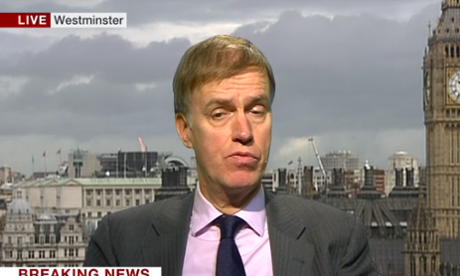
And Stephen Timms, the shadow employment minister, has been on BBC News too. He said that the fall in unemployment was welcome but that there were “no grounds for complacency”.
I very much welcome the fact that unemployment has fallen again. That’s good news. There’s absolutely no grounds for complacency here, however, because the figure for youth unemployment in the three months to September is actually slightly higher than in the three months to August. Long-term unemployment among women over 50 has gone up. So youth unemployment, long-term unemployment, remain very serious problems.
Duncan Smith criticises TUC for being too negative about employment figures
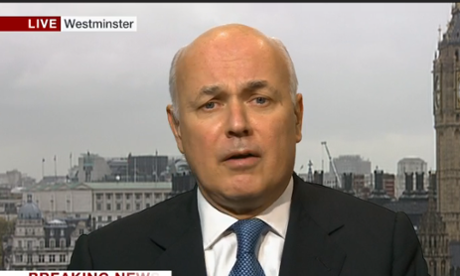
You can tell the employment figures are good: Iain Duncan Smith, the work and pension secretary, has been on TV himself to talk about them, instead of leaving it to a junior minister.
Here are the key points he made.
-
Duncan Smith said welcomed the fact that salaries (excluding bonuses) are rising faster than inflation and said salaries would continue to rise.
And I think the progression, as the CBI and others will tell you, the forecast for next year, is that they will get higher.
For people who have been in work for more than a year, pay is going up on average by around 3.7%, he said.
-
He said the new jobs being created were overwhelmingly professional and full-time.
Two thirds of these jobs are managerial, professional jobs. and almost all of them this time round are of course full-time. We constantly get this jibe that this is not about full-time work. Oh yes it is. Full-time work is absolutely the key to this.
-
He criticised the TUC for being too negative about the employment figures.
Every month they put a really terrible doom and gloom message in advance of these figures. Every month I think they’re wrong. But I do wish they would smell the coffee and wake up over this. The reality is if they were sitting in any other country in Europe right now they would be saying this is quite remarkable.
I was in Italy only a week or so ago and talking to the employment minister there. What did he want to ask me about? How is it that you are now creating jobs in the UK. So everybody else, except for them, wants to think this is positive.
- He said the employment figures were “rather remarkable”.
- He said around 13,000 people a week were getting back into work.
-
He said youth unemployment was “falling like a stone”.
Employment hits record high as joblessness falls by 115,000
And here’s a summary of the figures from the Press Association.
A record number of people are in work after another huge fall in unemployment, new figures have shown.
The jobless total fell by 115,000 in the quarter to September to 1.96m, the lowest figure since the start of the year.
The number of people claiming jobseeker’s allowance was 931,700 in October, 20,400 down on September, and the 24th consecutive monthly cut.
Employment increased by 112,000 in the latest quarter to 30.7m, the highest since records began in 1971, the Office for National Statistics (ONS) reported.
The number of non-UK nationals working in this country increased by 230,000 over the past year to 2.9m, while the figure for UK nationals went up by 445,000 to almost 28m.
Pay, including bonuses, was 1% higher than a year ago and excluding bonuses went up by 1.3%, the first time the figure was above CPI inflation for five years.
The 1% average earnings figure is 0.3% higher than last month.
Around 14.7% of workers, or 4.5m, are self-employed, down by 88,000 on the quarter but up by 279,000 on a year ago, while the number of part-time workers wanting a full-time job remained at around 1.3m.
There were just over nine million people classed as economically inactive, including students, long-term sick or those who have given up looking for work, 38,000 more than between April and June.
Here is a full quote from George Osborne, the Conservative chancellor, on the unemployment figures.
Today’s figures are a strong sign that our long term economic plan is working. We’ve seen another big fall in unemployment, record numbers of jobs, and encouraging signs that pay cheques are beginning to rise faster than inflation. If we want to keep Britain on this path then we need to keep working through our economic plan.
And this is from Danny Alexander, the Lib Dem chief secretary to the Treasury.
Britain is in the fast lane of job creation. The British economy has created over 1.7m new jobs since we formed the coalition in 2010, pushing total employment to a record high of 30.79m. On average, that’s a new job created every minute of every 24hr working day. But these welcome figures are so much more than mere numbers. Every job created helps someone build or secure a livelihood. This, combined with the news that September regular pay growth has significantly exceeded inflation, is real progress in building the stronger economy and fairer society that we aspire to.
Here’s Duncan Weldon, BBC Newsnight’s economic correspondent, on the figures.
Unemployment a touch higher than expected but wage growth a bit stronger. Hours worked up 0.1% last quarter vs GDP +0.7% = productivity up.
— Duncan Weldon (@DuncanWeldon) November 12, 2014
Job growth being driven by full time employee positions. Self employment down again.
— Duncan Weldon (@DuncanWeldon) November 12, 2014
George Osborne, the chancellor, has welcomed the figures.
Today's stats show record number of jobs &big fall in unemployment.Encouraging signs that pay cheques starting to rise faster than inflation
— George Osborne (@George_Osborne) November 12, 2014
Pay, excluding bonuses, is now rising faster than inflation - just.
It is only one month, but pay excluding bonuses actually rose teeny weeny bit faster than inflation in Sept (1.3% vs 1.2%)
— Robert Peston (@Peston) November 12, 2014
And here are more details from the Office for National Statistics.
- Comparing the estimates for July to September 2014 with those for April to June 2014, employment continued to rise and unemployment continued to fall. These changes maintain the general direction of movement since late 2011/early 2012.
- There were 30.79 million people in work. This was 112,000 more than for April to June 2014 and 694,000 more than for a year earlier.
- The proportion of people aged from 16 to 64 in work (the employment rate), was 73.0%, higher than for April to June 2014 (72.8%) and higher than for a year earlier (71.6%).
- There were 1.96 million unemployed people, 115,000 fewer than for April to June 2014 and 529,000 fewer than for a year earlier.
- The unemployment rate was 6.0%, lower than for April to June 2014 (6.3%) and lower than for a year earlier (7.6%). The unemployment rate is the proportion of the economically active population (those in work plus those seeking and available to work) who were unemployed.
- There were 9.03 million people aged from 16 to 64 who were out of work and not seeking or available to work (known as economically inactive). This was 38,000 more than for April to June 2014 but 16,000 fewer than for a year earlier.
- The economic inactivity rate was 22.2%, little changed compared to April to June 2014 (22.1%) and compared to a year earlier (22.3%).
- Pay including bonuses for employees in Great Britain was 1.0% higher than a year earlier. Pay excluding bonuses for employees in Great Britain was 1.3% higher than a year earlier.
And here is the ONS statistical bulletin (pdf) with the full details.
Here are the headline unemployment figures.
- Unemployment fell by 115,000 between July and September, to 1.96m.
- The number of people claiming jobseeker’s allowance last month fell by 20,400 to 931,700.
- Average earnings increased by 1% in the year to September, 0.3% up on the previous month.
For the record, here are today’s YouGov GB polling figures.
Labour: 34% (up 1 from YouGov yesterday)
Conservatives: 33% (up 1)
Ukip: 15% (down 2)
Lib Dems: 7% (up 1)
Greens: 6% (no change)
Labour lead: 1 point
Government approval: -26 (down 2)
According to Electoral Calculus, this would give Labour a majority of 6.
The big story is in the City this morning, where record fines have been imposed on five banks for rigging the foreign exchange market.
In total, regulators in the UK and the US have imposed fines worth £2bn. My colleague Jill Treanor has the story here, and here’s how it starts.
The corruption of the world’s biggest currency dealers has been laid bare with regulators imposing fines of £2bn on five major banks for rigging the £3.5tn a day foreign exchange markets.
Regulators said they had found for a “free for all culture” rife on their trading floors that has allowed the markets to be rigged for five years.
The much-anticipated record settlement with US and UK regulators did not include Barclays, which remains in discussions with other regulators.
The UK fines are worth £1.1bn. There are more details in this news release from the Financial Conduct Authority.
This is a City story and my colleague Graeme Wearden is covering it in detail on his business live blog. He’s been going since 6.20 this morning and his blog is covering all the detail and reaction.
But the politics of this are quite interesting too. George Osborne has strongly welcomed the decision. If a Labour chancellor were taking £1.1bn from the banks through punitive taxation, Osborne would be the first to complain. But, when a regulator takes the money, he’s the first to applaud.
The House of Commons is having a mini recess for the rest of the week, and the political diary looks quite thin. Here’s the agenda for the day.
9.30am: Unemployment figures are released
10am: Lord Thomas, the lord chief justice, holds his annual press conference.
10.30am: Mark Carney, the Bank of England governor, holds a press conference to mark the publication of the Bank’s quarterly inflation report. Graeme will be covering this on his business live blog.
10.35am: Ed Davey, the energy secretary, gives a speech to the Renewable UK conference.
As usual, I will be also covering all the breaking political news from Westminster, as well as bringing you the most interesting political comment and analysis from the web and from Twitter. I will post a summary at lunchtime, but I will be wrapping up after that because I’ve got a meeting this afternoon.
If you want to follow me on Twitter, I’m on @AndrewSparrow.