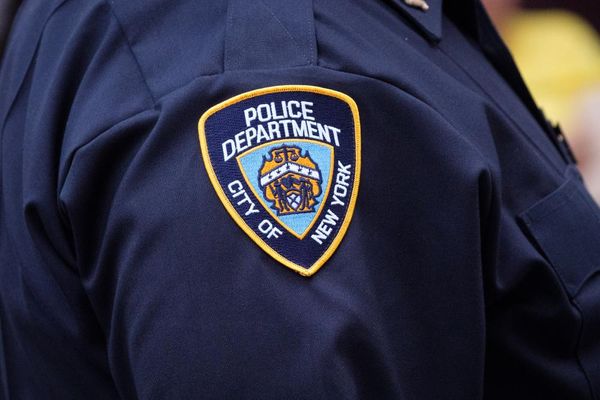
MILWAUKEE _ With neighbors sweeping debris from scorched businesses, and political and religious leaders urging calm, Milwaukee began to come to terms Sunday with the night of fire and violence that followed the fatal shooting of a 23-year-old armed suspect by a 24-year-old police officer.
Less than 24 hours after the uprising, however, Milwaukee was still not at peace with rocks being thrown at police officers and gunshots ringing out in the Sherman Park neighborhood.
About 11 p.m., police had to move in and disperse a crowd at Sherman Boulevard and Burleigh Street, after protesters started throwing objects. Milwaukee police said that they used an armored vehicle to rescue a shooting victim in the 3000 block of North Sherman Boulevard. The victim was taken to a hospital.
Milwaukee Police said an officer was taken to a hospital after suffering an injury when a thrown rock broke the windshield of a squad car.
Just after midnight, lines of police holding riot gear began moving down Burleigh Street telling people they were in an unlawful assembly. Several protesters were handcuffed and taken into custody after they refused repeated requests to leave the area.
Earlier Sunday, Milwaukee Police Chief Edward Flynn provided details of Saturday afternoon's police-involved shooting and confirmed that the officer is African-American. So was the suspect, Sylville K. Smith.
"We are concerned for his safety," Flynn said of the officer, who was not identified. "He has been staying with relatives out of town."
Businesses in the Sherman Park neighborhood were torched, cars overturned and set ablaze, and gunfire erupted Saturday night following the fatal police shooting. Gov. Scott Walker activated the Wisconsin National Guard to assist if needed.
Flynn said that based on his review of the officer's body camera video, the chain of events leading to the shooting of Smith took 20 to 25 seconds. Smith, who has a lengthy record, was fleeing a traffic stop about 3:30 p.m. Saturday near West Auer Avenue and North 44th Street when the confrontation occurred, officials said.
"I mean, there was virtually no time between the officer unhooking his seat belt, turning on his body camera, getting out of the car and immediately he was in a foot chase. That foot chase went maybe a few dozen feet before he encountered this individual in a fenced yard," Flynn said.
"The individual was armed. The individual did turn toward the officer with the firearm in his hand. You can't tell when the officer discharges his firearm."
Flynn said he doesn't know how soon the body camera video would be released, but he and Milwaukee Mayor Tom Barrett said transparency was important and they hoped it could be released soon. That decision will be up to the state Department of Justice. Flynn said the quickest release he knew of was one week, in a Chicago case.
"It's a delicate balance between what the community needs to know ... and the criminal justice process."
Flynn said Smith was wounded in the chest and arm. The chief didn't know how many times he was shot or how many shots the officer fired. He said that based on the video, the officer faced a credible threat. He said Smith did not comply with an officer's command to drop his gun. There is no indication that Smith fired a shot.
"It (the gun) was in his (Smith's) hand. He was raising up with it."
Flynn said there have been threats to officers since the incident, but he didn't have information on who made the threats or how many there have been.
Flynn said during the ensuing violence, no police officers used any force _ no gunshots, no Taser or spray, no batons, no force by hand.
The late night unrest came at the end of a day filled with sorrow, reflection and recriminations.
On Sunday morning, city and community leaders gathered to discuss the unrest and the underlying concerns of residents.
Common Council President Ashanti Hamilton, who took part in the meeting with community leaders, said organizations that work in the Sherman Park neighborhood have begun outreach in the community.
"What we want is to make sure now that this does not spread to other parts of the city," Hamilton said. "And we'll be sharing information with the community so they are aware of what's going on and understand that things will be moving forward.
"We need to continue to address the issues that people are frustrated by," Hamilton said. "People want to feel like they're getting a fair shake."
Alderman Khalif Rainey, who represents the neighborhood where the incident occurred, had suggested that failure to deal with the frustrations of Milwaukee's black residents _ poverty, joblessness, lack of opportunity _ could lead to unrest elsewhere in the city, including downtown where hundreds of millions of dollars are being invested in redevelopment.
Walker said he put the Guard on alert after a request from Milwaukee County Sheriff David A. Clarke Jr., and after conferring with Barrett and Maj. Gen. Donald Dunbar.
Barrett said the Guard would not be deployed unless requested by Flynn. "I'm hopeful that that will not be necessary, that calm will remain in this community."
Clarke, who was out of town when the violence took place, said he called Walker at 8:14 a.m. to ask for the Guard to be called out and later notified Barrett.
"I'm not going to get caught like Ferguson and Baltimore," Clarke said during a news conference at the sheriff substation in Wauwatosa Sunday evening.
In the Sherman Park neighborhood, a sense of unease seemed to prevail much of the day.
A few hundred people gathered at a BP gas station at North Sherman Boulevard and West Burleigh Street, one of several buildings destroyed by fire Saturday night. Some people came out to look at the destruction. Others cleaned up.
Three teenage friends who live in the area were among the latter group. They all said a lack of good education and jobs had boiled over and led to the uprising. And while they didn't defend what happened, they weren't surprised.
"It's energy that just keeps building up, and it boiled over," said Naeem Hunter, 18.
Tony Whitley Jr., a pastor at Resurrection Life Worship Center, said he doesn't attribute the unrest to police relations but rather to a generation of young people who have not been parented and who have needs that are not being met.
He said it is a calling for churches including his own to go into the homes to help address those needs.
"We have to take responsibility. We can't say it is the police or whatever," he said. "We have grandparents who are in their 20s and 30s and that's a problem. This is the result of unparented kids with no values or morals. They are hurting."
Mark Hale, 52, who works the third shift at the Hilton hotel downtown, said he was driving home and stopped by on his own to pick up trash.
"Instead of being part of the problem, I wanted to be part of the solution," he said. "I figured if I started picking up trash, other people might do the same."
Hale, who is African-American and has lived in the city his whole life, said he attributed the fires to "a lot of idiots who don't have jobs and don't want to have jobs."
Hale said he has four grown children, three of whom are in training or studying to be in law enforcement.
"Point blank, I support the police," he said.
For the most part, the people who gathered on the streets reflected varying attitudes toward the shooting and police relations, and in a broader sense toward the persistent segregation and economic instability that haunts Milwaukee.
Most people called for peace and understanding, encouraging better dialogue between rich and poor, black and white, those in power and those subjected to it. As a show of solidarity, more than 100 people linked arms in prayer and called for peace.
Some denounced the overnight violence but welcomed the attention it is bringing to the issues confronting the community. DeShawn Ewing, who grew up several blocks from the shooting site, said he was troubled by the uprising. But he said it should bring a renewed focus to the poverty, shortage of economic investment, and failure of the city's political leaders to address residents' concerns.
"I don't approve of reactionary actions. I do approve of having your voice heard," Ewing said. "It's unfortunate that this is the way the voices were heard."
In midafternoon, state Sen. Lena Taylor, D-Milwaukee, arrived at the BP station to address the crowd, which included several onlookers hostile toward her message.
Taylor implored the community to vote, encouraging change through politics, while calling on local and state leaders to better respond to the area's residents.
"Today, what we need to do is clean up our community," Taylor said. "Then what we need to do is demand what we need from our city and our county. Don't tell me what won't change without trying."
Some in the crowd grew frustrated, questioning when political leaders will deliver more fairness and opportunity to Milwaukee. One speaker, addressing the crowd with a microphone, called for residents to arm themselves, saying there's a war going on in the neighborhood.
A point of tension Sunday came when a group of about 50 people marched to a police station near North 36th Street and West Fond du Lac Avenue, where about a dozen officers were briefly stationed outside. The protesters blocked traffic for a few minutes as police watched, then moved one block south to a busy intersection. The group formed a large circle and sat for about 10 minutes, causing cars to navigate around it. Nobody was hurt.
The Milwaukee Police Association, the police union, issued a statement Sunday defending the officers' use of force and calling the unrest "terroristlike" and denouncing the suggestion that there is racism in its ranks.
"Our ranks are broad and diverse. ... These officers deserve respect and support ... which must begin with leadership," union President Mike Crivello said. He called the people who set buildings on fire and fired weapons "thugs" and "terrorists" and said they "must be held accountable."
Crivello said the Police Department is understaffed and called on the department to permanently institute two-man squads, which were adopted temporarily after a recent police shooting.
Sunday night there was a visible police presence in the Sherman Park neighborhood. Milwaukee police were also present at the Midtown Court mall, which was largely vacant.
At a vigil for the victim, held at the spot where he died on 44th Street, prayers were offered and grieving members of Smith's family released about a dozen blue and silver balloons in his memory.
Maria Hamilton, whose son Dontre was shot and killed in a confrontation with a police officer in Red Arrow Park in 2014, was among the speakers. She said the Smith family will be facing something "harder than anything they've faced in their lives. ... The pain will never be gone."
After the vigil, several hundred people marched peacefully to nearby Sherman Park.