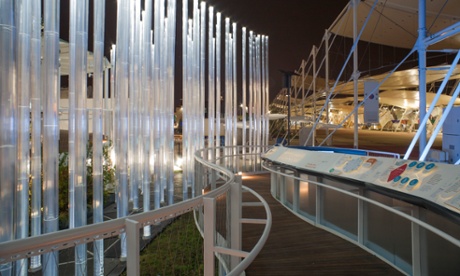
On the outskirts of Milan, past airport-style security, you enter 110 hectares of weird and wonderful architecture that are the most visible part of this year’s world expo.
Visitors can pause at the concrete clad rectangle of Angola – one of just a handful of African countries with a stand-alone presence at the Expo – and a multimedia exhibition that celebrates Angolan women that rises up three storeys through an atrium. More eccentric are Brazil’s pavilion, which looks like a cross between a climbing frame and a bouncy castle, the UK’s metallic bee-hive, or Azerbaijan’s pavilion complete with biospheres and undulating walls.
But, arguably, it is the technology running in the background of the latest of these expo world fairs – five-yearly extravaganzas where nation showcase their cultures and technology – that makes the Milan Expo remarkable. Multinational power company, Enel, has conceived the expo as a smart city, capable of meeting the energy needs of 100,000 people – a population just smaller than the Greek island of Corfu.
For urban planners and policy makers, smart cities offer a way to solve the problems caused by mass migration to urban areas and the increasingly untenable economic, social and environmental costs of powering and managing cities the way we do now. In a smart city, digital technologies are used to transform transport, energy, healthcare, water and waste management.
Typical technologies in a smart city might include electric cars, smart electricity meters and power grids, renewable energy plants, better energy storage systems, or high-tech systems for recycling and disposing of waste. The EU’s smart city model defines the concept of a smart city more broadly: encompassing six areas a smart city might seek to improve: economy, mobility, people, governance, environment and living – with the aim of making urban areas less polluted, lower carbon, better managed, more prosperous and pleasant places to live and work.
Songdo in South Korea, built on 1,500 acres of reclaimed land, could be the world’s first smart city and is due to be completed this year. The city is raising the bar in a country already well known for its advanced technology. Developed over 10 years at an estimated cost of over £100m, it includes sensors that monitor temperature, energy use and traffic flow; a water recycling system that prevents clean drinking water from being used to flush toilets; and, perhaps most impressive, a network of underground tunnels that suck household waste directly from each home to processing centres.
Back in Milan, Enel is the official “smart energy and official global lighting solution partner” for the expo, where it directly addresses three distinct smart city areas. The first is electrical mobility: 30 charging stations are located around the site to power electric cars. Second, is smart lighting: the expo is lit by smart LED lighting points; ‘smart’ because they have sensors that turn on and off depending on the amounts of natural light available. And third is the smart power grid. Here, is where complex engineering meets big data.
Designed in collaboration with Siemens, the power grid controls energy loads, optimises energy flows, integrates renewable energy plants and storage systems and manages lighting.
Such smart grids will be vital to making cities smarter and more sustainable. Renewable energy sources such as wind or solar power can produce energy in unpredictable ways and the grid needs to be able to deal with these variations. Crucial too will be energy storage systems that can hold on to the energy produced and distribute it when and where it is needed. Enel has installed a 270KW storage station at the expo to demonstrate how energy flows can be optimised in the future.
Intriguingly, the electric cars also offer energy storage possibilities. Enel chief executive Francesco Starace calls the electric car “a battery on wheels”, as idle cars connected to smart grids can be used to store energy that can then meet demand elsewhere. Enel is already piloting such “vehicle to grid” systems in a partnership with Japanese car maker Nissan.
A huge amount of data is required for a smart city to work effectively. Take street lighting alone: the data from each LED light point is gathered so that the times it needs to be switched on and off, as well as its brightness, can be better regulated according to specific needs such as road traffic, weather conditions or the needs of local administrators. This attention to detail enables reductions in energy consumption as well as reducing carbon emissions and light pollution. All of that data is collected and processed at the heart of the Expo Milano smart city in Enel’s control room, where technicians oversee the technology that operates the city’s smart functions.
The idea of smart, sustainable cities is particularly relevant to the Milan Expo, which puts sustainable living at its heart with the theme: “Feeding the planet, energy for life.” Pavilions are being encouraged to address the themes of food and food security during the fair, an issue at the top of the development agenda.
Enel sees the two issues of food and energy as inextricably linked.“The future of food and the future of energy actually depend on the same solutions: smarter, more rational and less intensive production; more efficient distribution; and sustainable sharing of available resources in order to meet the increasing needs of the world population,” argues Andrea Valcalda, Enel’s head of sustainability.
“Just as food production is becoming more sustainable, energy generation too has gotten closer, in the past few years, to people and the land, through distributed power facilities that citizens rely upon, for producing electricity in the same locale where they consume it.”
And in Milan, energy is indeed produced where it is consumed: with 75MW of installed capacity, 10 perimeter electricity substations and 100 delivery substations for the pavilions. Moreover, those consuming it can see their own consumption: all the data acquired by Enel’s energy management system is uploaded onto the “cloud” and each pavilion can access its data via the web.
Of course smart cities are not just about technology, and places like Songdo will soon demonstrate what such environments will actually be like to live and work in – with a key challenge being to retain the creative chaos that often leads people to cities in the first place, while streamlining the infrastructure. But clearly smart, sustainable technology of the sort showcased at the expo must play a bigger role in the globe’s fast expanding cities.
Ever since Prince Albert’s famous Great Exhibition of 1851 in London at The Crystal Palace in Hyde Park, these world fairs have had something to say about each era’s vision of an ideal future. If the Milan Expo is any guide, that vision today contains a revolution in urban infrastructure, not least in the invisible networks of cables and pipes beneath our feet.
Content on this page is paid for and produced to a brief agreed with Enel, sponsor of the energy access hub at the Guardian Global Development Professionals Network.