Procedures using cosmetic fillers, in which chemical substances are injected into the skin for such purposes as removing facial wrinkles, have caused various side effects.
Cosmetic filler injections are one of the minor cosmetic surgery procedures called "petit seikei," which are popular because they do not involve going under the surgeon's knife. However, most of the substances used in such injections are unapproved in Japan and their safety is yet to be confirmed, according to sources.
Some cases involving side effects have even developed into lawsuits.
"Today, we're offering discounts. We'll also offer you other types of injections. There's no danger at all."
A 66-year-old woman from Osaka Prefecture was told this at a major cosmetic surgery clinic in Nara in June last year when it was suggested to her that she receive cosmetic filler injections.
Although it was her first visit to the clinic, she had injections of the filler "Alcamid" in her cheeks and other places the same day. She paid 3.42 million yen for the treatment.
Immediately afterward, she started suffering pains and lumps in her nose and cheeks. She consulted the doctor but was only provided with a massage.
Six months later, she had the fillers removed by surgery at another hospital. However, not all of the filler was removed, as it is a fluid. She is still experiencing pain.
In July, the woman filed a suit against the clinic with the Osaka District Court, claiming that the clinic failed to explain to her the possible risks of the injections. She is demanding the clinic pay about 14 million yen in damages and other fees.
The clinic intends to fight the claim, stating: "We did explain the risks. There is no causal relationship between the injections and her symptoms."
Knowledge of risks important
Cosmetic fillers are used for such purposes as removing wrinkles and sharpening the nose, and cost anywhere from tens of thousands of yen to over 1 million yen per treatment.
According to Akihiro Ichinose, a doctor knowledgeable about cosmetic surgeries and a member of the Japan Society of Aesthetic Plastic Surgery, hyaluronic acid injections are a widely known form of filler treatment. However, the effects of the treatment last only about three months at the shortest as the body easily absorbs the substance.
Ichinose said that chemical substances that are less easily absorbed into the body and last longer have been under development since the 1990s, with more doctors using such substances.
Chemical substances widely used for filler injections, including alkamide and aquamid, are produced abroad and have yet to be approved by the government for use as a medical product, unlike hyaluronic acid.
Doctors can individually import these substances. However, they are responsible for telling patients about the effects of the treatment and possible side effects, and there are thought to be cases in which doctors do not provide adequate information to those receiving injections.
The Health, Labor and Welfare Ministry does not know the full extent of damage to patients' health caused by filler treatments.
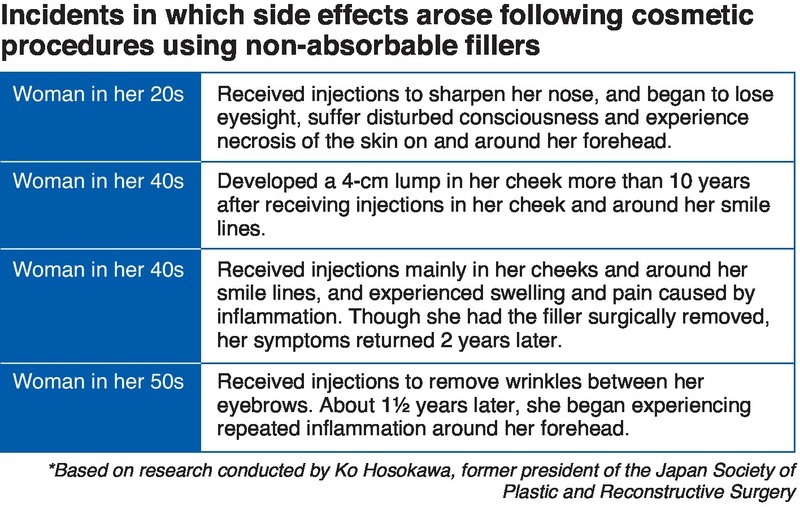
However, Ko Hosokawa, a former president of the Japan Society of Plastic and Reconstructive Surgery, discussed 13 cases in which filler treatments caused negative health effects in a specialist journal published in 2015.
The cases included a women in her 20s who lost vision in her right eye after receiving a filler injection in her nose, which obstructed blood flow, and a man in his 50s who developed a lump five years after receiving a filler treatment to eliminate wrinkles on his forehead.
"Many people misunderstand the safety of 'petit' cosmetic operations," said Hosokawa. "However, those who receive such operations must be fully aware of the risks. The government should also gather information on the negative health effects of non-approved medicine and make such problems known to society."
Read more from The Japan News at https://japannews.yomiuri.co.jp/