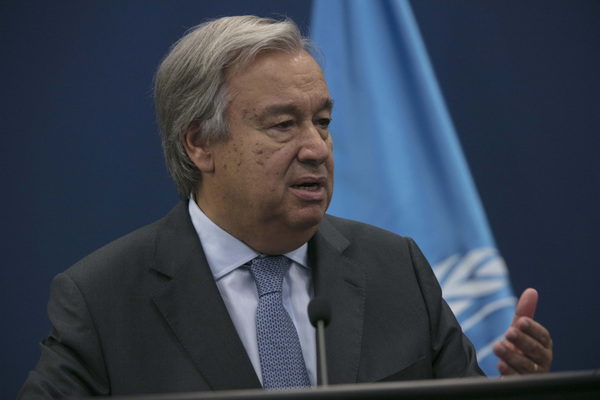
RAMALLAH, West Bank _ Wading into the heart of the Mideast conflict, United Nations Secretary-General Antonio Guterres turned up at the Palestinian Authority's headquarters and called on Israeli Prime Minister Benjamin Netanyahu to stop expanding Jewish settlements in the combustible West Bank.
Guterres spoke out in Ramallah Tuesday after Netanyahu appeared at a settlement 30 miles to the north the night before and vowed before thousands of its residents to continue building. He said he would never again uproot any of the Jewish enclaves that dot the West Bank, which Israel captured in 1967. U.S. President Donald Trump has declined to endorse establishing a Palestinian state alongside Israel, saying the two sides must thrash out a solution themselves.
"There is no Plan B for the two-state solution," Guterres said Tuesday after meeting with Palestinian Authority Prime Minister Rami Hamdallah. "We believe that settlement activity is illegal under international law. It's an obstacle to the two-state solution."
Palestinians have expressed frustration with Trump's approach and are trying to ratchet up international pressure for a settlement freeze, an action Netanyahu dismisses as useless.
Israel demolished 21 settlements when it withdrew from the Gaza Strip in 2005, along with four of the more than 100 in the West Bank. About 400,000 Israelis live in the settlements amid almost 3 million Palestinians who have limited autonomy in their cities and are subject to Israeli military law elsewhere in the territory.
Last week's visit by the U.S. negotiating team led by Trump's son-in-law, Jared Kushner, left Palestinians impatient for an American plan that might renew peace talks, which have been frozen since 2014.
"They promised to come back in a few weeks with clearer answers," Hamdallah said of the U.S. negotiators at a news conference with the U.N. chief.
After several visits to Ramallah and meetings in Washington, Kushner and fellow U.S. negotiator Jason Greenblatt have shown little sympathy for the Palestinian plight and appear to have adopted Netanyahu's positions, said Jehad Harb, a researcher at the Palestinian Center for Policy and Survey Research in Ramallah.
"They didn't have high hopes," Harb said. Accepting U.S. proposals to stop government payments to prisoners in Israeli jails convicted of terrorist acts "would be political suicide for any Palestinian leader," he said.
The White House refused to take a side Tuesday after Netanyahu's declaration at the Barkan settlement. The opposing Israeli and Palestinian positions are well known, and the U.S. will focus on facilitating discussions aimed at brokering a deal, a senior White House official said, speaking on condition of anonymity because of the delicate political issues involved.
Guterres is scheduled to spend the third day of his trip in the Gaza Strip, where he will visit U.N. facilities but won't meet with its militant Hamas rulers. The group called his planned visit to the territory "unwelcome."
Although he lashed out at the U.N. on Tuesday for an "absurd obsession with Israel," Netanyahu told Guterres a day earlier that he expects to open a "new page" with the organization. Israel is currently seeking a seat on the Security Council, vying with Germany and Belgium.
The Israeli leader, who is trying to strengthen international alliances, has made several trips to Africa over the past year and is planning to visit Argentina, Colombia and Mexico next month before addressing the U.N. General Assembly in New York. He has also said Arab states in the Persian Gulf that were once enemies are now cultivating wider ties with Israel.
None of this is likely to affect U.N. voting patterns, which regularly condemn Israel's settlement construction and 50-year occupation of the West Bank, said Jonathan Rynhold, a researcher at the Begin-Sadat Center for Strategic Studies at Bar-Ilan University near Tel Aviv.
"I don't think it's within Israel's ability to change things structurally," he said.
Israel has been a source of controversy at the U.N. since its establishment. It was prevented from seeking high-profile seats at the world body until 2000, when it was allowed to join the "Western European and Others" group.
In its final days last December, President Barack Obama's administration abstained on a resolution condemning the settlements in an action Trump immediately denounced.