The Northern Territory and Western Australian governments have rejected calls from the United Nations to abolish mandatory sentencing laws as a way of reducing the overrepresentation of Aboriginal and Torres Strait Islander people in prison.
The UN committee against torture this week urged Australia to have its states and territories review the laws “with a view to abolishing them”, saying mounting evidence shows they disproportionately affect Indigenous people. It said judges need to be given sentencing discretion on a case by case basis.
However the acting NT attorney general and minister for correctional service, Willem Westra van Holthe, said the government will not be reviewing the territory’s law, which “looks after the interests of all Territorians”.
“Whilst the UN report focuses on the overrepresentation of Indigenous offenders it fails to give adequate weight to the overrepresentation of Indigenous victims in the Northern Territory,” Westra van Holthe told Guardian Australia.
“The Northern Territory government makes no apology for looking after the interests of victims.”
He said the government was focused on rehabilitation programs such as post-incarceration trade skills training.
In WA, where the Indigenous prison population is about 20 times that of the non-Indigenous population, the attorney general, Michael Mischin, also rejected the recommendations.
Mischin said that while he regrets the overrepresentation in WA prisons, the government is committed to and intends to go ahead with legislating minimum jail sentences for serious offences in the course of home invasions.
Such offences “by any standard of justice should be punished by terms of imprisonment,” Mischin told the ABC.
Currently the state has a three-strike rule for burglary convictions, punishable by a two-year minimum sentence.
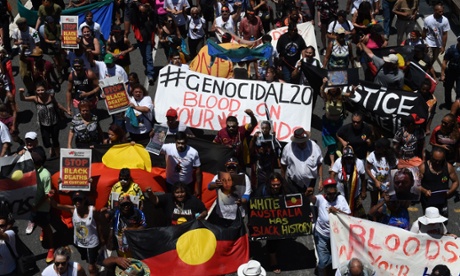
Indigenous people make up 2-3% of the general population, but more than a quarter of the prison population. In WA and the NT the proportion is even higher.
Nationally the adult Indigenous incarceration rate increased by 57% between 2000 and 2013. Indigenous young people are 24 times more likely to be imprisoned than non-Indigenous youth.
The federal minister for Indigenous affairs, Nigel Scullion, was criticised for backing away from setting justice targets as part of the closing the gap strategy. The targets have been called for by multiple corners of Indigenous justice sector, including the social justice commissioner, Mick Gooda.
“All sides of politics need to put aside populist ‘tough on crime’ rhetoric and punitive policies in favour of an economically, socially and morally responsible approach to criminal justice issues,” Gooda said last week.
The UN committee also said Australia “should also guarantee that adequately funded, specific, qualified and free-of-charge legal and interpretation services are provided as from the outset of deprivation of liberty.”
Funding cuts to Indigenous legal services have been widely criticised throughout the term of the Abbott government, which revealed the proposed cuts just days before the federal election while still in opposition. Several legal services have had to cut staff or close offices as a result of the funding changes.
The UN committee’s recommendations came amid revelations that four Indigenous men with disabilities were imprisoned indefinitely in the Northern Territory, despite not being convicted of any crime. The Human Rights Commission said the federal government breached the rights of the four men, and should have worked with the NT government to provide accommodation and support services for the men.
Labor senator for the Northern Territory, Nova Peris, told Guardian Australia mandatory sentencing “leads to wrongful and unjust imprisonment” and will ensure the”shocking” imprisonment rates in the territory will not change.
“Mandatory sentencing laws effectively remove any judicial discretion,” said Peris. “The out of sight, out of mind mentalities of governments don’t address the core issues. The NT CLP government are simply locking up their problems instead of dealing with them.
“We are dealing with real people here – something we seem to have forgotten.”
The MP for Lingiari, Warren Snowdon, told Guardian Australia mandatory sentencing “has a disproportionate impact on Aboriginal and Torres Strait Islander people and does not break the cycle of offending”.
“The committee is right to express serious concerns, particularly when the Abbott government has cut funding to Atsils, cut programs that support families and communities to combat recidivism (such as prisoner throughcare programs), and walked away from its commitment to address rates of offending and incarceration through the development of a Close the Gap justice target,” Snowdon said in a statement. “All people should be treated equally and not victimised because of who they are.”
The federal attorney general, George Brandis, has been contacted for comment.