One hundred and forty five days later, Oleg Sentsov’s lonely protest has apparently come to an end.
On Friday, the deputy head of Russia’s prison service told a state news agency that the Crimean film director, controversially jailed in Russia, had ended his hunger strike. Mr Sentsov had agreed to eat again, Valery Maksimenko said, after being “persuaded by doctors … to choose life.”
In recent weeks, as his health deteriorated, Mr Sentsov had already moved from a total hunger strike to one that included limited nutritional support, and later glucose drips and small doses of protein shakes.
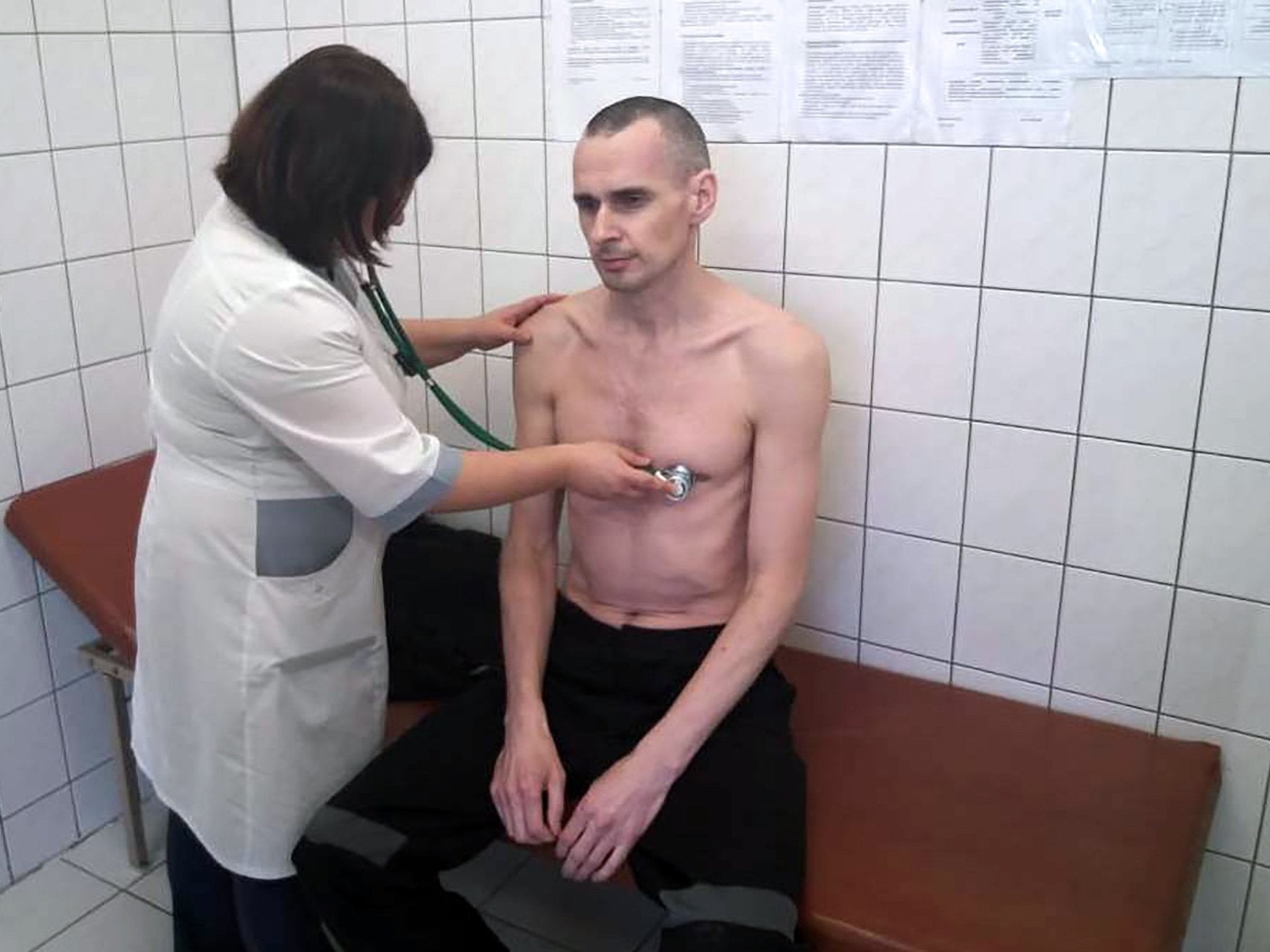
But the four months of hunger striking have had an obvious effect. A picture released last Sunday, on his 141st day of fasting, show an obviously aged, pale and emaciated man. Shortly after that photo was released, Mr Sentsov’s lawyer, Dmitry Dinze, said his client had been suffering from heart, kidney and liver problems. Mr Sentsov had already refused to be hospitalised a few times, he said, and prison doctors had threatened to force feed him.
The film director announced a hunger strike in May, a month before Russia was due to host the World Cup, timing his actions to impart maximum embarrassment for Russia. He said he would end his protest only when the Kremlin released 64 Ukrainian political prisoners understood to be held in Russia.
The ultimatum did not have the desired effect.
Not even an emotional appeal for clemency by Mr Sentsov’s mother was enough to move Russia’s president. Mr Sentsov would need to make the appeal himself, Vladimir Putin retorted, aware that was something that the film director had ruled out. Far from a political prisoner, Mr Sentsov was in fact “a terrorist.”
Mr Sentsov’s arrest and 20-year prison sentence are heavily disputed.
Russia says the film director and pro-Ukrainian activist were responsible for terrorist attacks on pro-Russian organisations in Crimea and had attempted to blow up the Lenin statue in Simferopol. For those who knew Mr Sentsov around this time, the accusations did not ring true: he urged people away from violence, one told The Independent.
Mr Sentsov pleaded not guilty to all the charges. There was never any real doubt of the verdict: In Russia, over 99 per cent of trials end with the word “guilty.”
Ukraine and several European countries have pushed for Mr Sentsov’s release, but in recent weeks, negotiations stalled. Last week, a Russian newspaper suggested that Moscow was trying to extract a high price, asking to exchange the film director for three Russians held in the United States: Victor Bout (held over illegal arms trading), Konstantin Yaroshenko (cocaine smuggling) and Marina Butina (an alleged Russian agent).
The State Department replied curtly. The offer was “senseless” and an “attempt to use the illegal detention of a Ukrainian citizen as a negotiating base,” it said.