Closing summary
… and on that note, it’s a wrap!
Ukrainian justice and energy ministers have been forced out amid a deepening government crisis following allegations about a $100m corruption scandal in the country’s energy sector (9:55, 14:51, 15:34, 15:59, 16:31).
All 20 personnel on board of a Turkish military cargo plane that crashed in Georgia on Tuesday were killed, Turkey’s defence minister said (11:54, 12:58).
Czech president Petr Pavel has ramped up pressure on the incoming prime minister, billionaire Andrej Babiš, repeating his demand for Babiš to resolve his conflicts of interests before taking up the post (17:05).
French lawmakers voted to suspend a contested pension reform as next year’s budget bills inch through parliament under persistent threats to the government’s survival (17:48).
Search-and-rescue operations are still under way to find missing migrants desperate to get to Europe from Libya, following a deadly shipwreck in southern Greece (17:08).
Prosecutors in Milan have opened an investigation into Italians who allegedly paid members of the Bosnian Serb army for trips to Sarajevo so that they could kill citizens during the four-year siege of the city in the 1990s (13:12).
And that’s all from me, Jakub Krupa, for today.
If you have any tips, comments or suggestions, email me at jakub.krupa@theguardian.com.
I am also on Bluesky at @jakubkrupa.bsky.social and on X at @jakubkrupa.
Wars of tomorrow will begin in space, Macron says
Modern conflicts are already being fought in space and the next wars will begin there, the French president Emmanuel Macron has said as he outlined France’s future space strategy.
“The war of today is already being fought in space, and the war of tomorrow will begin in space,” Macron said in Toulouse, France’s space and aviation hub. “Let us be ready: this will be a condition for the success of military operations on land, in the air, and at sea.”
The Finnish defence minister Antti Hakkanen has said China is “massively” financing Russia’s war efforts, increasing the security threat in Europe and posing a challenge to Nato.
Speaking to the AFP agency, Hakkanen said Russia’s cooperation with China had “gone so far” that “China is currently massively financing Russia’s war chest”.
“Russia would not be able to wage war for very long with its own resources. India, of course, provides funding in other ways, but China is doing so quite deliberately,” the minister said after meeting with his Nordic counterparts in Helsinki.
“It is supplying military components, cooperating in the defence industry, and organising joint military exercises and various other large-scale activities in the Arctic, Indo-Pacific and European regions,” he added, calling it a big but manageable challenge for the Western military alliance Nato.
Nordic countries are stepping up their defence cooperation to counter future threats while supporting Nato’s capabilities in the north, Hakkanen said.
“Today, we already discussed the use of 250 Nordic fighter aircrafts from the air forces as a unified force,” he said.
Finland, Sweden, Iceland, Norway and Denmark are planning to triple ammunition production and develop military mobility corridors in the Nordic region, he added.
Top diplomats from the G7 industrialised democracies met with Ukraine’s foreign minister on Wednesday, Associated Press reports.
Ukrainian foreign minister Andriy Sybiha said at the start of a meeting on defence coordination, attended by US secretary of state Marco Rubio, that Kyiv needs to overcome what will be a “very difficult, very tough winter.”
“We need the support of our partners,” Sybiha said. “We have to move forward to pressure Russia, to raise the price for the aggression, for Russia, for Putin, to end this war.”
Canada announced new sanctions against Russia on Wednesday, and the United Kingdom has pledged money toward Ukraine’s energy infrastructure. Rubio made no immediate announcements Wednesday about new US initiatives but said on social media that the meeting delved into ways “to strengthen Ukraine’s defence and find an end to this bloody conflict.”
“The United States remains steadfast in working with our partners to encourage Russia to pursue diplomacy and engage directly with Ukraine for a durable and lasting peace,” he posted on X.
The Ukraine talks were part of the G7 meeting that Canadian Foreign Minister Anita Anand is hosting in southern Ontario.
French parliament moves to suspend unpopular pension reform
Over in France, lawmakers voted to suspend a contested pension reform as next year’s budget bills inch through parliament under persistent threats to the government’s survival, Reuters reported.
A majority of 255 lawmakers voted in favour of the suspension with 146 who voted against.
Reuters noted that, after a rocky start, prime minister Sebastien Lecornu’s second attempt at a government has made headway, pushing parts of the budget through parliament thanks to costly concessions.
One of the biggest trade-offs was offering the Socialists – a pivotal swing bloc – a suspension of Macron’s plan to raise the pension age to 64.
The freeze effectively keeps the minimum retirement age at 62 years and nine months until after the 2027 presidential election, a move that has been hard to swallow for Macron loyalists but which has handed Lecornu a lifeline, Reuters noted.
Canada explores participation in the Eurovision song contest
European community affairs correspondent
When Canada released its federal budget this month, much of it was standard fare, from the plans to downsize the public service to the boost in defence spending.
But one line tucked in the nearly 500-page document has captured imaginations on both sides of the Atlantic: a mention that the government is working with Canada’s national broadcaster to explore participation in the Eurovision song contest.
When asked about the line, the country’s finance minister, François-Philippe Champagne, said the proposal to join the glitzy TV extravaganza had come from “the people who participate”.
He did not specify whether he was referring to specific countries or the European Broadcasting Union, who organises the contest. CBC-Radio Canada is an associate member of the union; another associate member, Australia, was invited by the contest’s governing board to join Eurovision in 2015.
The minister, however, appeared to embrace the longshot bid, hinting that it was part of the government’s strategic realignment away from the US and towards Europe.
“I think it’s a platform for Canada to shine,” Champagne told broadcaster Global News last week. “This is about protecting our identity – yes, we want to protect our sovereignty, but you also want to help people in the arts sector and in the film industry to make sure they can shine around the world. And we have a lot to offer as Canadians.”
In recent months, as Donald Trump’s takes aim at Canada’s sovereignty and slaps tariffs on its economy, the Canadian government has scrambled to deepen its relationships with allies around the world.
In March, the country’s prime minister, Mark Carney, made a point of visiting France and the UK on his first overseas trip as prime minister, seizing on the visit to declare Canada the “most European of the non-European countries.”
Two government sources told the Canadian Broadcasting Corporation that Carney – who spent years studying and living in the UK, most recently as the governor of the Bank of England – was personally involved in Canada’s push to join the world’s largest live music event.
While Canada has never formally participated, the pop platform has hosted an array of Canadian artists. Most famously was Céline Dion, who won the contest for Switzerland in 1988 with the song Ne Partez Pas Sans Moi, while in 2001, Natasha St-Pier represented France as did La Zarra in 2023.
And now for something different…
Search and rescue operations under way to find missing migrants after vessel capsizes near Greek island
in Athens
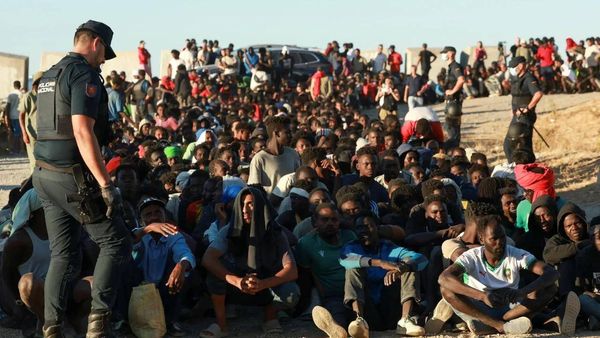
In more distressing news from the Mediterranean, search-and-rescue operations are still under way to find missing migrants desperate to get to Europe from Libya, following a deadly shipwreck in southern Greece.
Greek coast guard officials, citing the accounts of the more than 50 people rescued so far, believe as many as 13 others were also on board the wooden vessel at the time it capsized 15 nautical miles south of tiny Gavdos off Crete.
Emergency services confirmed that the bodies of three people were found shortly after a Frontex vessel rushed to the scene when the vastly overcrowded boat began to take on water.
Footage released by Greece’s public broadcaster, ERT, shows passengers screaming desperately for help before the tragedy occurs.
As Greece’s most southerly point, the islet of Gavdos has become a magnet for migrants fleeing Libya and one of the most popular if also deadly routes in the Mediterranean.
In a statement the Hellenic coastguard said:
“During procedures to approach the boat to gather those on board, there was movement towards the left side of the vessel with the result of water entering and the boat overturning. The crew of the Frontex boat immediately threw circular and individual lifejackets and athe vessel’s lifeboat was launched.”
Updated
Czech president presses incoming PM Babiš to resolve conflicts of interest, spell out view on Ukraine, Nato
Meanwhile in the Czech Republic, the country’s president Petr Pavel has ramped up pressure on the incoming prime minister, billionaire Andrej Babiš, repeating his demand for Babiš to resolve his conflicts of interests before taking up the post, iDnes.cz and Lidovky reported.
The main conflict of interest is about Babiš’s control over the Agrofert conglomerate, which is a recipient of EU funds.
Leaving the meeting with Pavel, Babiš told reporters he would take necessary business decisions in line with Czech and EU law, without specifying his next steps.
President Pavel stressed that he will appoint the new prime minister as soon as he meets all the formal requirements.
Amid concerns about the new government’s foreign and defence policy, Pavel also asked the new right-wing government to consider clarifying its stance on Ukraine and Nato in the coalition manifesto.
In response, Babiš pledged he would discuss these issues with coalition partners.
Ukrainian justice, energy minister to be formally dismissed from positions, prime minister confirms
Ukrainian prime minister Yulia Svyrydenko has now confirmed that she formally submitted a motion to dismiss both energy and justice ministers from their posts to the country’s parliament, as per Zelenskyy’s request.
Updated
Russia is not wasting any time as its diplomats seek to exploit the corruption allegations in Kyiv in a bid to undermine the broad support for Ukraine among western societies.
The Russian embassy in the Netherlands has just posted a meme portraying a cartoon character sweating over making a choice between “solving Dutch social problems” and “helping corrupt Ukrainian junta,” with a note:
“Is @Minpres still ready to pour billions into Ukraine after Zelensky’s close ally Timur Mindich has been accused of a $100m corruption scheme?”
Ukrainian energy minister Hrynchuk resigns as corruption probe fallout continues
Following Zelenskyy’s request, Ukraine’s energy minister Svitlana Hrynchuk has now also resigned from her post as the fallout from the alleged energy corruption probe continues.
Posting a handwritten note to Facebook, she said denied any wrongdoing “in her professional activities,” and stressed her thanks to Zelenskyy and the government for being able to serve in successive roles over the past 10 years.
'Undermining state means you will be held accountable,' Zelenskyy warns
In a separate post in English, Zelenskyy sent a clear signal that “undermining the state means you will be held accountable; breaking the law means you will be held accountable.”
He also said:
“There must be maximum integrity in the energy sector, in absolutely all processes. I support – and the prime minister supports – every investigation carried out by law enforcement and anti-corruption officials. This is an absolutely clear and consistent position for everyone.”
His strong comments will be no doubt closely watched by the EU as it continues to assess the country’s progress on its accession path.
Ukraine's Zelenskyy calls for justice, energy ministers to be dismissed
Ukraine’s Volodymyr Zelenskyy has just commented on the corruption scandal uncovered by the country’s anti-graft authorities (9:55), calling for justice and energy ministers to be dismissed from their positions, as the investigation continues.
“This is also a matter of trust. If there are accusations, they must be answered,” he said in a post on Telegram.
Zelenskyy said he had asked PM Svyrydenko to “request resignation letters from these ministers” so they are not involved in positions of influence as the investigation continues.
He said that as the country faces growing energy issues with power outages, caused by continued Russian strikes on Ukraine, “it is absolutely abnormal there are still some [corruption] schemes in the energy sector.”
In a video accompanying his post, Zelenskyy also said he fully supported the work of the anti-corruption agencies.
Updated
Norway's Stoltenberg rules out using sovereign wealth fund to guarantee EU's Ukraine loan
In other news, Norway said it could support a European Union plan to utilise frozen Russian assets for Ukraine but will not use its sovereign wealth fund as a sole financial backstop for the scheme, finance minister Jens Stoltenberg said.
EU finance ministers are set to discuss the issue on Thursday as they continue search for a way to provide some €140bn to Ukraine to help it fight the Russian aggression, as Belgium continues to oppose te idea of using the frozen Russian funds in Euroclear.
Reuters said that in a bid to break the deadlock, some members of Norway’s parliament have proposed that the country’s sovereign wealth fund, the world’s biggest with assets of more than $2tn, could offer a guarantee that would cover a potential legal liability.
But Stoltenberg said it was “not an option,” despite Oslo’s broader readiness to join in the EU’s plans.
He said Norway, which is not a member of the EU, was already making major financial contributions to Ukraine and could also potentially participate in the EU’s plans, but would not provide guarantees on its own, Reuters noted.
New sleeper service will run from Paris to Berlin next year
The resurgence of sleeper trains on the continent hit a kink in the tracks in September, when the Austrian state operator ÖBB announced that it would be axing its two Nightjet services – Paris to Vienna and Paris to Berlin – from 14 December. ÖBB cited the French government’s ending of subsidies, dealing a blow to the night-train renaissance.
However, there is light at the end of the tunnel.
European Sleeper has told the Guardian that it will be taking over the route from Paris to Berlin, with the first train to run on 26 March 2026.
The train will operate three times a week with departures likely to be from Paris Gare du Nord on Tuesday, Thursday and Sunday evenings and the return service from Berlin Hauptbahnhof and Ostbahnhof on Monday, Wednesday and Friday.
The news is certainly welcomed by Oui au train de nuit!, a French campaign group who in September took to the platforms of Paris Gare de l’Est in their nightwear and threw a pyjama party to protest against the cuts to the sleeper services out of Paris.
“This is a partial victory for the 91,000 people who signed our petition,” said Nicolas Forien, spokesperson for the group.
In different and perhaps more positive news, let’s take a look at the latest update on the future of night trains across Europe…
More than 1,000 people died in people smuggling operations in the Med region this year
Meanwhile, more than 1,000 people have died in people smuggling operations across the Mediterranean this year with 42 presumed dead off the coast of Libya in the past week alone, the UN’s International Organization for Migration has said.
In a statement on Wednesday, IOM said, according to survivors, that the vessel, carrying 49 migrants and refugees, departed from Zuwara on 3 November at 3am in the morning but capsized six hours later after hitting high waves “throwing all passengers overboard”.
“After drifting at sea for six days, only seven men – four from Sudan, two from Nigeria, and one from Cameroon – were rescued. Tragically, 42 individuals remain missing and are presumed dead, including 29 from Sudan, eight from Somalia, three from Cameroon, and two from Nigeria,” IOM said.
“This tragic event, coming just weeks after other deadly incidents off Surman and Lampedusa, underscores the persistent dangers faced by migrants and refugees along the Central Mediterranean Route,” it said.
Irregular border crossing down across EU, while UK remains strong pull, Frontex data show
Almost 60,000 people have tried to cross the English channel small boats this year, according to the latest figures from the European border agency, Frontex.
The latest data which includes “attempted and successful crossings” shows the irregular border crossings, now one of the biggest political challenges in the UK, has remained “unchanged” compared to 2024 rising 3% to 58,900 in the first 10 months of 2025.
People from Eritrea, Somalia and Afghanistan were the main nationalities of those attempt to cross to the UK.
Across the EU, irregular crossings have fallen 22% to 152,000 in the same period, suggesting the UK remains a strong pull for those who have already made it into the bloc.
Frontex data shows “strong declines” on attempts to cross to the Canary islands from west Africa, which is down 59%, and in the western Balkans, down 46% while the eastern land border, a hotspot for suspected migration orchestrated by Russia, down by 38%.
The figures show that the central Mediterranean route (from Tunisia or Algeria) remains the busiest irregular route in the EU with 59,000 people detected as arriving between January and October.
Separately, we also got the latest set of Frontex figures on migration in Europe this morning.
Let’s go to Lisa O’Carroll for her analysis.
'Important results' reported from growing pressure on Russia, Zelenskyy says
Back to Ukraine, the country’s president Volodymyr Zelenskyy said he received the head of the foreign intelligence service, Oleh Ivashchenko, earlier this morning.
On their meeting, he said:
“There are important results from our joint efforts with partners to put pressure on Russia.
For the first time since the beginning of the war, a noticeable decline has been recorded this year in Russia’s oil production and refining. The oil and gas revenues of the Russian budget are decreasing, and by the end of this year, Russia will have lost at least 37 billion dollars in budget oil and gas income. In addition, Russian oil companies and the entire energy sector are losing tens of billions more. All this curbs Russia’s war machine.
Both conventional sanctions against Russia and Ukraine’s long-range sanctions are working effectively. Further directions for our sanctions pressure have also been identified. I thank all our partners who are also delivering entirely justified legal blows against the vessels of Russia’s oil fleet – the Russians are now using fewer tankers.”
Zelenskyy also said the pair discussed “bringing home Ukrainian children abducted by Russians, as well as other operations abroad.”
Milan prosecutors investigate alleged ‘sniper tourism’ during Bosnian war
Angela Giuffrida in Rome and Kim Willsher in Paris
Prosecutors in Milan have opened an investigation into Italians who allegedly paid members of the Bosnian Serb army for trips to Sarajevo so that they could kill citizens during the four-year siege of the city in the 1990s.
More than 10,000 people were killed in Sarajevo by constant shelling and sniper fire between 1992 and 1996 in what was the longest siege in modern history, after Bosnia and Herzegovina declared independence from Yugoslavia.
The snipers were perhaps the most feared element of life under siege in Sarajevo because they would pick off people on the streets, including children, at random, as if it was a video game or a safari.
Groups of Italians and other nationalities, so-called “sniper tourists”, are alleged to have participated in the massacre after paying large sums of money to soldiers belonging to the army of Radovan Karadžić, the former Bosnian Serb leader who in 2016 was found guilty of genocide and other crimes against humanity, to be transported to the hills surrounding Sarajevo so that they could shoot at the population for pleasure.
Sarajevo is in a basin surrounded by mountains, which made cutting it off and attacking it particularly easy.
Milan prosecutors, led by Alessandro Gobbi, launched an investigation aimed at identifying the Italians involved on charges of voluntary murder aggravated by cruelty and abject motives.
The investigation originated from a legal complaint submitted by Ezio Gavazzeni, a Milan-based writer who gathered evidence on the allegations, as well as a report sent to the prosecutors by the former mayor of Sarajevo Benjamina Karić.
Gavazzeni said he had first read reports about the alleged sniper tourists in the Italian press in the 1990s, but it was not until he watched Sarajevo Safari, a 2022 documentary by the Slovenian director Miran Zupanič, that he began to investigate further.
Let’s bring you now a different, astonishing story from Italy…
Investigators looking into the Turkish plane crash in Georgia have found the plane’s black box (11:54), Turkish president Recep Tayyip Erdoğan confirmed in the last few minutes.
Meanwhile, back to Ukraine, Ukraine’s military said that it had pulled back troops from near a settlement on the southeastern Zaporizhzhia front, but that it has stopped Russian advances in the area, Reuters reported.
“On 11 November 2025, late in the evening, as a result of combined fire damage to our positions in the Rivnopillya area, Ukrainian units moved to more advantageous lines in order to save the lives of personnel,” it said in a statement.
20 dead after Turkish military plane crashes in Georgia
All 20 personnel on board of a Turkish military cargo plane that crashed in Georgia on Tuesday were killed, Turkey’s defence minister said, AP reported.
The confirmation came in Yaşar Güler’s post on X, which included photographs of the personnel who died in the accident.
The C-130 military transport aircraft, manufactured in 1968, was en route from Azerbaijan to Turkey, when it crashed in Georgia, with the cause of the incident still being under investigation.
AP said that, speaking at the crash site, Georgian interior minister Gela Geladze said details concerning the accident would be released “in stages” in coordination with the Turkish authorities, due to military sensitivities.
Kazakh parliament passes Russian-style anti-LGBTQ law
Separately, Kazakhstan’s parliament passed a bill to ban the promotion of what it calls “non-traditional sexual orientation” in public spaces and the media, a copycat of Russia’s anti-LGBTQ laws, AFP reported.
Rights groups described the measure, which needs to be approved by the upper house, as discriminatory and said it would increase the vulnerability of LGBTQ people in the Central Asian Muslim-majority country, an ally of Russia.
AFP said that numerous rights groups urged MPs to reject the law, saying adopting it “would blatantly violate Kazakhstan’s international human rights commitments,” the International Partnership for Human Rights said in a statement.
Located between Russia and China, the vast former Soviet republic rich in natural resources, is trying to balance between its superpower neighbours and the West.
It’s worth noting that Kazakh president Kassym-Jomart Tokayev is currently on a state visit to Moscow, where he is expected to sign a strategic partnership agreement with Russian leader Vladimir Putin.
Kremlin confirms failed talks with Britain on Ukraine
Meanwhile, the Kremlin also confirmed there had been contact between Kremlin foreign policy aide, Yuri Ushakov, and Britain’s national security adviser, Jonathan Powell, but the dialogue did not work out, Reuters reported.
The contact between the two man was first reported by Financial Times newspaper earlier today, which said the call “did not go well” despite Britain’s attempt to develop a direct channel of contact with Moscow to avoid being sidelined by US president Donald Trump.
Kremlin spokesman Dmitry Peskov said that Britain had shown no desire to listen to Russia’s position on the Ukraine conflict, Reuters reported.
“There were indeed contacts,” Peskov said. “A dialogue took place, but it did not continue.”
“During this contact there was an acute desire of the interlocutor to talk about the position of the Europeans and there was a lack of any intention or desire to listen to our position,” Peskov said.
“Given the impossibility of exchanging views, the mutual dialogue has not developed.”
Ukraine hits Russia's 'Stavrolen' plant producing components for drones, military equipment
The Ukrainian military said that it struck Russia’s “Stavrolen” plant in Stavropol krai, Reuters reported.
Ukraine’s General Staff reported explosions and fire in the area of the plant, which it said produces components for drones and materials for other types of Russian military equipment.
Russia ready to resume talks with Ukraine in Istanbul, official says
Meanwhile, a Russian foreign ministry official told reporters that Russia was ready to resume negotiations with Ukraine in Istanbul over the peace process.
In comments reported by Russian state news agency Tass and Reuters, Alexei Polishchuk indicated Moscow’s willingness to resume talks with Ukraine.
The two sides have held no face to face talks since July.
Updated
Morning opening: Focus on corruption in Ukraine
Ukrainian justice minister German Galushchenko has been suspended amid an alleged corruption scandal in the country’s energy sector, uncovered by the Specialised Anti-Corruption Prosecutor’s Office, or SAPO.
AFP reported that the authorities alleged that Galushchenko was involved in a $100m corruption scheme orchestrated by Timur Mindich, an ally of president Volodymyr Zelenskyy, and personally benefited from the plot.
But Reuters said the ministry confirmed he was subject to an active investigation, but did not specify if it was linked with the energy corruption case.
Prime minister Yulia Svyrydenko said in a social media post this morning that the decision had been taken at an emergency government session, with deputy justice minister for European intergration Lyudmila Suhak tasked with taking over Galushchenko’s duties.
Galushchenko agreed with the government’s decision, saying that “suspension for the duration of the investigation is a civilised and appropriate scenario.”
“I will defend myself in the legal arena and prove my position,” he added.
The scandal comes at a particularly difficult time for the administration amid continuing Russian attacks on Ukrainian energy infrastructure and concerns about how well it’s prepared for the upcoming winter, but also just days after the European Union highlighted the fight against corruption as an area requiring particular improvement if Ukraine wants to join the bloc.
After a row over SAPO’s independence over the summer, which triggered rare protests against Zelenskyy, the commission put on record its concerns about any potential backsliding in this area (Europe Live, last week).
Let’s see what reactions are we going to get during the day, including from the EU.
It’s Wednesday, 12 November 2025, it’s Jakub Krupa here, and this is Europe Live.
Good morning.
Updated