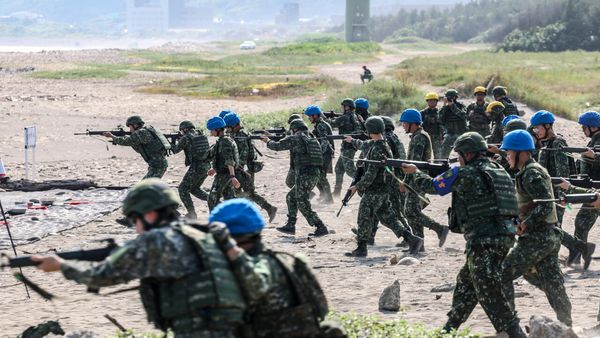
First came the infantry, next the missiles, then the drones.
Now, after more than four years of a bloody and grinding war in Ukraine, remote-controlled ground robots are assuming command over the battlefield.
Last Wednesday, Volodymyr Zelensky claimed Ukraine’s 3rd Separate Assault Brigade had regained territory exclusively using a combination of unmanned ground vehicles (UGVs) and drones – a mission he says was a first in the war.
“The occupiers surrendered, and the operation was carried out without infantry and without losses on our side,” he went on, referring to an operation from the northeastern Kharkiv region last year, in which Ukrainian infantry occupied a position gained using the UGVs.
This shapeshifting conflict has transformed modern conventional warfare, most notably through the use of unmanned aerial vehicles (UAVS – or drones) for reconnaissance and attack missions. But UGVs are the new future of warfare, Ukrainian commanders and engineers say – a future that has already arrived.
Ukraine’s 3rd Assault Brigade wants to replace around 30 per cent of its infantry with UGVs as it looks to cut down on costly troop losses on the eastern front lines, Mykola Zinkevych, callsign Makar, commander of the “NC13” Strike UGV Unit that carried out the Kharkiv operation, tells The Independent.
Click here to read an investigation by world affairs editor Sam Kiley on how Russia’s drone warfare has been limited after access to Starlink was blocked.
“The logic is simple: where the risk to a human is high, a robot should be used. Because the life of an infantryman is priceless, and robots don’t bleed,” he says. “We’re working toward a model where UGVs take on the most dangerous tasks, while infantry becomes a highly specialised force focused on what UGVs cannot perform.”
Yaroslav Drobysh, callsign Zhulyk, is the operator and chief sergeant of the unit. He says growing use of UGVs has already significantly eased the burden for infantrymen, carrying out several logistical tasks and transporting large volumes of supplies and ammunition without losses.
“This is a new phase of the war,” Sgt Drobysh says.
“Having walked the path of an assault infantryman, I know first hand the true price of every metre of our land. That is why I deeply understand the value of decisions that reduce risk to human life.”
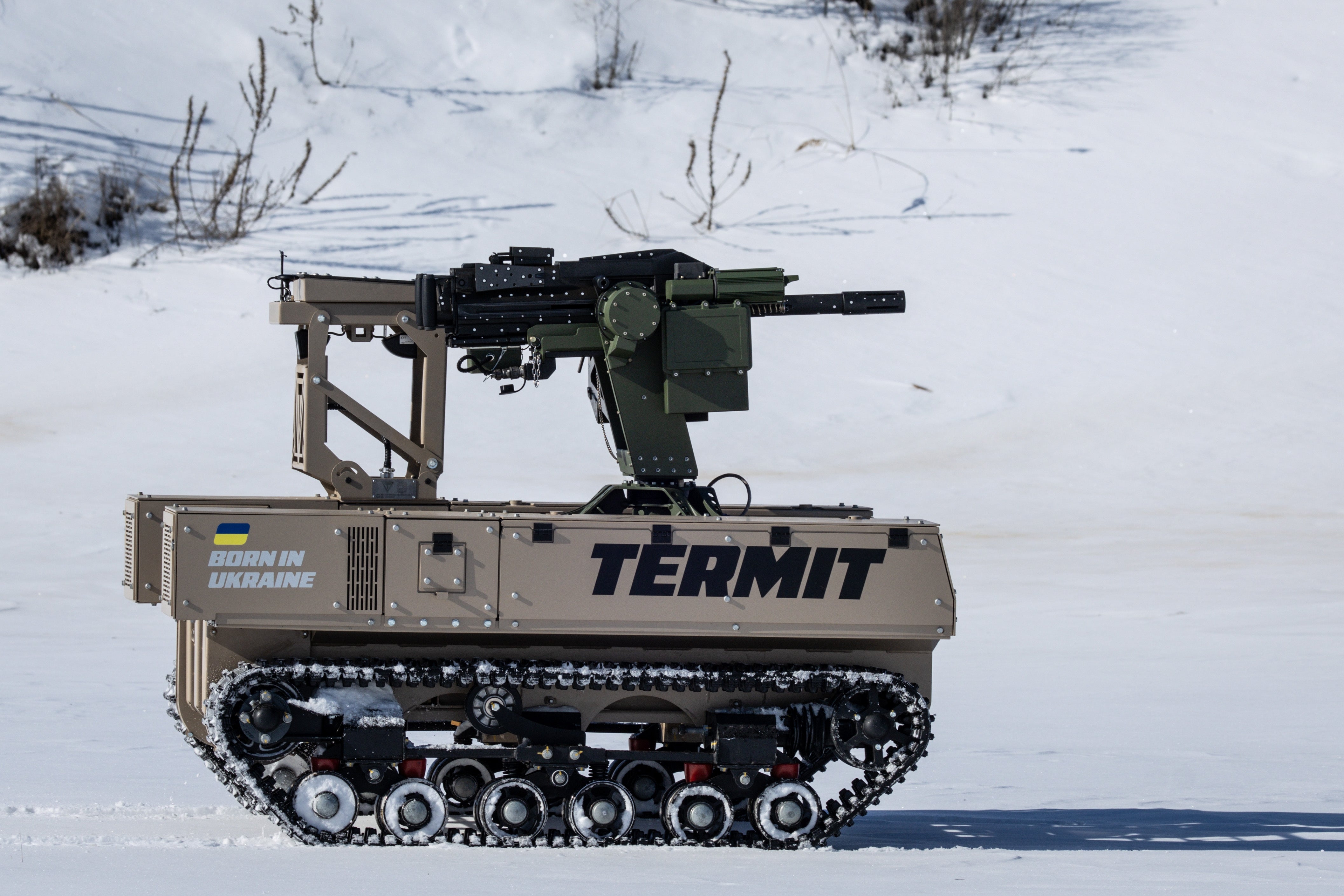
Sgt Drobysh’s unit says it is the world’s first strike UGV unit, starting from scratch with no military doctrine for the use of the vehicles in modern combat. Ukraine is now a world leader in their production and use; last year, its UGV market grew by 488 per cent, according to a study by the KSE Institute, BRAVE1, and Defence Builder.
The vehicles have already been transformative to logistics on the battlefield. While a modern infantryman can carry an average of 20kg of gear over distance, logistics UGVs can transport a cargo of 200 to 600kg to frontline positions.
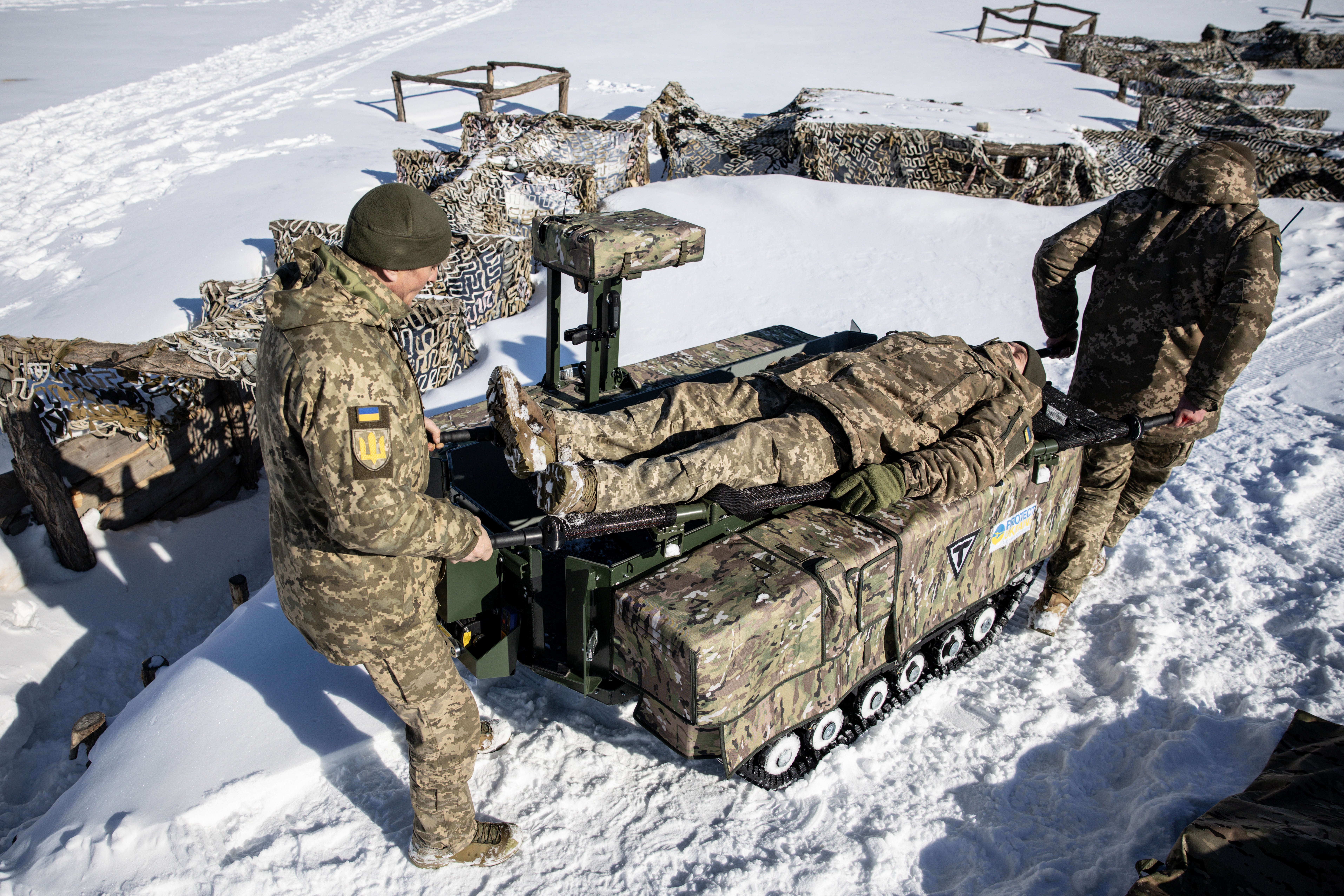
They deliver critical supplies, evacuate wounded troops, hold territorial positions, destroy enemy positions, carry out sabotage missions and lay mines.
Cmdr Zinkevych says the unit has carried out more than 100 strike operations using UGVs in the past few months. “During these missions, we’ve destroyed enemy troops, shelters, command posts, and other high-value targets,” he says. “This is daily, systematic combat work.”
Although he says the vehicles have altered the course of the war, Cmdr Zinkevych has concerns about a slowdown in the pace of their development. He calls for a boost in funding, warning that slowing development is “something we cannot allow”.
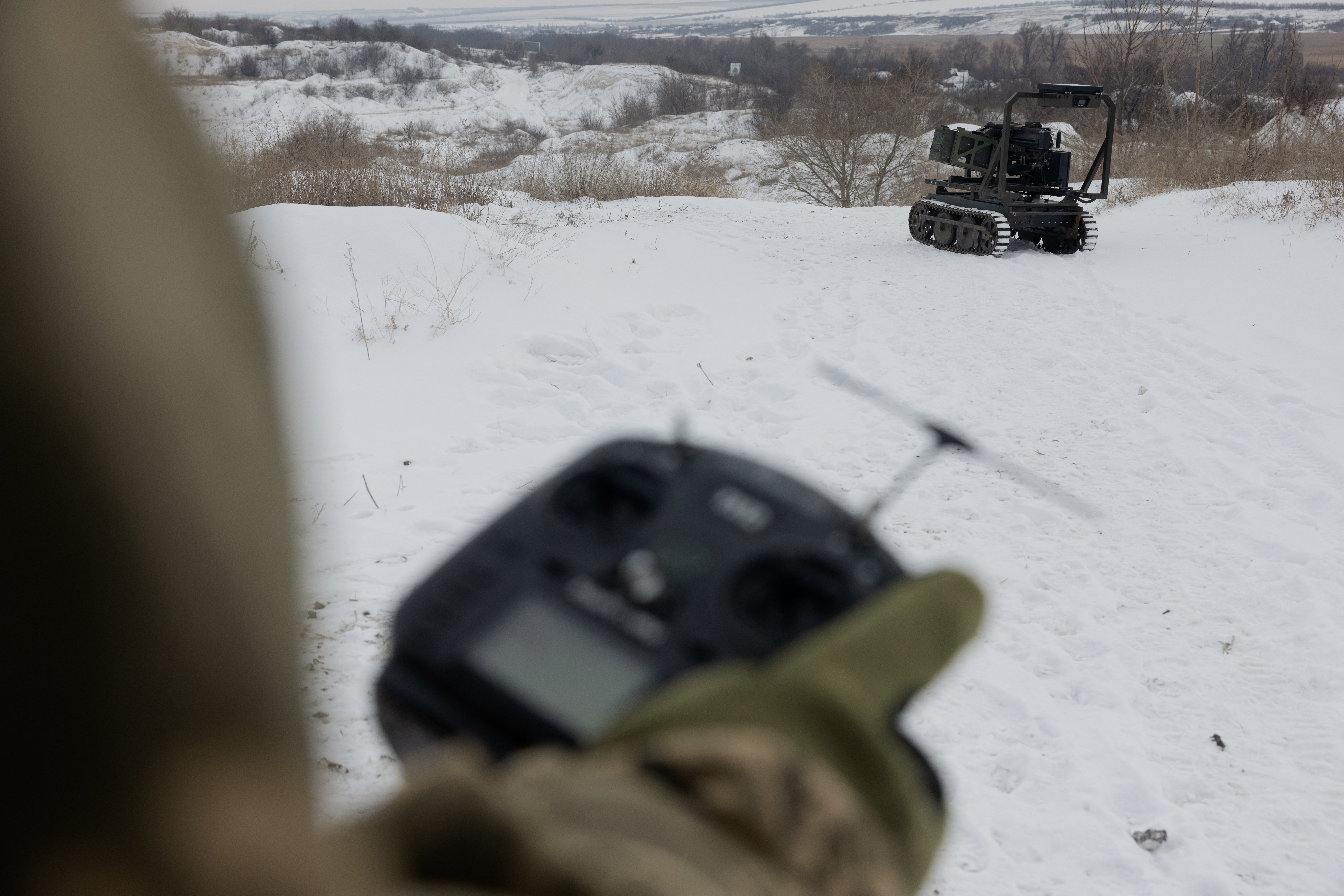
Among the most used robotic units is the TW12.7, produced by the Ukrainian company DevDroid. It is a vehicle with a Browning machine gun mounted on top, and has been used extensively on the battlefield by the unit.
Earlier this year, Cmdr Zinkevych claimed a single TW12.7 held a position on the frontline for six weeks, moving to the forward position on the frontline to watch for any Russian movements and delivering suppressive fire, before withdrawing to a covered location in the evenings.
Oleg Fedoryshyn, head of research and design at DevDroid, says the UGV has transformed how Ukrainian troops hold positions.
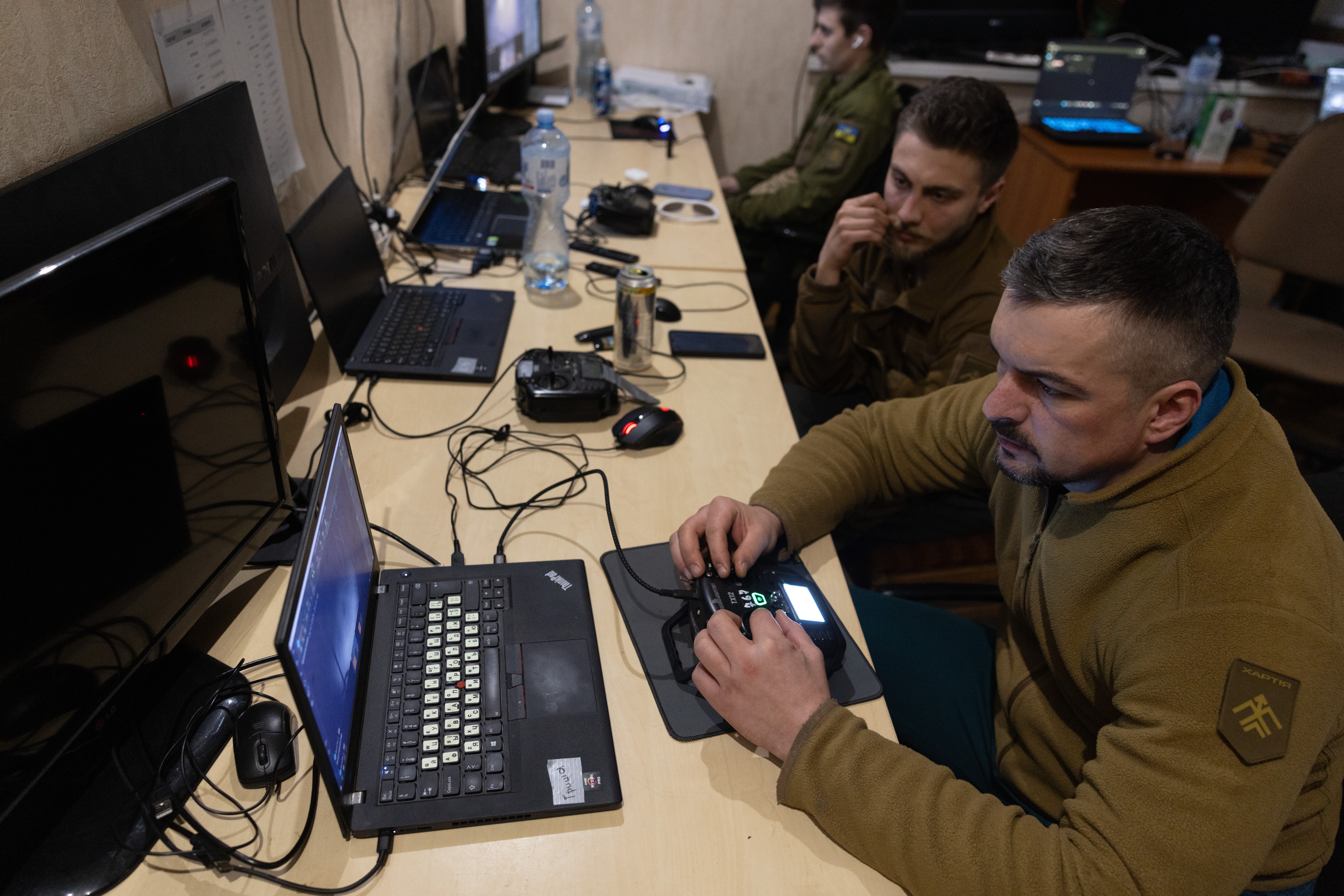
“It’s easier to control an area for 24 hours when you are sitting in a safe zone 50km from the UGV, and you can swap with your team and another guy does it,” he tells The Independent.
The average cost of a UGV for the Ukrainian military, as sold by Devdroid, is $30,000 (£22,100). This rises to $50,000 if it comes equipped with a Browning machine gun, and the price increases significantly if it is sold to any military other than Ukraine’s.
Mr Fedoryshyn is coy about how many robots Devdroid has produced for Ukraine, but says the figure is growing rapidly. “From year to year, it's increasing and increasing a lot. It's not enough at this moment. In this year, in the next year, I think it will increase a lot.”
He is also wary of revealing details of a new UGV he says is currently being trialled by military units, which has not yet been publicly unveiled.
DevDroid is in constant contact with troops on the ground about how the new robots can be improved to better meet their needs.
“We try to produce UGVs that will work after one year. We just try to imagine how it changed, and how the front line changes, how the world is changing. And our product mustn't be outdated in one year,” he says. “Every day we talk with them about it, and they give us some improvements.”
Around 10 or 15 per cent of the robots sent by Devdroid were lost in battle, he estimates. Many of these were repaired and returned to their brigades, so were lost only temporarily.
Experts warn that the growing use of robots does come with its own risks. The physical detachment between the operator and the lethal weapon raises concerns over how force is used.
“Where we have an instrument that serves toward the application of force, operated from a distance, there is a risk that the threshold to use force becomes lowered ... and civilian populations are potentially at risk of bearing the brunt of the use of force,” explains Professor Elke Schwarz, an expert in military technologies at Queen Mary University.
But Prof Schwarz notes that Kyiv is developing the UGV tactics “out of necessity” and in the context of an existential threat.
It is a certain boost for Kyiv’s self-reliance in the war, she adds: “These are often homegrown systems, meaning that there is less reliance on external provisions, and the companies developing these UGVs can later expect to export the systems to other states.”
Ukraine war live: US ambassador to Kyiv to leave ‘over differences with Trump’
Rare earth mining is poisoning Mekong River tributaries, threatening 'the world's kitchen'
United Arab Emirates will leave OPEC in a blow to the oil cartel
Probe launched into pardon of bunga bunga showgirl at centre of Berlusconi scandal
Decision by the UAE to leave OPEC shakes up alliance that influences oil prices worldwide