Afternoon summary
We are now wrapping up this live blog on a day when Ukip has made a breakthrough by winning its first seat in Westminster. Both Labour and the Conservatives conceded that Ukip could be a potent force in next year’s general election. Here is a summary of today’s drama.
- Ukip claims there are no longer safe seats after its victory in Clacton and almost winning in the Labour stronghold of Heywood and Middleton in Greater Manchester. Its next target is Rochester and Strood, which will hold a byelection next month, triggered by Mark Reckless’s defection to Ukip from the Conservatives. It will be an important test for the Tories in terms of defending a seat that had not previously figured highly in places favourable to Ukip based on demographic factors. Ukip leader Nigel Farage said he expects more MPs to defect to his party before the election.
- David Cameron is under pressure from his backbenchers to break up the coalition and harden his message on immigration. Sir Edward Leigh, a former minister, said breaking up the coalition would be one way of showing fed-up Conservative voters that Cameron was serious about addressing their concerns, instead of being shackled to the Liberal Democrats.
- Ed Miliband said he understood why people voted for Ukip and promised to “listen and deliver” over their worries. He said Labour realised voters had “specific concerns” about immigration and reiterated Labour’s view that it was not prejudiced to worry about its effects. The Labour leader acknowledged the party needed to reach out to voters who feel neglected and said there would not be a “shred of complacency” within Labour about the threat of Ukip to the party’s support base.
-
Douglas Carswell, the newly elected Ukip MP for Clacton, declined to offer a specific endorsement of Farage’s call for a ban on migrants with HIV from entering the UK. Carswell, whose father Wilson was one of the first doctors to identify HIV/Aids in Uganda in the 1980s, said Farage’s position had been mischaracterised by the Guardian. Carswell went on to quash speculation he might use his position as Ukip’s first elected MP to manoeuvre for his party’s leadership, which he said would be “disastrous” for Ukip.
Ed Miliband has tried to perk up his party after Labour scraped past Ukip in Heywood. Here is the Guardian’s Rowena Mason on the Labour leader’s pep talk.
Speaking from the steps of Heywood library, Miliband said he understood why people voted for Ukip and promised to “listen and deliver” over their worries. He said Labour realised voters had “specific concerns” about immigration and reiterated Labour’s view that it was not prejudiced to worry about its effects.
In a passionate address, he said: “This is a fight for the everyday working people of Britain. This is a fight for the next generation. This is a fight against disillusionment and despair, this is a fight for the working people of Britain and this is a fight I am determined to win.”
Earlier, Miliband acknowledged the party needed to reach out to voters who feel neglected and said there would not be a “shred of complacency” within Labour about the threat of Ukip to the party’s support base. However, several Labour figures have now questioned the party’s strategy, including former home secretary Jack Straw, who said there should have been a stronger message about immigration.
Labour party veteran Michael Meacher insists that immigration is not the issue but austerity. “Economic policy is what fundamentally needs to be changed. We are going down and down and we need growth,” he tells BBC News. Immigrants, he argues, have become a scapegoat during hard economic times.
Mehdi Hasan, political director of The Huffington Post UK, urges Ed Miliband to ignore calls to tack to the right on immigration in order to see off Ukip at the general election next May.
As I have said before, “Labour cannot win a Dutch auction on immigration”. It was Miliband who once rightly warned Cameron that the PM couldn’t “out-Farage Farage”. The Labour leader needs to remind himself of this fact and also bear in mind that he can’t afford to lose his bloc of ex-Lib Dem voters, who have ensured his party has had a poll lead since 2010 and who won’t be keen on an opposition that brings back the nasty ‘British jobs for British workers’ rhetoric of the New Labour days.
As for Ukip, as Douglas Alexander, Labour’s general election coordinator, observed in an interview on Friday morning: “There’s no instant magic policy, no speech or campaign tactic that can itself address the depth of disengagement we’re witnessing across the electorate.”
He’s right. Labour certainly has to find ways of reaching out to and reconnecting with the so-called ‘left behind’ Ukip voters but without - to borrow a line from activist and commentator Ellie Mae O’Hagan - throwing immigrants - and, for that matter, British-born ethnic minorities - under the bus.
A British woman with HIV challenges Ukip leader Nigel Farage on his views during an LBC radio phone-in programme.
Former Tory MP for Corby Louise Mensch, who now lives in New York, posits this intriguing scenario after next year’s general election. She writes on her Unfashionista blog:
I am NOT suggesting that the SNP go into coalition with the Conservatives – it would be toxic for both parties north of the border. Ruth Davidson needs those Unionist votes to start rebuilding in SNP WM areas. And SNP are banned from propping up the Tories, their left-wing support wouldn’t like it.
But I AM suggesting a scenario where Sturgeon can demand a DEAL with an rUK Conservative majority – after all the Referendum itself happened because Alec Salmond and David Cameron made a binding deal. A deal isn’t a coalition and the SNP wouldn’t need to prop up the Tories in this scenario – because devo-max and English votes for English laws would have meant that the SNP was “mainly governing” Scotland via Holyrood, and in rUK, the Tories would no longer need any Scottish votes (or even be able to use them) – on devolved matters for Eng Wales and NI. Cameron would still need other parties like the DUP and probably even the LibDems for comfort, but Sturgeon’s SNP would not be involved.
Scenario goes like this - Tories largest party, no majority. SNP offer a deal whereby Nicola Sturgeon becomes Deputy PM as being able to command the second party of United Kingdom government, with or without a WM seat of her own. She need not have one, and she can always take a peerage if she likes, a nice Scottish peerage obviously. Sturgeon and Cameron horse-trade over devo-max and the financial settlement for Scotland in exchange for immediate, first-order-of-business “English votes for English laws” legislation. EVEL has been long planned by the Tories and has been in the last three Tory manifestos. This constitutional deal done, Sturgeon repairs to Scotland to govern.
My colleagues, Patrick Wintour and Nicholas Watt, have this story on tensions between Nigel Farage and Douglas Carswell when the newly elected Ukip MP declined to offer a specific endorsement of his leader’s call for a ban on migrants with HIV from entering the UK. Here’s a snippet.
Carswell, whose father Wilson was one of the first doctors to identify HIV/Aids in Uganda in the 1980s, said Farage’s position had been mischaracterised by the Guardian.
Farage expanded on his remarks on Friday morning during a chaotic walkabout through the centre of Clacton-on-Sea with Carswell when he said that migrants suffering from all serious medical conditions, including tuberculosis, should be banned from settling in Britain.
Carswell, who used his acceptance speech to call for Ukip to be a tolerant party, said he agreed with Farage but declined to say whether he supported the specific proposal for a ban on people with HIV.
Asked by the Guardian whether he was upset by Farage’s remarks given his father’s role in helping to discover Aids, Carswell said: “We need an Australian-type immigration system with control over our borders. I don’t recognise the Guardian’s characterisation of the debate … I agree with everything that Nigel has said and we need an Australian-type immigration system.”
Ed Miliband claims the Conservative party was the biggest loser after yesterday’s two byelections, the Tories losing to Ukip in Clacton and to Labour in Heywood and Middleton.
The Telegraph’s Tom Rowley has spent the week touring four of the most likely seats to fall to Ukip: South Thanet (Nigel Farage); Rochester and Strood (Mark Reckless); Great Grimsby (Victoria Ayling); and Thurrock (Tim Aker).
Alberto Nardelli (@albertonardelli), the Guardian’s data editor, looks at five key lessons from last night’s votes. He writes that the Rochester and Strood byelection in November will be a better indicator ahead of the general election next year.
The margin in Heywood aside, both of yesterday’s results were not surprises. In Clacton, Carswell was the incumbent where he had won 53% of the vote in 2010, and in Heywood and Middleton, Labour retained a seat it has held ever since the constituency was created in 1983.
The upcoming byelection in Rochester will be a far more useful bellwether ahead of May’s general election - in terms of understanding Ukip’s ability to win a seat where it’s more about party than local candidate, and translate intent into actual votes.
The byelection triggered by Mark Reckless’s defection to Ukip, will also be an important test for the Conservatives in terms of defending a seat that hadn’t previously figured highly in places favourable to Ukip based on demographic factors. So it is an interesting working example of a constituency whose dynamics fundamentally change with Ukip’s presence, and where a relatively safe seat may become a three-horse race.
Updated
Tim Aker, Ukip’s head of policy, tells BBC News that Clacton and Heywood and Middleton show that there are no more safe seats. “If you think you are in a safe seat, watch out,” he warns. His message to the public: “If you’ve had enough of the establishment, come and join the people’s revolution, come and join us.”
This is Mark Tran (@marktran) taking over from Andrew Sparrow after his marathon effort.
Nigel Farage defends his comments suggesting immigrants who are HIV-positive should not be allowed to come to the UK.
Updated
Lunchtime summary
Here’s my lunchtime summary
- Labour and the Conservatives have conceded Ukip is likely to be a major force at the general election, warning that the May 2015 poll was no longer just be a fight between the two main parties, but a battle against alienation from politics. As Patrick Wintour reports, the warning by Douglas Alexander, Labour’s campaign coordinator, came as the Tory party chairman Grant Shapps again told voters that if they voted for Nigel Farage they would end up with Ed Miliband in Downing Street.
-
Ed Miliband and David Cameron have both faced criticism from within their own parties for not having a better strategy for dealing with Ukip. In the Conservative party, the most critical voice has been Edward Leigh’s. In Labour there seems to be greater unease, but much of the criticism has taken the form of anonymous briefing to journalists. John Mann MP has been the most outspoken person in public. He told the World at One.
Ed Miliband needs to step up to the mark. Amongst Labour voters there is a huge frustration. But let’s not personalise this on Ed Miliband – this is about the Labour leadership as a whole, the people at the top. This is much more than: ‘do we like Ed Miliband? What does he look like on the telly?’ They are small issues that can be addressed and I think should be.
But there’s a bigger issue: is Labour in touch with its core vote and with those people who voted Labour in 1997 but have abstained since? Because that’s a lot of the people who say they’re Labour who have shifted to Ukip – those lost 5m voters from 1997.
Labour needs to broaden its base. People like me need to feel comfortable that we are being properly part of that coalition in Labour and that has not been the case in recent times.
In truth, though, there is no obvious strategy either party can adopt to counter the rise of Ukip. For my money, about the most sensible thing said all morning came from Douglas Alexander, who said: “There’s no instant magic policy, no speech or campaign tactic that can itself address the depth of disengagement we’re witnessing across the electorate.” This blog by Anthony Painter, though quite heavy, is a useful and intelligent guide to the scale of the problem.
It's time we are honest. Politics is going through fundamental change. There may be extinctions. http://t.co/GcxRTUk2UC @policynetwork
— Anthony Painter (@anthonypainter) October 10, 2014
-
Nigel Farage has said he expects further MPs to defect to Ukip before the election. Asked if he expected this to happen, he replied:
I do, yes. It would be very surprising if more people did not come across, and we’ve spoken to Labour people too on this subject. There are people sitting there on the backbenches frustrated that they’re not able to change things in British politics and they can see with Ukip a party that’s now got some real momentum.
-
Douglas Carswell has ruled out trying to become Ukip leader. He said:
I am not the leader of the United Kingdom Independence party. I never will be the leader of the United Kingdom Independence party and I will never seek to be the leader of the UK Independence Party. I don’t have the qualities, including the endless reservoirs of patience that are required to do that. If I was ever to be the leader of the party it would be bad for me, bad for my family and disastrous for the party.
- Farage has defended his proposal to ban HIV positive immigrants from receiving NHS treatment, saying he believes the health service should not be open to migrants with serious or life-threatening illnesses. Carswell has also defended Farage’s comments, although with a noted lack of enthusiasm.
That’s all from me for today.
My colleague Mark Tran will be taking over the blog for the rest of the afternoon.
Updated
Here are four good blogs about the byelection results.
Ultimately, however, Ukip can only go so far under the current rules of the game. To really break the mould, it needs – just like the SDP needed but never succeeded – to break the electoral system. If it can’t or won’t do that, then its only hope is to break the Conservative party. Whether that happens is ultimately down to the Tories themselves.
The SNP are poles apart from Ukip when it comes to their actual policies: the former is pro-European and broadly left-wing, the latter the opposite.
But there is a palpable read-across from the 45 per cent of Scots who voted “Yes” for independence last month and the huge numbers of English voters who backed Ukip on Thursday.
Both parties are mining the same seam of discontentment about the main three parties in Westminster.
Could it just be that voters do not see such a significant difference between the two big parties and their leaders? That the fine distinctions between two smart 40-something PPE graduates from the south east of England are lost on people who feel far removed from Westminster?
Freud’s observation about the narcissism of small differences could have been made about Britain’s political class and its media, whose collective fixation on detail is notable and baffling: does anyone beyond London’s upper-middle class really care about the difference between David Cameron’s £2 million house in north Kensington and Ed Miliband’s £2 million house in Dartmouth Park?
Tories accuse Cameron of being to blame for the rise of Ukip
A whole host of errors conceived or approved of by Tory bigwigs has fostered the steady loss of votes to the Faragists: the deliberate policy of triangulation, the coalition with the Liberals, increased taxes on the middle classes, cuts to the armed forces, failed and wasteful green policies, failing to deliver the promised referendum on Lisbon, the massive increase in international aid spending, and controversial and revolutionary social policies such as same-sex civil marriage. All these actions have been pervaded by a constant tone of attacking the record of the oldest and most successful political party in the world as “the nasty party”.
Lord Ashcroft, the former Conservative party deputy chairman, made much the same point in a Tweet last night.
The ConservativeParty leadership must take a large part of the credit for the rise of UKIP!!!
— Lord Ashcroft (@LordAshcroft) October 10, 2014
Andy Burnham criticises media for being unduly negative about Labour
On the Daily Politics Andy Burnham, the shadow health secretary, criticised the media for being unduly negative about Labour’s peformance in Heywood and Middleton.
This is what he told Jo Coburn on the Daily Politics.
I know the media script at the moment is to proclaim everything a disaster for Labour, it’s the way the media is operating at the moment. I mean, it’s not borne out by the facts is it? As you said in your own introduction, Labour’s vote held up. It wasn’t Labour’s vote that collapsed last night and I think that is, to be honest with you, the story...
I’m not coming on to be complacent. I’m never complacent. There is more we need to do to listen to people who are voting Ukip, particularly on immigration, I would be the first to say that. But I am entitled, I think, to push back at a media narrative that’s been running since the conferences to say that Labour has the problem and all the momentum is with the Conservatives.
I’ve taken the quote from PoliticsHome.
At Elections Etc the academic Stephen Fisher produces a weekly forecast for the result of the 2015 election, based on polling figures and a sophisticated analysis looking at the historic relationship between poll ratings and subsequent election results.
More anonymous Labour briefing against Ed Miliband.
Labour MP: "As retail proposition Miliband is dreadful...even people who aren't interested in politics have an opinion on him: he's weird."
— Jim Pickard (@PickardJE) October 10, 2014
Douglas Carswell has ruled out standing for the Ukip leadership.
Douglas Carswell: "I will never be the leader of Ukip. I will never seek to be the leader of Ukip."
— Michael Crick (@MichaelLCrick) October 10, 2014
Ed Miliband has been speaking in Heywood and Middleton, where the party held its seat last night.
Ed Miliband ignores 'why did you nearly lose' shouts on Heywood and Middleton victory lap pic.twitter.com/R6HXAPOoLc
— Rebecca Keating (@RebeccaKeating) October 10, 2014
"Lessons for labour in this result" says @Ed_Miliband sending direct message to ex lab voters "know you have specific immigration concerns"
— Faisal Islam (@faisalislam) October 10, 2014
Miliband channels Michael Howard with 'direct message' to Lab voters who switched to Ukip: 'It's not prejudiced to worry about immigration'
— James Chapman (Mail) (@jameschappers) October 10, 2014
Ed Miliband declines to answer questions from journalists in Heywood and Middleton. pic.twitter.com/aOkvimjRnA
— Nick Sutton (@suttonnick) October 10, 2014
Channel 4 News’s Michael Crick points out that the Conservatives won a byelection in Clacton last night.
Tories win by-election in Clacton, take seat from Ukip. That's Essex Cty Council by-election in Brightlingsea ward, partly in Clacton seat
— Michael Crick (@MichaelLCrick) October 10, 2014
Essex CC seat in Brightlingsea ward which Ukip lost in Clacton area last night was held by Roger Lord, man Carswell deposed as candidate
— Michael Crick (@MichaelLCrick) October 10, 2014
Jack Straw, the Labour former foreign secretary, has told Sky News that Labour needed a stronger message on immigration.
We could and should have done better. That said, bear in mind that our share of the vote went up [in Heywood and Middleton], albeit by 1%, that there was a swing in our favour against the Conservatives by 8%. So as the leader of the Labour party Ed Miliband has just said, we’re not the least complacent about this. But this should have been a better night for us, but it was nothing compared to the catastrophe for the Conservatives.
I come from Essex, I know Clacton. Clacton is where people vote Conservative with their breakfast, lunch, dinner and tea and they didn’t. That was a catastrophe [for the Conservatives].
But there are lessons in this by-election result. We were right to concentrate on the NHS; we’ve also, however, got to be stronger about our messages on immigration as well.
I’ve taken the quote from PoliticsHome.
Paul Nuttall, Ukip’s deputy leader, has been holding a news conference in Heywood and Middleton. He said Labour was “morally bankrupt” because it moved the writ for the byelection before Jim Dobbin’s funeral.
They [Labour] are a morally bankrupt party who called this election early simply because they knew that Ukip could go on and win and had the momentum.
He also said Ukip was now the only opposition to Labour in the north.
For us up here in the north of England, we’ve proven we are the only opposition to the Labour party.
John [Bickley] came literally within 600 votes of taking this seat. Labour’s majority has been cut from 6,000. They couldn’t get their vote out. Their campaign was flat. In the North of England, if you vote Conservative, you get Labour. That now is perfectly clear.
Interesting take on the byelection result from Mike Smithson.
Want to know where UKIP will flourish? Where Billy Butlin established holiday camps in the 1930s. Skegness was first followed by Clacton.
— Mike Smithson (@MSmithsonPB) October 10, 2014
Here’s a Guardian video of Nigel Farage and Douglas Carswell commenting on the Clacton result.
David Cameron has commented on the byelection results. He says they show a big Ukip vote will put Ed Miliband in Downing Street.
I think the next election is the most important in a generation and I think what last night demonstrated is that if you see a big Ukip vote, you will end up with Ed Miliband as prime minister, Ed Balls as chancellor, Labour in power, and, more to the point, you won’t have the long-term economic plan that is really beginning to deliver for this country the stability and security that people want.
Here are some more pictures from the Farage/Carswell walkabout.
Somewhere in that lot is Nigel Farage and Douglas Carswell... pic.twitter.com/hyYCUvYSDx
— Theo Usherwood (@theousherwood) October 10, 2014
Dave Monk in the thick of it in #Clacton pic.twitter.com/KyHnnEtJ37
— Tom Barton (@tombarton) October 10, 2014
I’ve been covering it from the TV because I guessed (correctly, I think) that I would not be able to blog very easily from the the middle of that.
To use a technical term, it was what photographers describe as a rolling goat fuck.
I estimate @nigel_farage managed to walk approximately 2 feet during his walkabout in #Clacton
— Chris Ship (@chrisshipitv) October 10, 2014
This is what happened when Nicholas Watt asked Douglas Carswell if he agreed with what Nigel Farage said about banning HIV-positive migrants from the UK. Carswell did not criticise Farage, but he did not sound hugely supportive either.
Nick Watt: Douglas, can I ask you, your father was a pioneer in discovering Aids. Are you upset by what Nigel Farage has said about people with HIV not being allowed to enter the UK?
Douglas Carswell: We need an Australian-type immigration system with control over our the borders. I don’t recognise [the characterisation of Farage’s remarks.]
Nigel Farage: There’s tuberculosis, there are many, many diseases. If you actually listen to what senior clinicians say about the pressure put on the National Health Service by foreign patients, you would know what we are saying.
Media scrum around #ukip victory walkabout stops traffic on Clacton's Station Rd @BBCNews pic.twitter.com/WFgfgSas2Q
— Kathryn Stanczyszyn (@stanchers) October 10, 2014
Nigel Farage and Douglas Carswell are doing a walkabout in Clacton now.
My colleague Nicholas Watt has just asked Carswell what he thinks about Farage’s HIV-positive comments, especially in the light of his father’s record on this question. (See 11.16am.)
Carswell did not fully engage with the question. He just said he favoured Autralian-style immigration measures.
I will post a transcript of the exchange short.
Redwood says Clacton result may have weakened the Eurosceptic cause
John Redwood, the Conservative Eurosceptic, says on his blog that he thinks the Clacton result may have “slightly weakened the overall Eurosceptic cause.”
Mr Carswell will be able to do less as a UKIP Eurosceptic than he could do as a Conservative one, because he will no longer have a voice and vote within a large Parliamentary party. He will need to rebuild some of his links with us Conservative Eurosceptics if he wants other MPs to back any of his proposals, second any of his motions and help him get some airtime in a Parliament which requires numbers to achieve things.
Redwood also thinks the Nigel Farage/Douglas Carswell relationship could soon get difficult.
It will be interesting to see how the Farage/Carswell relationship works. Mr Carswell already sounds at variance with his new Leader over immigration, and sounds as if he fancies being the UKIP leader. In the Commons, of course, Mr Carswell will be the UKIP Leader – and Chief Whip, and spokesman on every topic. It will have the fortunate consequence for him that he will never have to rebel against his own Parliamentary whip, but for Mr Farage it will mean there is now a very independent voice speaking for UKIP who may not be the same as Mr Farage.
It will be interesting to see if Douglas Carswell has anything to say about Nigel Farage’s comments about HIV-positive immigrants. PoliticsHome’s Paul Waugh says Carswell’s father, a doctor working in Africa, was one of the first people to highlight the threat posed by Aids in the 1980s.
He's no Farage. @DouglasCarswell's father among 1st to confirm/publicise cases of HIV in Uganda in 80s: http://t.co/esTVSNNB7D
— Paul Waugh (@paulwaugh) October 10, 2014
Richard Howitt, the Labour MEP for the East of England, has written an article for the New Statesman today about the abuse he has received at the hands of Ukip supporters after highlighting some of the things party figures have said about the disabled. He thinks his experience is revealing.
So what does all this say about Ukip and its supporters?
That too many of them appear to hold offensive and discriminatory views against disabled people.
That they embrace an unbelievable hypocrisy by repeatedly defending their own statements as “free speech,” whilst denouncing the right of those of us who disagree with them to do the same.
NAT (National Aids Trust) condemns Farage over HIV-positive comments
NAT (National Aids Trust) has strongly condemned Nigel Farage for saying HIV-positive immigrants should be banned from the UK. This is from Yusef Azad, its director of policy and campaigns.
Nigel Farage’s comments on banning people with HIV from migrating to the UK are both ignorant and discriminatory. People with HIV on treatment can live normal life-spans and be non-infectious – they make important contributions to our society in every field and profession. And HIV treatment itself is becoming cheaper all the time with the arrival of generic drugs.
If Mr Farage believes a migrant with HIV cannot make a net contribution to our society, he believes the same about UK-born citizens with HIV. That is factually incorrect and deeply stigmatising. To call for entry bans, to lump people with HIV in with criminals, to describe HIV as simply as a ‘life-threatening disease’ are relics from the bad-old days of AIDS panic. They don’t contain the spread of HIV, they drive the spread of HIV.
Sky’s Joey Jones has been speaking in private to Labour figures about the results.
Some Lab figures drawing positives from Tories' dire results, but am picking up a lot of anger now as well.
— Joey Jones (@joeyjonessky) October 10, 2014
Senior Lab MP: "Where our problem lies is leadership. Wherever you go you hear "It's your leader." Monday PLP "could be absolute bloodbath."
— Joey Jones (@joeyjonessky) October 10, 2014
Another Lab MP: "Anyone who thinks they can take comfort from Heywood + M needs their head examined." Result "awful...terrible."
— Joey Jones (@joeyjonessky) October 10, 2014
Shad Cab: "v worrying"; another shad cab: "Time for humility from both big political parties."
— Joey Jones (@joeyjonessky) October 10, 2014
Chief Whip Rosie Winterton has a busy weekend ahead. This is going to get quite nasty.
— Joey Jones (@joeyjonessky) October 10, 2014
Here it is worth noting the work of David Goodhart, much disparaged by the left but probably onto something. The liberal left, he says, is today dominated by people whose worldview is “universalistic, suspicious of most kinds of group or national attachment, and individualistic…they don’t “get” what most other people also get – loyalty, authority and the sacred’.
This is in contrast to working class voters, who value family, patriotism and social and economic stability.
In other words, there is a schism between the liberal left and many working class voters; a schism that’s also apparent on issues surrounding welfare – Labour’s core voters are the most enthusiastic proponents of welfare reform, quite at odds with most middle class left-wingers.
Douglas Alexander says there's no 'magic' solution to problem of disengagement
Douglas Alexander, the shadow foreign secretary and Labour’s general election strategy chair, has been giving interviews this morning about the byelection results. Here are the key points he’s been making.
-
Alexander stressed that Labour increased its share of the vote in Heywood and Middleton.
Both the Conservative vote and the Liberal vote collapsed into supporting Ukip. We actually increased our share of the vote in the seat last night. I was elected myself in a by-election just six months after our greatest landslide in 1997 and got a comparable share of the vote to that which Liz got last night.
-
He said that Labour was showing “absolutely no complacency” and that it was not taking any voters for granted.
I think the idea that somehow you could rely in perpetuity on any section of the vote or any part of the country to vote for any one party disintegrated some months ago. I’ve just spent recent months battling a populist nationalism in Scotland to defeat the Yes side in the referendum. I’ve spent all of my life engaged in four-party politics in Scotland. So I’m the very last person who needs to be convinced about the scale of the challenge that is presently being thrown up against the parties – the Labour party, the Conservative party, the Liberal Democrat party – by new parties across the United Kingdom.
-
He rejected claims that Labour was adopting a core vote strategy.
Such a strategy that you’re describing would both be risky and wrong. We should be setting our sights higher because the truth is whether it’s a sense of concern about the cost of living or the NHS, that stretches across the whole electorate; or frankly, whether it is the sense of alienation towards how politics has been done, that stretches across the electorate.
-
He said Labour would need new methods to combat Ukip.
If you’re dealing with a political party whose principle appeal is that they’re not part of traditional party politics then you can’t simply expect to deploy the tools of traditional party politics. So of course we’ll work hard in the months ahead to expose the fact that their policies are more Tory than the Tories, but we’ve got to defeat Ukip conversation-by-conversation.
-
But he also said there were no easy solutions.
There’s no instant magic policy, no speech or campaign tactic that can itself address the depth of disengagement we’re witnessing across the electorate.
I’ve taken the quotes from PoliticsHome.
Miliband promises not 'a shred of complacency' over need to reach new voters
Ed Miliband has welcomed Labour’s victory in Heywood and Middleton, but promised that there will be not “a shred of complacency” as the party reaches out to new voters.
I want to congratulate Labour’s new member of parliament for Heywood and Middleton, Liz McInnes. What we saw last night was a Tory party losing in their own backyard in Clacton and in retreat on what used to be their frontline in the northwest.
But there won’t be a shred of complacency from us as we reach out to all of those voters who didn’t vote Labour and those who didn’t vote at all.
Farage says he would be 'surprised' if there are no further defections to Ukip
Nigel Farage ended his LBC phone-in by saying he would be “surprised” if there were not more defections to Ukip over the coming months.
Nigel Farage "I would be surprised if there were not over the course of the next few months more defections". #LBC
— Patrick Wintour (@patrickwintour) October 10, 2014
John Mills, a Labour party donor and chair of Labour for a Referendum, says the result in Heywood and Middleton shows why the party should back an in/out referendum.
I am delighted that Labour held Heywood and Middleton and I congratulate Liz McInnes and the local Labour party on their victory. But this result should serve as a wake up call to the Labour leadership. Labour voters have serious concerns about immigration and our current relationship with the EU. The only way serious reform in Europe can be achieved is if it backed up by a pledge to hold an in/out EU referendum.
Mills has probably missed the boat. For reasons I explained here, Ed Miliband now seems more confident than ever about not offering an in/out referendum.
Nigel Farage says Grant Shapps was “absolutely pathetic” on the radio this morning. All he could say was that, although the Tories might be bad, Labour would be even worse, Farage says.
Ukip favourite to win in three seats at general election, say Ladbrokes
Ladbrokes have Ukip as favourites to win in three seats in the general election. Here’s an extract from their press release.
The bookies make Douglas Carswell a red hot 1/10 favourite to retain Clacton in 2015, with 5/1 offered about the Tories retaking the constituency. Elsewhere, Nigel Farage is odds on to win South Thanet and the party is also now favourite to take Boston & Skegness.
Back to LBC, where Nigel Farage has been asked what Ukip would do about Ebola. Farage says the government is probably doing the right thing in checking passengers. But they are only asking people if they have a temperature, Nick Ferrari points out. Farage says the authorities should probably check people’s temperatures too.
Paddy Ashdown has noticed there is a considerable difference between what Douglas Carswell thinks about immigration and what Nigel Farage is saying. (See 7.38am.)
A chasm separates Farage and Carswell this am. The real question is can they unite behind a sensible manifesto for a civilised nation?
— Paddy Ashdown (@paddyashdown) October 10, 2014
I think he’s implying the answer is no.
Farage says, after last night’s results, he went for a drink to a Ukip-supporting pub that was open. He was there until about 4.45am, he says.
The next caller is a woman who says she is a Polish immigrants. She has been here for some time, she works and she pays her taxes, she says. She says a lot of Ukip support comes from people on benefits.
Farage asks her how much she earns. She declines to say. Farage says lots of people in work qualify for in-work benefits. But benefits are there for British people, he says.
She wants to know what Ukip would do about someone like her. Farage says, if she came her legally, she does not need to worry.
Updated
On LBC Nigel Farage is being challenged about his comments about banning HIV-positive immigrants from coming to the UK. The caller is a woman who says she has been HIV-positive for years and who says she is no threat to anyone.
Farage says he was was making the point that the NHS is there for Britons.
The caller suggests he is trying to equate being HIV positive with Ebola. He is playing the race card, she says. HIV is not a black disease.
Farage says he did not mention Ebola. It is “ridiculous” to claim he is playing the race card, he says. He says tuberculosis is now costing the NHS a lot of money. A lot of it comes from southern Europe, he says.
Frank Field says even safe Labour seats could be under threat from Ukip
Frank Field, the Labour former minister, has also added his voice to those saying the party needs to take the threat posed by Ukip more seriously. Even safe Labour seats could be at risk, he says.
If last night’s vote heralds the start of Ukip’s serious assault into Labour’s neglected core vote, all bets are off for safer, let alone marginal seats at the next election.
Updated
Nigel Farage's LBC phone-in
Nigel Farage is hosting his LBC phone-in.
I will be covering the key points, while also keeping an eye on the other byelection reaction coming in.
Miliband under pressure to change after Heywood near defeat
Chris Bryant, the Labour MP running the party’s campaign in Clacton, says he thinks journalists are overstating the extent to which the Heywood and Middleton was bad for Labour.
.@IsabelHardman I think journos overreact when they are surprised. The bigger longterm story is collapse of Tory vote and loss of seat.
— Chris Bryant (@ChrisBryantMP) October 10, 2014
Journos hate to be surprised so are now hyperbolic. The big long term story of 10.10.2014 is collapse of Tory vote, loss of MP and seat.
— Chris Bryant (@ChrisBryantMP) October 10, 2014
Of course Labour has things to learn but the massive Tory swing to UKIP is the seismic element here.
— Chris Bryant (@ChrisBryantMP) October 10, 2014
But the Labour MP John Mann thinks Labour needs to change course. I posted these tweets on last night’s blog, but I will quote them again in case you missed them.
Time for Labour to take the fight to UKIP and stop taking false comfort from Tory losses
— John Mann MP (@JohnMannMP) October 9, 2014
50% Clacton turnout shows that the key issue in General election will be motivating voters to turn out at all
— John Mann MP (@JohnMannMP) October 9, 2014
The real issue is why so many Labour voters are not bothering to vote. The mantra of 'must work harder' is not sufficient.
— John Mann MP (@JohnMannMP) October 10, 2014
If Ed Miliband does not broaden the Labour coalition to better include Working class opinion then we cannot win a majority government
— John Mann MP (@JohnMannMP) October 10, 2014
Ed Miliband does a lot of listening. Now he needs to do a bit more hearing.
— John Mann MP (@JohnMannMP) October 10, 2014
And here’s Luke Akehurst, a former member of Labour’s national executive committee, making a similar point.
Even clearer after Heywood & Middleton near miss need complete rewrite of Labour's election strategy and shake up of the team delivering it
— Luke Akehurst (@lukeakehurst) October 10, 2014
Only last night it was revealed that Nigel Farage has been banging on about banning people with HIV from moving to the UK. The man is a walking 1980s Tory tribute act, and yet his incoherent anti-politics rabble came close to taking a safe Labour seat just seven months before a general election when we’re seeking to return to power. Labour’s UKIP problem is undoubtedly smaller – at present – than the Tory UKIP problem. But in opposition you hope not to have these problems. In opposition you’re meant to be the stick with which people beat the government, and you’re meant to be the vessel for people’s hopes and dreams ...
What’s clear is that Labour’s general election campaign cannot plod on regardless after results like these and hope for the best in 2015. That truly would be a campaign strategy worthy of Mr Micawber. We must be not be cowed in our offer, nor limited in the scope of our ambition. We should aim to win 40% of the votes and be disappointed if we fall short, rather than setting our sights lower and bracing ourselves for a lesser result. We should grasp once again the organising rooted in our communities of Arnie Graf and embrace firmly the genuinely transformative agenda – pushing power away from the centre and towards people – that Jon Cruddas has advocated.
George Galloway, the Respect MP who won his own byelection in Bradford as an insurgent fighting an established party, says the three main parties deserve to lose votes to outsiders.
Britain has turned away and forever from it's traditional parties. They are headed for defeat. All three of them deserve what's coming...
— George Galloway (@georgegalloway) October 10, 2014
We’re now getting Nick Robinson’s post-match analysis.
It is striking that Grant Shapps admits Labour could win if people vote Ukip, he says. The Tories have tried other ways to counter them: calling them loonies, or pointing out the inconsistencies. But those techniques have not worked.
And at one point people claimed that Ukip’s appeal was limited, and that they would not get beyond a certain share of the vote, or that they would not win in certain seats. Those predictions have been confounded, he says.
He says it is generally thought Ukip will only win a very small number of seats at the general election. But no one can be sure, he says.
Q: But wouldn’t it be worth it to get back into power?
Shapps says the system is not as simple as that.
If Conservative seats become Ukip seats, Labour will be the largest party. Ed Miliband will be prime minister.
Shapps says you have to seriously wonder whether Nigel Farage actually wants an in/out referendum, because David Cameron is the only person who can deliver it.
Grant Shapps, the Conservative chairman, says this is an alarm clock moment.
People might think it is fun to vote Ukip. But it increases the chance of Labour winning. He repeats David Cameron’s line about going to bed with Nigel Farage and waking up with Ed Miliband.
Q: Why not do a deal with Ukip?
Shapps says the Tories do not know what Ukip stands for. They keep changing their policies.
Q: Why not have some kind of a deal?
Shapps says people want a government with a clear plan.
The election will either be won by David Cameron or Ed Miliband. If it’s Miliband, there won’t be a plan for the economy.
Talking about Ukip, he goes on:
You simply don’t know what these guys stand for.
Grant Shapps and Nigel Farage interviewed on Today
John Humphrys is interviewing Grant Shapps and Nigel Farage.
Q: What next, Nigel Farage?
Rochester, says Farage. Ukip is aiming to win the byelection there.
Q: But Mark Reckless is just another Tory.
Farage says there was a big Ukip vote in Clacton. It won the European elections in the seat. And it is strong in the north. He wants to tell people there that if they vote Conservative, they will get Labour.
Q: Douglas Carswell made an impressive acceptance speech. He spoke about the need for compassion and tolerance. But you gave an interview with Newsnight saying you want to keep HIV-positive people out of Britain.
Farage says he will say what he said.
Q: I’ve got the quotes here.
Farage says Britain cannot afford to have people with life-threatening diseases coming to the UK.
Q: America does not keep HIV-positive out.
Farage says if they go to the US, they need health insurance.
Q: So why should they be kept out of the UK.
Farage says the NHS is not there to treat foreigners with life-threatening diseases.
My colleague Patrick Wintour has filed his take on the overnight results. Here’s an extract.
For a decade the British electorate has had a compulsion to punish governing parties in byelections, and voters on Thursday in Essex and the north-west refused to kick the habit, but that does not do justice to the way in which a new chapter in British politics has opened. It may yet turn out to be a brief chapter, or a diversion in the main direction of the plot, but it does not quite feel like that ...
The biggest message from these results is that four-party politics is here to stay, something that no one thought possible within the straitjacket of first past the post.
Once the Greens and Scottish nationalists are taken into account, it is possible to argue we have reached six-party politics. Solving what this may mean for politics is as easy solving a Rubik’s cube.
Nigel Farage, the Ukip leader, told ITV’s Good Morning Britain this morning that the results showed that Ukip was “a truly national party” and that it was not just a protest vote.
Let’s go back to 22 May, the European elections. We topped the poll across England, Scotland, Wales and Northern Ireland; we won a national election. And I know people in Westminster choose to ignore these things and hope it will go away and comfort themselves by saying it’s a protest vote. It isn’t. What people were voting for in Clacton yesterday and in Heywood and Middleton, they’re voting for real change. They are sick to death of a career political class who are not prepared to stand up for the interests of ordinary people and increasingly they see Ukip as their champion.
He also dismissed protests about his comments about wanting to stop people who test positive for HIV coming to the UK.
This is a desperate attempt by the newspapers who support the existing parties to try to sully the phenomenal performance of Ukip last night by picking up one little area. What I’ve said is this: I believe that we should control the number of people that come into Britain. We should control the quantity, but also control the quality. We want immigration into Britain with people who have got skills, trades and jobs; but we don’t want them if they’ve got serious criminal records and we don’t want them if they’ve got life-threatening diseases.
And you only have to look at senior cancer specialists ... saying we have an epidemic problem now of foreign people coming to Britain and using our healthcare services. It’s called the National Health Service and the clue is the name. It’s designed for the people of this country and not for the whole world.
I’ve taken the quotes from PoliticsHome.
Overnight reaction and analysis from the commentariat
Here is some overnight reaction and analysis to the byelection results from journalists.
From the New Statesman’s George Eaton
None of the three main parties could hope to win Clacton and nearly win Heywood - stunning achievement by UKIP.
— George Eaton (@georgeeaton) October 10, 2014
That UKIP ran Labour this close at a time when the Lib Dem vote has collapsed should terrify them.
— George Eaton (@georgeeaton) October 10, 2014
From the Spectator’s Fraser Nelson
From @frasernelson: What Labour and the Tories can learn from their Ukip spanking http://t.co/WfSfMXpza2
— Coffee House (@Spectator_CH) October 10, 2014
From the BBC’s Nick Robinson
The revenge of the "loonies, fruitcake a & closet racists" http://t.co/lLMsWT73gi
— Nick Robinson (@bbcnickrobinson) October 10, 2014
From the Spectator’s James Forsyth
Ukip’s breakthrough night; It wins Clacton from the Tories and runs Labour mighty close in Heywood & Middleton http://t.co/Kaqz1fS8r3
— James Forsyth (@JGForsyth) October 10, 2014
From Sky’s Joey Jones
Can't imagine many of the Ukip supporters I spoke to in Clacton would have been put off by suggestion they're helping Labour by back door.
— Joey Jones (@joeyjonessky) October 10, 2014
Anoosh Chakelian from the Staggers has five lessons from the Clacton result.
Ukip wins its first elected MP: what does this mean? Here are my five lessons from the Clacton by-election result http://t.co/6EOkojHJMj
— Anoosh Chakelian (@AnooshChakelian) October 10, 2014
From the BBC’s Robert Peston
For me an interesting point about #HeywoodAndMiddleton is that many LibDems switched to #UKIP not Labour. That must surely worry Labour
— Robert Peston (@Peston) October 10, 2014
From Channel 4 New’s Michael Crick
Lib Dem saved deposit in Heywood & Middleton is quite an achievement - they've lost deposit in 9 of the 15 other by-elections in this Parlt
— Michael Crick (@MichaelLCrick) October 10, 2014
From ConservativeHome’s Andrew Gimson
By being a liberal Conservative, Cameron inflicted mortal damage on the Lib Dems: and created room for a new protest party
— Andrew Gimson (@AndrewGimson) October 10, 2014
From the Daily Mirror’s Kevin Maguire
Can't see a Con or Lab outright majority at next May's General Election after Clacton & Heywood
— Kevin Maguire (@Kevin_Maguire) October 10, 2014
From the Economist’s Jeremy Cliffe
If these abysmal by-election results don't persuade Labour that its recent tide of negativity & cynicism benefits UKIP first, nothing will.
— Jeremy Cliffe (@JeremyCliffe) October 10, 2014
Updated
Most speeches given at the count by newly elected MPs are bland, or even sometimes rather embarrassing. But Douglas Carswell’s was quite striking, because he had a message for his party. It had to be a party “for all Britain and all Britons, first and second generation as much as every other”, he said.
I resigned from parliament to face this election because I answer first, foremost and last to you, you are my boss, I will not let you down.
To my new party I offer these thoughts: humility when we win, modesty when we are proved right. If we speak with passion, let it always be tempered by compassion. We must be a party for all Britain and all Britons: first and second generation as much as every other.
Our strength must lie in our breadth. If we stay true to that there is nothing that we cannot achieve.
Nothing we cannot achieve in Essex and East Anglia, in England and the whole country beyond.
My colleague Nicholas Watt has more on Carswell’s speech, and his reaction to his victory, here.
Carswell has been described as a Ukip moderniser. I wrote more about this here, on last night’s blog.
Grant Shapps, the Conservative party chairman, is doing media interviews for his party this morning. Here he summarises his message.
On @SkyNews at 7.30am discussing how voting for UKIP is effectively voting for Ed Miliband in No10 with no plan for immigration or jobs
— Grant Shapps MP (@grantshapps) October 10, 2014
Full results for Clacton and Heywood and Middleton
Here are the Clacton results in full.
Douglas Carswell (UKIP) 21,113 (59.75%)
Giles Watling (C) 8,709 (24.64%, -28.38%)
Tim Young (Lab) 3,957 (11.20%, -13.84%)
Chris Southall (Green) 688 (1.95%, +0.71%)
Andy Graham (LD) 483 (1.37%, -11.57%)
Bruce Sizer (Ind) 205 (0.58%)
Howling Laud Hope (Loony) 127 (0.36%)
Charlotte Rose (Ind) 56 (0.16%)
UKIP maj 12,404 (35.10%)
Electorate 69,118; Turnout 35,338 (51.13%, -13.05%)
And here are the Heywood and Middleton results in full.
Liz McInnes (Lab) 11,633 (40.86%, +0.75%)
John Bickley (UKIP) 11,016 (38.69%, +36.06%)
Iain Gartside (C) 3,496 (12.28%, -14.88%)
Anthony Smith (LD) 1,457 (5.12%, -17.59%)
Abi Jackson (Green) 870 (3.06%)
Lab maj 617 (2.17%)
17.65% swing Lab to UKIP
Electorate 79,170; Turnout 28,472 (35.96%, -21.57%)
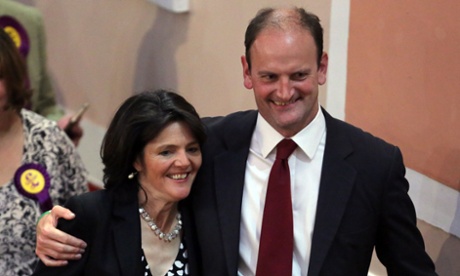
Ukip, 21 years after its creation, has now had its first MP elected to parliament. Just over four hours ago Douglas Carswell, who defected to the party from the Conservatives, won back his Clacton seat with a result that saw the Conservative vote collapse. But just as significantly, or perhaps even more so, it came very close to winning in the Labour seat of Heywood and Middleton. The two results pose serious questions for both main parties.
Here’s the Guardian’s overnight splash. And here’s how it starts.
Nigel Farage has delivered a mini-earthquake in British politics with the former Conservative MP Douglas Carswell capturing Ukip’s first parliamentary seat and the party squeezing Labour in its north-west heartland.
The Ukip leader declared early on Friday morning that he now leads the only truly national party after Carswell swept to victory in Clacton following a collapse in the Tory vote. Carswell won with 21,113 votes (59.66%) ahead of the Tory candidate Giles Watling on 8,709 votes, as the Conservative vote fell from the 53% that Carswell won as a Conservative in 2010 to 24.6%. The turnout was 51.2%.
The Liberal Democrats lost their deposit for the tenth time in a byelection this parliament after Andy Graham came fifth in Clacton behind the Greens with 483 votes, securing just 1.1% of the overall share compared with the 12.9% his party won in 2010. Labour came third on 3,957 votes.
And here’s Helen Pidd’s analysis of what happened in Heywood and Middleton.
I’ll be providing reaction and analysis.
If you want to read last night’s blog, which reported on events as they unfolded, it’s here.
And if you want to follow me on Twitter, I’m on @AndrewSparrow.