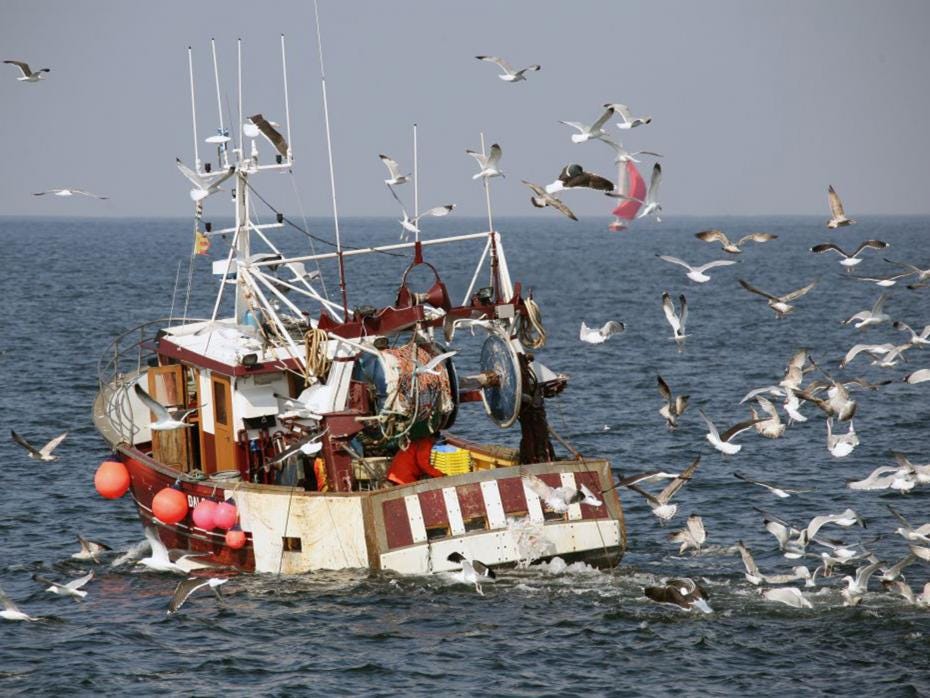
The government is withdrawing the UK from an arrangement that allows foreign countries to fish in British waters, it has announced.
Ministers will trigger withdrawal from the London Fisheries Convention, signed in 1964 before the UK joined the European Union, to start the two-year process to leave the agreement.
The convention allows vessels from France, Belgium, Germany, Ireland and the Netherlands to fish within six and 12 nautical miles of the UK’s coastline.
It sits alongside the EU Common Fisheries Policy which allows all European countries access between 12 and 200 nautical miles of the UK and sets quotas for how much fish nations can catch.
Ministers claimed the move would help control fishing access to UK waters, as it will no longer be bound by existing access agreements, and enable the country to become fully responsible for fisheries management.
UK vessels will also lose the right to fish in waters six to 12 nautical miles from the shores of the other countries.
Environment Secretary Michael Gove said: “Leaving the London Fisheries Convention is an important moment as we take back control of our fishing policy. It means for the first time in more than 50 years we will be able to decide who can access our waters.
“This is an historic first step towards building a new domestic fishing policy as we leave the European Union – one which leads to a more competitive, profitable and sustainable industry for the whole of the UK.”
Barrie Deas, chief executive of the National Federation of Fishermen’s Organisations, said: “This is welcome news and an important part of establishing the UK as an independent coastal state with sovereignty over its own exclusive economic zone.”
The UK fishing industry was made up of more than 6,000 vessels in 2015, landing 708,000 tonnes of fish worth £775 million.
Some 10,000 tonnes of fish were caught by other countries under the convention, worth an estimated £17 million.
Will McCallum, Greenpeace UK’s head of oceans, warned that pulling out of the London Convention would not alone deliver a better future for the UK fishing industry.
“For years, successive UK governments have blamed Brussels for their own failure to support the small-scale, sustainable fishers who are the backbone of our fishing fleet,” he said.
“If Brexit is to herald a better future for our fishers, the new Environment Secretary Michael Gove must keep the 2015 Conservative Party manifesto commitment to re-balance fishing quotas in favour of ‘small-scale, specific locally-based fishing communities’.”
Environmental law firm ClientEarth consultant Dr Tom West said the move appeared to be an aggressive negotiating tactic.
“As a country outside the EU we need to consider how we can best co-operate with our neighbours rather than unilaterally withdrawing from all agreements in the hope that standing alone will make us better.
“Many fish stocks in UK waters are shared with our neighbours and so need co-operation and shared management.”
He also warned of the need to put in place strong laws to protect marine wildlife, or there was a risk the UK would row back on hard-won environmental protection over the last 40 years.
Press Association