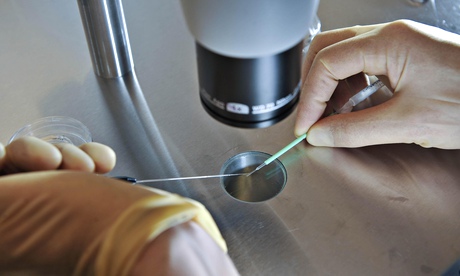
Families at risk of passing on devastating genetic diseases to their children should be allowed to have a ground-breaking but controversial IVF procedure involving biological material from three “parents” to prevent the illnesses, leading experts have said.
Forty scientists from 14 countries have urged the British legislature to approve laws allowing mitochondrial DNA transfer in a crucial vote in the House of Commons on Tuesday. The vote to amend the Human Fertilisation and Embryology Act 2008 would allow an expert panel to consider requests from families who wanted to have the procedure.
Mitochondrial diseases are caused by genetic faults in the DNA of tiny structures that provide power for the body’s cells. The DNA is held separately to the 20,000 genes that influence a person’s identity, such as their looks and personality. Because mothers alone pass mitochondria on to children, the diseases are only passed down the maternal line.
The procedure is controversial because it replaces the affected mother’s mitochondrial DNA with healthy DNA from a female donor. As a result, the child is born with a minuscule amount, about 0.2%, of DNA from a third person.
Among the US scientists to back the law change are Professor John Gearhart, a member of the US Food and Drug Administration’s gene therapies advisory committee; Evan Snyder, the former chair of the panel; and Carlos Moraes, who has advised the FDA on mitochondrial transfer.
In a letter to the Guardian, senior US government advisers, as well as IVF specialists, bio-ethicists and leading academics from four continents gave overwhelming support for a change in the law that could prevent babies being born with disorders that often kill them in childhood.
“Mitochondrial diseases are devastating inherited conditions that can lead to serious disability and death,” the letter states. “The UK hosts a world-class team at Newcastle University developing this technology, which is ideally placed to be among the first to treat patients.”
The scientists praised Britain’s medical regulatory system as being among the best in the world, stating that it benefited patients, science and society. “We therefore hope that parliament will approve the government’s proposed regulations for mitochondrial donation,” they say.
“A positive vote would not only allow affected families to choose to use this new procedure under the care of the globally respected Newcastle team, with proper advice and safeguards. It would also be an international demonstration of how good regulation helps medical science to advance in step with wider society.”
On Thursday, the Church of England said it opposed any change in the law, stating that there had not been sufficient scientific study of or consultation over the safety, ethics or efficacy of the technique.
The Human Fertilisation and Embryology Authority has conducted three independent reviews of published and unpublished scientific research and found no evidence that the procedure is unsafe. The Deparment of Health and the HFEA have held public consultations. A six-month ethical review by the Nuffield Council on Bioethics said it was ethical to offer the procedure if it was considered “acceptably safe and effective”.
Doug Turnbull, who has pioneered the procedure at Newcastle, said patients would lose out if the law was not changed. “This is research they support. They want to see this go forward. They are the ones who will make the decisions,” Turnbull said.
“If people are saying we cannot do something until this is 100% safe, that stops all sexual reproduction. What they don’t realise is that if we delay, it means some women will be denied the option and denied the potential to have their own healthy children. If it doesn’t go through now, it may never go through.”
The letter
Mitochondrial diseases are devastating inherited conditions that can lead to serious disability and death. They are passed from mothers to children, often striking at a very young age, and are caused by faulty mitochondria – the “batteries” that provide cells with energy. These diseases cannot usually be treated or prevented.
New IVF techniques, collectively known as mitochondrial donation, offer some affected families the opportunity to have healthy children. The UK hosts a world class team at Newcastle University developing this technology, which is ideally placed to be among the first to treat patients. British law, however, does not currently permit its use.
Since 2007, the UK has run an exemplary and internationally-admired process for considering benefits, risks, ethical issues and public consent, which must properly precede a change in the law. This has revealed broad public, ethical and scientific support for approving mitochondrial donation, so that the fertility regulator can licence clinical use when there is sufficient evidence it is safe enough to proceed.
As experts in this field, we consider the UK’s system for regulating advances in reproductive medicine to be among the world’s best. This benefits patients, science and society, by enabling medical progress with appropriate consideration of risk and public opinion. We therefore hope that Parliament will approve the Government’s proposed regulations for mitochondrial donation. A positive vote would not only allow affected families to choose to use this new procedure under the care of the globally-respected Newcastle team, with proper advice and safeguards. It would also be an international demonstration of how good regulation helps medical science to advance in step with wider society.
Signatories:
John Carroll, professor of reproductive biology, Monash University, Australia
Prof John Christodoulou, chair of the Australian mitochondrial disease foundation and Western Sydney Genetics Programme head, Australia
Dieter Egli, assistant professor of development cell biology, New York, US and senior research fellow at the New York Stem Cell Foundation Research Institute. Lead author on one of the MST papers
Adam Eyre Walker, professor of evolutionary biology, Sussex University
Prof Francis Flinter, consultant in clinical genetics, Guy’s and St Thomas Hospital, London
Prof John Gearhart, Institute for Regenerative Medicine, Philadelphia. Member of the FDA committee.
Prof Susan Golombok, director of Centre of Family Research, Cambridge
Prof Michael Hanna, consultant neurologist, director of MRC Centre for Neuromuscular Diseases, London
Dr Stephen Harbottle, chair of Association of Clinical Embryologists, Cambridge
John Harris, professor of bioethics, Manchester University
Outi Hovatta, professor in obstetrics and gynaecology, Stockholm University
Howard Jacobs, professor of mitochondrial genetics and molecular biology, Tampere University
Martin Johnson, emeritus professor of reproductive sciences, Cambridge University
Prof Richard Kennedy, president elect of International Federation of Fertility Societies and executive director of women and Children’s Services, Australia
Thomas Klopstock, professor of neurology and speaker of mitoNET, Germany
Nils Goran Larsson, managing director of Max Planck Institute for Biology of Ageing and professor of mitochondrial genetics, Cologne
Shoukhrat Mitalipov, director of Centre for Embryonic Cell and Gene Therapy, Oregon
Prof Carlos Moraes, department of neurology and cell biology and anatomy, Miami. Sat on FDA committee
Gail Norbury, RCPath SAC chair for genetics and reproductive sciences, London
Guido Pennings, professor of ethics and bioethics, Belgium
Alexandre Quintanilha, worked on mitochondrial bioenergetics, Portugal
Mike Ryan, president of Australian Society for Biochemistry and Molecular Biology, Melbourne
Mark Sauer, professor of obstetrics and gynaecology, vice-chair Ob&Gyn chief, New York
Julian Savulescu, director of Oxford Centre for Neuroethics
Randy Schekman, Nobel prize in physiology of medicine 2013, Berkley, California
Sonja Schrepfer, professor of transplant and stem cell immunobiology, Hamburg. Lead author on a paper Morrow and Knoepfler tweeted about immune responses against foreign mitochondria
Prof Hongying Sha, department of neurobiology, China. Lead author on polar body transfer paper
Joe Leigh Simpson, president of International Federation of Fertility Societies, US
HJM Smeets, professor of clinical genomics, Netherlands
Jan Smeitink, chair of Nijmegen Centre for Mito Disorders, Netherlands
Evan Snyder, former chair FDA committee, director of Centre for Stem Cells and Regenerative Medicine, Sanford
Julie Steffan, Genetics of Mito Disorders, Paris
Carolyn Sue, professor and director of neurogenetics, Sydney
Seang Lin Tan, prof of obstetrics and gynaecology, Canada
Atsushi Tanaka, director of Saint Mother Obstetrics and Gynaecology Clinic and Institute for ART, Japan
David Thorburn, director of Genetics Research Theme and head of mitochondrial research, Melbourne
Anna Veiga, scientific director of Reproductive Service, Barcelona
Anu Suolmalainen Wartiovaara, professor of clinical molecular medicine, Helsinki
Dagan Wells, associate professor, Nuffield Department of Obstetrics and Gynaecology, Oxford
Massimo Zeviani, director MRC mitochondrial biology unit, Cambridge