The British government sought to block EU legislation that would force member states to carry out surprise checks on the emissions of cars, raising fresh questions over ministers’ attitude to air pollution and their conduct in the Volkswagen scandal.
A document obtained by the Observer reveals that the Department for Environment, Food and Rural Affairs has been advising British MEPs to vote against legislation that would oblige countries to carry out “routine and non-routine” inspections on vehicles’ “real-world” emissions.
The revelation will add to the growing concerns over the government’s commitment to tackling air pollution. It follows the admission last week that the Department for Transport had ignored significant evidence of the fraudulent practices being employed by the car industry when this was sent to it a year ago.
Around 29,000 deaths in the UK are hastened by inhalation of minute particles of oily, unburnt soot emitted by all petrol engines, and an estimated 23,500 by the invisible but toxic gas nitrogen dioxide (NO2) discharged by diesel engines.
Volkswagen has been engulfed in a scandal after it emerged that some of its diesel cars had been fitted with devices that could detect when they were being tested, concealing the real level of pollutants being emitted by them when on the road.
Now it has emerged that Defra has also been lobbying against part of a proposed EU directive that would force member states to establish national testing regimes to catch out those who tried to conceal the damage they were doing. The proposed legislation – the national emissions ceiling directive – is designed to “ensure that policies and measures are effective in delivering emission reductions under real operating conditions”, according to the European commission.
A Defra briefing document circulated among European parliamentarians in July, and seen by the Observer, says that, while the British government agrees in principle to the need for tough checks to enforce emission limits of NO2, MEPs should vote against the imposition on member states of “market surveillance and environmental inspections” as the legislation is unclear and legally unnecessary.
The British government has also been seeking to water down legislation in the directive which seeks to limit the emission of a series of pollutants other than NO2, including methane and ammonia. Officials claim that some of the measures proposed would unnecessarily increase the “administrative burden for industry and government”, according to the briefing paper. The European parliament is due to vote on the proposals at the end of October.
Alan Andrews, a lawyer based in Brussels for ClientEarth, a firm of environmental legal experts, said ministers were not matching their rhetoric with action. He said: “It is politically easy to say you agree in principle with reducing emissions, but without the mechanisms to enforce the law companies will breach it with impunity.
“The government says it supports in principle measures to ensure that the Euro 6 standard [current emissions rules] for diesel delivers real-world emissions cuts. But this clause they oppose is about a broader principle – requiring member states to have proper inspection and systems in place at the national level to ensure that technologies, products and pollution-reduction measures are really delivering reductions in the real world.
“This is important because it applies across the board, not just to diesel cars. We need to know that measures to cut pollution from farms, ships, trains, tractors etc are all doing what they say on the tin.”
Meanwhile air pollution is swiftly becoming a key issue for the London mayoral contest, in which Labour’s Sadiq Khan is expected to be pitched against Zac Goldsmith, the Tory MP for Richmond Park.
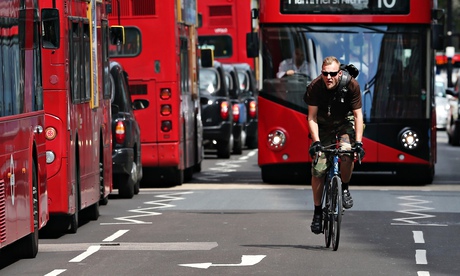
Khan told the Observer: “The Tories in government, and Boris Johnson, have stood by as London’s air has become dangerously polluted. We are now facing a health crisis – with air pollution responsible for as many as 10,000 deaths a year in the capital.
“I’ll make cleaning London’s air a top priority for City Hall – an expanded ultra-low emission zone, cleaner buses, more support for cycling, opposition to Heathrow expansion, and a pedestrianised Oxford Street, turning one of Europe’s most polluted streets into a world-class, tree-lined public space.”
The developments came as Volkswagen dealerships in Britain struggled to respond to the growing global scandal engulfing the company. A handful of customers on forecourts in northern England defiantly scoped out the latest German models, but sources saiuf others customers had already cancelled their orders.
Warren Marvelley and his wife, Jane, from Rochadale, Greater Manchester, told The Guardian on Saturday that the allegations of emissions cheating had not put them off the brand.
“I’ve read all about the scandal, but it really doesn’t bother me that much,” said Mr Marvelley, 51, as he walked into the showroom of Lookers Blackburn. “VW build very good, very reliable cars and that’s why we keep coming back to them.
“Yes, a few of their people have cooked the figures, but I don’t think we’re talking drastic amounts so I won’t be holding it against them.”
Mrs Marvelley, 50, who works for a local authority, added that she thought other car manufacturers would be likely to have employed similar tactics. “I suspect VW won’t be alone,” she said.
Car dealers elsewhere in the region have claimed some customers have cancelled their orders in recent days. One trade source told The Guardian: “I’ve heard of one dealership alone losing six orders.”
A spokesman for Volkswagen UK said: ‘We’ve had reports of some cancelled orders, but at the moment our sales are still normal.
‘The numbers of customers buying on finance have actually gone up slightly. We are not complacent and will continue to reassure our customers as we await further info from our parent company’.
Staff at the Blackburn dealership - and others - refused to speak to The Guardian about the scandal. They instead offered a company-wide statement issued from Wolfsburg, VW’s headquarters, that claims all new diesel engines currently available in the UK “fully comply with all legal requirements and environmental standards”.
The statement added: “Volkswagen has confirmed that all affected vehicles are completely safe and roadworthy and the engine management software in question does not affect the handling, consumption or emissions of the vehicles in any way.”