The UK will give £720m to an international fund to help poor nations cope with climate change, the Guardian can reveal.
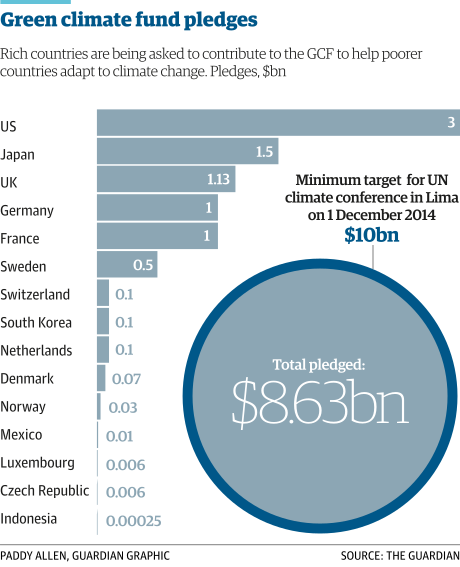
The UK commitment is greater than that of Germany or France and is only surpassed by the US and Japan. The deadline for contributions to the UN’s green climate fund (GCF) is Thursday and achieving its $10bn target is seen as a vital step towards rich and poor nations sealing a deal to tackle global warming in 2015.
The donation comes at a sensitive time in domestic UK politics. The parliamentary byelection in Rochester is expected to see the Conservatives lose the seat to the UK Independence Party (Ukip), which wants to slash overseas development aid, as do some backbench Conservative MPs. Earlier in the week, the prime minister, David Cameron, betrayed his anxiety over the issue by repeatedly stressing that the funding was not new money, but had already been set aside for the purpose.
Ed Davey, the Lib Dem energy and climate change secretary, told the Guardian: “A little-Englander approach, an isolationist approach, is going to be a disaster for the people of Britain. Climate change does not recognise borders.”
Experts warned recently that global warming would affect health, business and food production in the UK, with a senior military figure also warning that armed forces would be unable to provide global security if climate change went unchecked.
“There is a huge amount at stake,” said Davey. “Anyone who has followed the UN negotiations knows the poorest and most vulnerable countries on the planet are looking to developed countries to help them survive climate change. If we do not do this, I don’t think we will get a global deal. It is as simple as that.”
He said: “[Critics] do not realise the vital work this money is for. This is about saving lives and we have a duty to do this.” Examples, he said, were helping low-lying nations cope with rising sea levels and subsistence farmers cope with failing crops.
The contribution to the GCF will come from an existing UK climate aid fund, which will spend £3.9bn from 2011 to 2016.
Asked why the UK was offering the equivalent of $1.13bn, more than the $1bn pledged each by Germany and France, Davey said the UK would only pay the extra if other countries came forward to contribute. “We are doing that to encourage others to give,” he said.
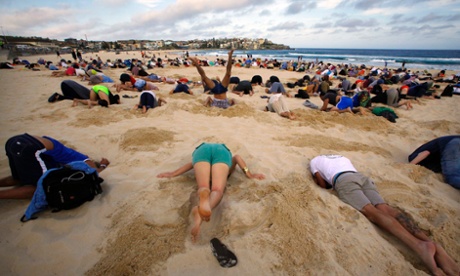
So far, 14 other nations including Mexico and South Korea have contributed to the GCF, bringing the total with the UK contribution to about $9bn. Australia, led by the climate sceptic Tony Abbott, has refused to give money to the GCF.
Meena Raman, from the NGO Third World Network and an official observer on the GCF board, said: “Given the scale of the challenge at hand for developing countries, the UK contribution is very small.”
She said the £10bn likely to be pledged for the GCF for the period 2015-18 was “backsliding” compared to the ambition in 2009, which was for $10bn a year. Subsequent UN talks have set a goal of $100bn a year by 2020, she said.
Sir David King, the UK foreign secretary’s special representative for climate change, told the Guardian last week that the billions spent by the UK on overseas climate aid were “critically important” to creating the trust between nations required to seal a global deal.
Sweden has pledged $0.5bn to the GCF and Isabella Lövin, international development minister, said: “The GCF is not a charity; it is an investment for our collective future, for a secure world.”