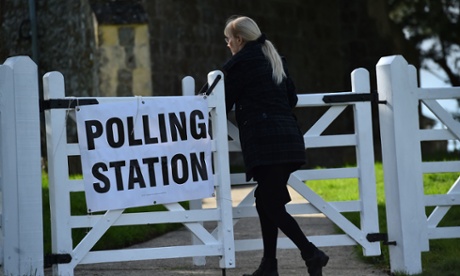
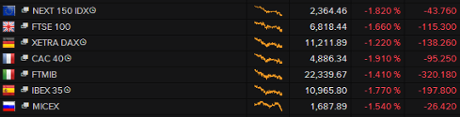
London shares suffered a sharp sell-off on Thursday morning as voting got under way in the closest general election for decades.
Fears that Britain is set for a second successive hung parliament added to a global markets sell-off after Federal Reserve chair Janet Yellen warned share valuations could be dangerously high.
The leading FTSE 100 index tumbled by 121 points, or 1.7%, to 6813, as voters headed for the polls in what is expected to be one of the closest elections in years, with the major parties neck and neck in opinion polls.
According to preliminary results of the final Guardian/ICM campaign poll, Labour and the Conservatives were tied at 35% each. A YouGov poll in Scotland for the Times shows Sturgeon’s party – with which Miliband has ruled out any formal deal – enjoying 48% of support to Labour’s 28%, putting several key figures, including the Scottish Labour leader, Jim Murphy, in peril of losing their seats.
Andy McLevey at Interactive Investor said: “As UK voters go to the polls, uncertainty surrounding the outcome of the UK election is also preying on sentiment as cautious investors remain on the sidelines.”
Dafydd Davies at Charles Hanover Investments told Reuters: “Given the [market] rally we’ve had so far this year, you could not say the mood is too alarmist over the election outcome.
“However the risk of a hung parliament is causing people to sell out a bit to cash in on the rally.”
As well as the UK election and Yellen’s comments, investors are also nervous about the situation in Greece, as another deadline approaches without any deal with its creditors.
Falling government bond prices are also adding to the uncertainty, with German 10 year bond yields at 0.74%, a new high for 2015. Italian 10 year yields have risen above 2% for the first time since December.
Several factors are being blamed, including the recent recovery in the oil price. If that pushes eurozone inflation higher, it could encourage the European Central Bank to slow its bond-buying quantitative easing scheme.
Other European markets were also sharply lower, with Germany’s DAX down over 1% and France’s CAC nearly 2% lower. On Wall Street the Dow Jones Industrial Average is expected to open down more than 100 points after an 86 point decline on Wednesday.
Election jitters drove up the cost of buying protection against overnight sterling volatility on Thursday.
The overnight cost of insuring against big swings in sterling’s exchange rate broke above the level before the Scottish independence referendum last September.
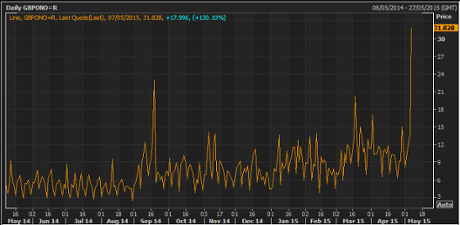
Buying protection against sterling volatility hasn’t been this expensive since the 2008 financial crisis:
#Sterling volatility overtakes Scottish Independence, Eurozone crisis #GE2015 http://t.co/Df2HOGXYM9 #forex pic.twitter.com/bMzaHTajZ3
— Ashraf Laidi (@alaidi) May 7, 2015
The pound also lost around half a cent against the euro, to €1.338.
“Sterling will be subdued as voters go to the polls today, and with no clear outcome in the pipeline for today’s election dealers will be avoiding the pound like the plague, explained David Madden, market analyst at IG.
Alex Gurr of currency foreign exchange site FXTM, says traders fear a hung parliament:
“The UK election is leaving the pound in a lurch verses other currencies as uncertainty continues to reign in the market over one of the closest elections in history.”
Ed Miliband, Nigel Farage and Nicola Sturgeon all cast their votes within the first hour of polls opening, while the prime minister, David Cameron, made a last-minute YouTube appeal for support.
Cameron’s 48-second message continued the Conservatives’ campaign theme of raising the spectre of Miliband as prime minister propped up by the Scottish National party.
“If you want to stop Ed Miliband and the SNP from getting into power and wrecking our economy ... and if you want me back on work on Friday working through our long-term economic plan as your prime minister then it is vital that you vote Conservative,” Cameron said.
#VoteConservative today - and together, we can secure a brighter future for Britain. https://t.co/t896F6oMoM
— David Cameron (@David_Cameron) May 7, 2015
Cameron’s message was echoed by the Daily Telegraph which emailed its readers pleading with them to back the Conservatives.
Slightly creepy "unprecedented" email from @Telegraph editor Chris Evans telling me to vote Conservative pic.twitter.com/sM42Czi6jm
— Toby Harnden (@tobyharnden) May 7, 2015
Miliband cast his vote in Sutton village hall, close to his constituency home in Doncaster North.
In Ballieston, Glasgow East, where Sturgeon cast her vote with her husband and SNP chief executive, Peter Murrell.
The Scottish Labour party made a last-ditch attempt to stop the SNP surge that threatens to wipe out the party’s strongholds in Scotland by putting out its own YouTube appeal for votes. It featured more from Labour’s previous leader Gordon Brown than his successor. “Only a Labour government can prevent five more years of bedroom tax poverty,” it quoted the former prime minister saying.
Nick Clegg, who faces a fight to hold on to his own Sheffield Hallam seat, urged voters to stick with the Lib Dems as the only party able to provide a “stable” influence in a Tory or Labour administration. He said his party’s performance will be the “surprise story” of polling day, dismissing predictions of an electoral mauling that has left key figures such as cabinet minister Danny Alexander vulnerable to a collapse in support after five years of governing in coalition with the Conservatives.
In a final plea to people to vote Labour, Miliband will say: “If you do that today, then tomorrow you won’t have to wake up to the news that five years of the Tories has turned into a Tory decade – a decade where only the privileged few will do well, where there will be one rule for a few and another for everyone else. So the stakes are high in these crucial hours.”
He said the Tories planned “the most extreme spending cuts of any political party for a generation” that posed “a clear and present danger to the family finances of working people”.
Polling stations will be open until 10pm on Thursday in what will be the busiest election day since 1979, with nearly 10,000 council seats also up for grabs.